


Magnitude and Factors Associated with Gestational Weight Gain Adequacy among Pregnant Women in South Gondar Zone, Northwest Ethiopia
- PMID: 38162997
- PMCID: PMC10756953
- DOI: 10.1016/j.cdnut.2023.102031
Magnitude and Factors Associated with Gestational Weight Gain Adequacy among Pregnant Women in South Gondar Zone, Northwest Ethiopia
Abstract
Background: Weight gain during pregnancy depends on the maternal prepregnancy weight and height. Inappropriate weight gain has negative consequences, including the health care system and society because of its adverse birth outcomes.
Objective: This study aimed to assess the magnitude and factors associated with gestational weight gain in Northwest Ethiopia.
Methods: From September 2018 to June 2019, a community-based prospective follow-up study was conducted in Northwest Ethiopia. A total of 422 pregnant women were followed from conception to delivery and the data were collected using a multistage sampling technique. Stata 14 standard edition (SE) software was used for data analysis. Multinomial logistic regression was used to determine the relationship between dependent and independent variables. P value of ≤0.05 was used to determine statistical significance.
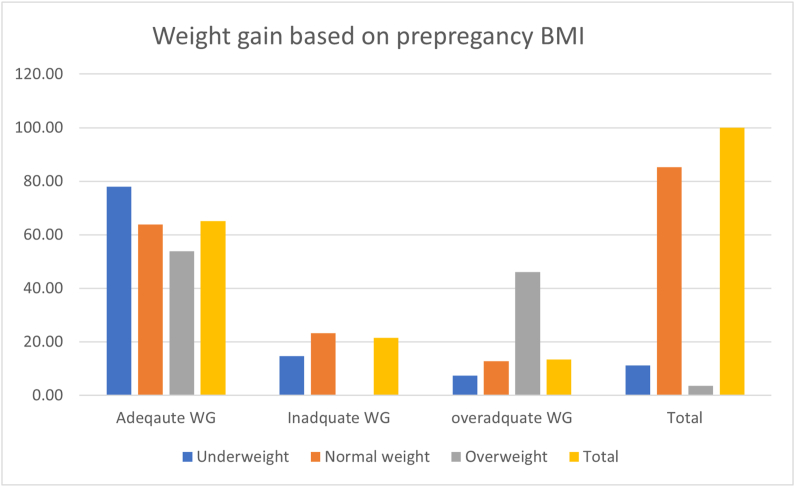
Results: Majority of the participants had normal weight gain [65.12%, 95% confidence interval (CI): 60.08, 69.85]. Besides this, the rate of inadequate and overadequate weight gain was 21.53% (95% CI: 17.60, 26.05) and 13.35% (95% CI: 10.22, 17.25), respectively. Inadequate weight gain was linked to meal frequency [adjusted odd ratio (AOR): 0.52, 95% CI: 0.28, 0.97], targeted supplementary feeding program (TSFP) enrollment (AOR: 2.47; 95% CI: 1.35, 4.50), parity (AOR: 0.18; 95% CI: 0.05, 0.62), and alcohol consumption history (AOR: 0.47; 95% CI: 0.25, 0.88), whereas overadequate weight gain was associated with residency (AOR: 5.22; 95% CI: 2.43, 11.22) and TSFP status (AOR: 2.22; 95% CI: 1.08, 4.57).
Conclusions: This study revealed a notable magnitude of both inadequate and overadequate weight gain. It found that good meal frequency, alcohol consumption, parity, and TSFP enrollment were associated with a reduced risk of inadequate weight gain during pregnancy. In addition, the study identified residence and TSFP enrollment as factors linked to overadequate weight gain during pregnancy.
Keywords: Ethiopia; Magnitude; pregnant women; prepregnancy BMI; weight gain adequacy.
© 2023 The Author(s).
Figures
References
-
- Yesfu M.E. Module on food and nutrition for master’s in public health modular teaching for diploma program. University of Gondar. Department of Community Health press; Gondar: 2004.
-
- Rasmussen K.M., Yaktine A.L., editors. Institute of Medicine (US) and National Research Council (US) Committee to Reexamine IOM Pregnancy Weight Guidelines. Weight Gain During Pregnancy: Reexamining the Guidelines. National Academies Press (US); Washington (DC): 2009. PMID: 20669500. - PubMed
-
- Ethiopia demographic and health survey 2011 report. Central statistics agency (CSA)[Ethiopia] and ICF. Addis Ababa, and Rockville CSA and ICF. 2011.
-
- Km B., Jima A., Sg A., Christian P., Stewart C.P., Pelto G.H., et al. Body mass index, gestational weight gain, and obstetric complications in Moroccan population. BMC Public Health. 2015;12(1):8–17.
-
- Bharpoda N.Y., Leuva B.R., Patel U., Patel S.G., Srikranthi K.A. Study of the effect of maternal body mass index (BMI) on perinatal outcome. Int. Arch. Integr. Med. 2016;3(2):74–78.
LinkOut - more resources
Full Text Sources
