. 2023 Dec 18:10:1329290.
doi: 10.3389/fcvm.2023.1329290. eCollection 2023.

Detection of heart rate using smartphone gyroscope data: a scoping review

Affiliations

Detection of heart rate using smartphone gyroscope data: a scoping review

Wenshan Wu et al. Front Cardiovasc Med. .

Abstract

Heart rate (HR) is closely related to heart rhythm patterns, and its irregularity can imply serious health problems. Therefore, HR is used in the diagnosis of many health conditions. Traditionally, HR has been measured through an electrocardiograph (ECG), which is subject to several practical limitations when applied in everyday settings. In recent years, the emergence of smartphones and microelectromechanical systems has allowed innovative solutions for conveniently measuring HR, such as smartphone ECG, smartphone photoplethysmography (PPG), and seismocardiography (SCG). However, these measurements generally rely on external sensor hardware or are highly susceptible to inaccuracies due to the presence of significant levels of motion artifact. Data from gyrocardiography (GCG), however, while largely overlooked for this application, has the potential to overcome the limitations of other forms of measurements. For this scoping review, we performed a literature search on HR measurement using smartphone gyroscope data. In this review, from among the 114 articles that we identified, we include seven relevant articles from the last decade (December 2012 to January 2023) for further analysis of their respective methods for data collection, signal pre-processing, and HR estimation. The seven selected articles' sample sizes varied from 11 to 435 participants. Two articles used a sample size of less than 40, and three articles used a sample size of 300 or more. We provide elaborations about the algorithms used in the studies and discuss the advantages and disadvantages of these methods. Across the articles, we noticed an inconsistency in the algorithms used and a lack of established standardization for performance evaluation for HR estimation using smartphone GCG data. Among the seven articles included, five did not perform any performance evaluation, while the other two used different reference signals (HR and PPG respectively) and metrics for accuracy evaluation. We conclude the review with a discussion of challenges and future directions for the application of GCG technology.

Keywords: GCG technology; digital health; heart rate monitor; mobile health; remote monitoring; seismocardiography; smart healthcare; smartphone application.


Conflict of interest statement

The authors declare that the research was conducted in the absence of any commercial or financial relationships that could be construed as a potential conflict of interest. The author(s) declared that they were an editorial board member of Frontiers, at the time of submission. This had no impact on the peer review process and the final decision.

Figures

Figure 1
Figure 1
PRISMA flow chart. This figure illustrates the search process, which consisted of the identification, screening, eligibility checking, and inclusion of articles, where n stands for the number of articles at each step. After our search, seven articles were included for further analysis.
Figure 2
Figure 2
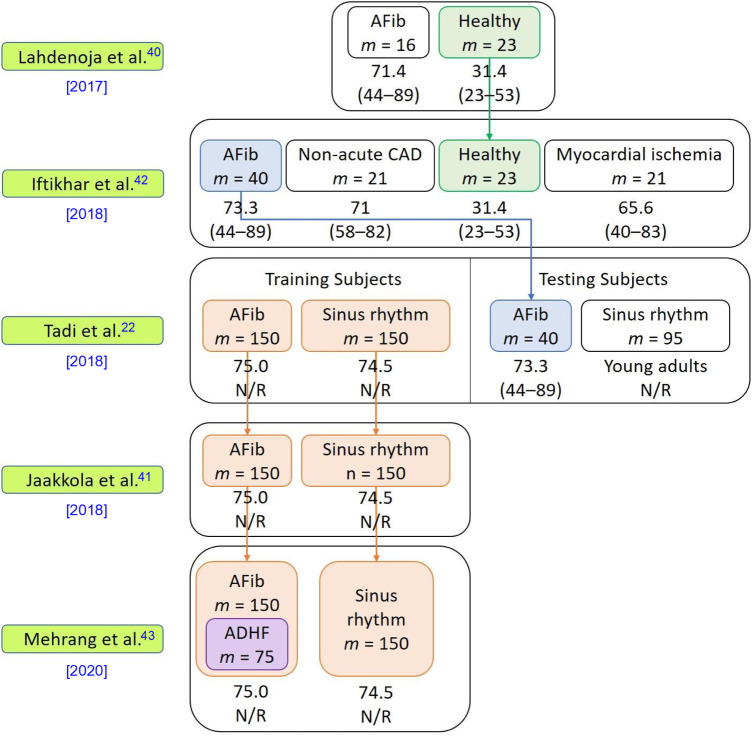
Dataset information used in the five included studies. This figure presents details of the datasets used in the articles, including the number of subjects, subjects’ comorbidities, and the relationships among the datasets in each publication. The symbol “m” denotes the number of subjects in each respective category. The average age of each cohort is presented beneath the cohort name, with the age range given in parentheses “()” below the average age. Abbreviations used in the figure include atrial fibrillation (AFib), coronary artery disease (CAD), acute decompensated heart failure (ADHF), and not reported (N/R). The downward arrow signifies the reuse of a dataset in subsequent studies.
Figure 3
Figure 3
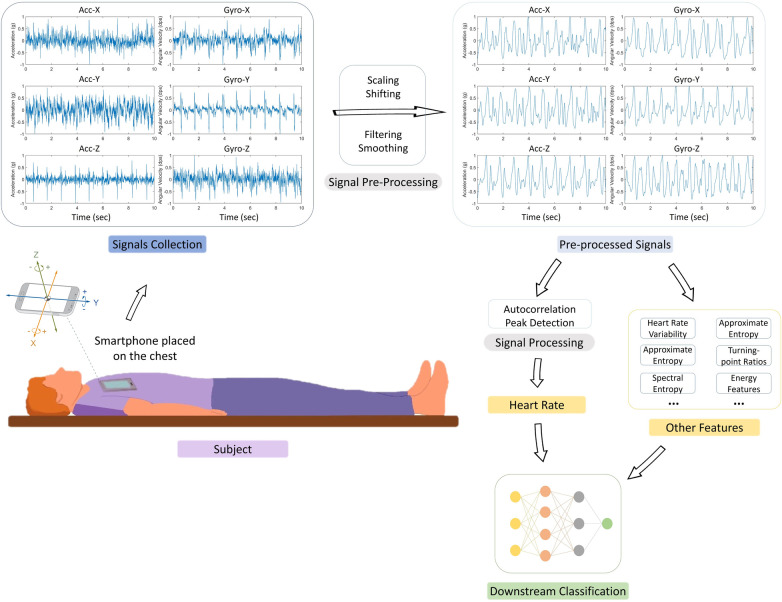
Experimental setup and signal processing pipeline in reviewed studies. This figure illustrates the generalized experimental setup and the signal processing steps employed in the seven articles analyzed in this review. Of these, two studies (38, 39) concluded their process at the Heart Rate (HR) detection stage post signal processing, while the remaining five (, –43) proceeded to extract additional features for downstream classification, using the HR data alongside other features. The figure depicts the typical subject positioning (supine) during data collection using a smartphone, followed by the stages of raw signal pre-processing (scaling, shifting, filtering, and smoothing). The subsequent HR derivation predominantly involved techniques like short-term auto-correlation and peak detection. For performance evaluation, the same two studies (38, 39) focused on analyzing the accuracy and error rate of HR estimation compared to reference signals, while the others used the derived HR for further classification tasks related to conditions such as atrial fibrillation (AFib).

Similar articles

Cited by

References

    1. Perret-Guillaume C, Joly L, Benetos A. Heart rate as a risk factor for cardiovascular disease. Prog Cardiovasc Dis. (2009) 52:6–10. 10.1016/j.pcad.2009.05.003 - DOI - PubMed
    1. Palatini P. Elevated heart rate as a predictor of increased cardiovascular morbidity. J Hypertens Suppl. (1999) 17:S3–10. 10.1016/s0895-7061(98)00207-6 - DOI - PubMed
    1. Holmqvist F, Kim S, Steinberg BA, Reiffel JA, Mahaffey KW, Gersh BJ, et al. Heart rate is associated with progression of atrial fibrillation, independent of rhythm. Heart. (2015) 101:894–9. 10.1136/heartjnl-2014-307043 - DOI - PMC - PubMed
    1. Indolfi C, Ross J, Jr. The role of heart rate in myocardial ischemia, infarction: implications of myocardial perfusion-contraction matching. Prog Cardiovasc Dis. (1993) 36:61–74. 10.1016/0033-0620(93)90022-6 - DOI - PubMed
    1. Palatini P, Julius S. Elevated heart rate: a major risk factor for cardiovascular disease. Clin Exp Hypertens. (2004) 26:637–44. 10.1081/CEH-200031959 - DOI - PubMed

Publication types

LinkOut - more resources