


Incidence of low-level viremia and its impact on virologic failure among people living with HIV who started an integrase strand transfer inhibitors: a longitudinal cohort study
- PMID: 38166689
- PMCID: PMC10759638
- DOI: 10.1186/s12879-023-08906-5
Incidence of low-level viremia and its impact on virologic failure among people living with HIV who started an integrase strand transfer inhibitors: a longitudinal cohort study
Abstract
Background: Low-level viremia (LLV) has been identified as a potential precursor to virologic failure (VF), yet its clinical implications, particularly within the context of Integrase Strand Transfer Inhibitors (INSTIs)-based regimens, remain insufficiently explored. The study aimed to investigate the relationship between LLV and VF within ART-naïve patients on INSTIs-based regimens in China.
Methods: A longitudinal cohort study was conducted with ART-naïve patients aged ≥ 18 years at Beijing Ditan Hospital, under the Chinese National Free Antiretroviral Treatment Program (NFATP). The LLV was defined as a viral load (VL) ranging from 50 to 199 copies/mL after six months of ART initiation, and VF as a VL ≥ 200 copies/mL. Sensitive analyses were also performed, defining LLV as 50-999 copies/mL and VF as exceeding 1000 copies/mL. Multivariate logistic regression, Kaplan-Meier (KM) curve, and Generalized Estimating Equation (GEE) models were used to evaluate the risk factors associated with LLV and VF events.
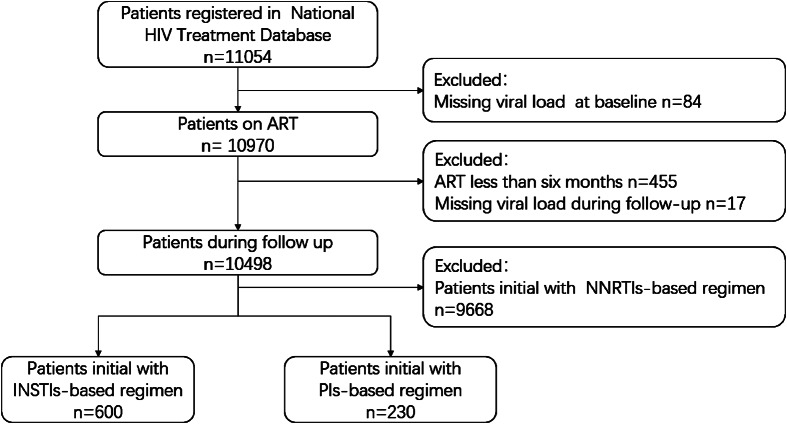
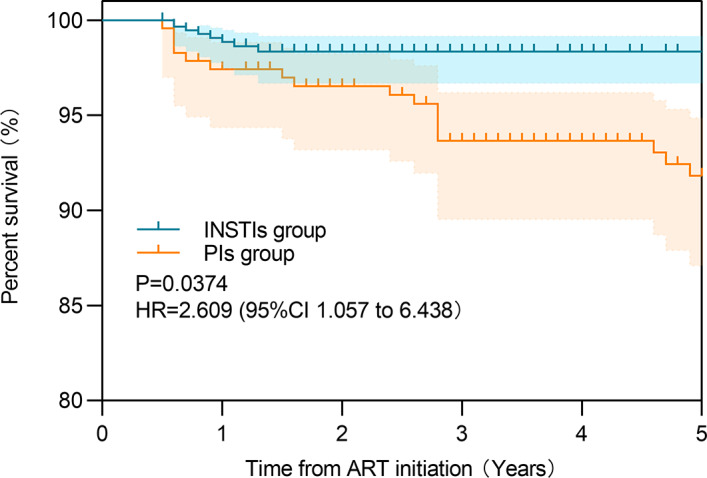
Results: The study involved 830 ART-naïve patients, comprising 600 in the INSTIs group and 230 in the protease inhibitors (PIs) group. LLV events were observed in 10.4% of patients on PIs-based regimens and and 3.2% on INSTIs-based regimens (P < 0.001). INSTIs-based regimens demonstrated a protective effect against LLV events (aHR = 0.27, 95% CI 0.137-0.532). VF events occurred in 10.9% of patients on PIs-based regimens and 2.0% on INSTIs-based regimens, respectively (P < 0.001). The occurrence of LLV events significantly increased the risk of VF by 123.5% (95% CI 7.5%-364.4%), while the integrase inhibitors were associated with a 76.9% (95% CI 59.1%-86.9%) reduction in VF risk.
Conclusion: Our findings indicate that INSTIs-based regimens are critical protective factors against LLV and subsequent VF. These results underscore the importance of HIV viral load monitoring to ensuring effective treatment outcomes, highlighting the necessity for prompt and precise monitoring to refine HIV treatment methodologies.
Keywords: Antiretroviral therapy; HIV; INSTIs; Integrase strand transfer inhibitors; Low-level viremia; People living with HIV; Risk factors; Viral load; Virologic failure.
© 2023. The Author(s).
Conflict of interest statement
The authors declare no competing interests.
Figures
Similar articles
-
Predictors of low-level HIV viraemia and virological failure in the era of integrase inhibitors: A Spanish nationwide cohort.HIV Med. 2022 Sep;23(8):825-836. doi: 10.1111/hiv.13265. Epub 2022 Mar 1. HIV Med. 2022. PMID: 35234328
-
Low-Level Viremia among Adults Living with HIV on Dolutegravir-Based First-Line Antiretroviral Therapy Is a Predictor of Virological Failure in Botswana.Viruses. 2024 May 1;16(5):720. doi: 10.3390/v16050720. Viruses. 2024. PMID: 38793602 Free PMC article.
-
Incidence of low-level viremia and its impact on virologic failure among people living with HIV-1 who switched to elvitegravir-based antiretroviral therapy.J Glob Antimicrob Resist. 2022 Jun;29:7-16. doi: 10.1016/j.jgar.2022.02.007. Epub 2022 Feb 13. J Glob Antimicrob Resist. 2022. PMID: 35172201
-
Clinical significance and management of low-level HIV viremia in the era of integrase strand transfer inhibitors.HIV Med. 2024 Mar;25(3):361-369. doi: 10.1111/hiv.13585. Epub 2023 Nov 22. HIV Med. 2024. PMID: 37990782 Review.
-
A clinical review of HIV integrase strand transfer inhibitors (INSTIs) for the prevention and treatment of HIV-1 infection.Retrovirology. 2022 Oct 22;19(1):22. doi: 10.1186/s12977-022-00608-1. Retrovirology. 2022. PMID: 36273165 Free PMC article. Review.
Cited by
-
Low-level HIV-1 viremia affects T-cell activation and senescence in long-term treated adults in the INSTI era.J Biomed Sci. 2024 Aug 19;31(1):80. doi: 10.1186/s12929-024-01064-z. J Biomed Sci. 2024. PMID: 39160510 Free PMC article.
-
Impact of low-level viremia on HIV non-viral load suppression in low and middle-income countries.Ann Med Surg (Lond). 2025 Apr 10;87(6):3777-3785. doi: 10.1097/MS9.0000000000003272. eCollection 2025 Jun. Ann Med Surg (Lond). 2025. PMID: 40486603 Free PMC article. Review.
-
Risk factors and clinical prediction models for low-level viremia in people living with HIV receiving antiretroviral therapy: an 11-year retrospective study.Front Microbiol. 2024 Nov 1;15:1451201. doi: 10.3389/fmicb.2024.1451201. eCollection 2024. Front Microbiol. 2024. PMID: 39552647 Free PMC article.
-
A Guide to the Evolving Clinical Landscape of Low-Level Viremia Among Persons with HIV in the Modern Treatment Era.Curr HIV/AIDS Rep. 2025 Jun 26;22(1):39. doi: 10.1007/s11904-025-00743-2. Curr HIV/AIDS Rep. 2025. PMID: 40569488 Review.
References
-
- UNAIDS, Global HIV. & AIDS statistics-Fact sheet 2023. https://www.unaids.org/en/resources/fact-sheet. Accessed 2023-09-13.
MeSH terms
Substances
Grants and funding
- PYZ22138/Capital Medical University Research Development Fund
- DFL20191802/Beijing Hospital Authority
- ZYLX202126/Beijing Municipal Administration of Hospitals Clinical Medicine Development of Special Funding Support
- 2020-2-2174/Capital Health Research and Development of Special Fund
- 2018ZX10302-102/National Science and Technology Major Project
LinkOut - more resources
Full Text Sources
Medical
