. 2023 Nov 25;10(1):e22808.
doi: 10.1016/j.heliyon.2023.e22808. eCollection 2024 Jan 15.

Microarray analysis of lncRNAs and mRNAs in spinal cord contusion rats with iPSC-derived A2B5+ oligodendrocyte precursor cells transplantation

Affiliations

Microarray analysis of lncRNAs and mRNAs in spinal cord contusion rats with iPSC-derived A2B5+ oligodendrocyte precursor cells transplantation

Hao Yuan et al. Heliyon. .

Abstract

Spinal cord injury (SCI) is a severe complication of spinal trauma with high disability and mortality rates. Effective therapeutic methods to alleviate neurobehavioural deficits in patients with SCI are still lacking. In this study, we established a spinal cord contusion (SCC) model in adult Sprague Dawley rats. Induced pluripotent stem cell-derived A2B5+ oligodendrocyte precursor cells (iP-A2B5+OPCs) were obtained from mouse embryonic fibroblasts and injected into the lesion sites of SCC rats. Serological testing and magnetic resonance imaging were employed to determine the effect of iP-A2B5+OPCs cell therapy. The Basso-Beattie-Bresnahan score and inclined plane test were performed on days 1, 3, 7, and 14 after cell transplantation, respectively. Differentially expressed long non-coding RNAs (lncRNAs) and messenger RNAs (mRNAs) were detected by microarray analysis. Gene Ontology and Kyoto Encyclopedia of Genes and Genomes pathway analyses were performed to analyse the biological functions of these lncRNAs and mRNAs. Real-time quantitative polymerase chain reaction (RT-qPCR) was used to verify variations in the expression of crucial target genes. The results demonstrated that induced pluripotent stem cells exhibited embryonic stem cell-like morphology and could differentiate into diverse neural cells dominated by oligodendrocytes. The neurobehavioural performance of rats treated with iP-A2B5+OPCs transplantation was better than that of rats with SCC without cell transplantation. Notably, we found that 22 lncRNAs and 42 mRNAs were concurrently altered after cell transplantation, and the key lncRNA (NR_037671) and target gene (Cntnap5a) were identified in the iP-A2B5+OPCs group. Moreover, RT-qPCR revealed that iP-A2B5+OPCs transplantation reversed the downregulation of NR_037671 induced by SCC. Our findings indicated that iP-A2B5+OPCs transplantation effectively improves neurological function recovery after SCC, and the mechanism might be related to alterations in the expression of lncRNAs and mRNAs, such as NR_037671 and Cntnap5a.


Conflict of interest statement

The authors declare that they have no known competing financial interests or personal relationships that could have appeared to influence the work reported in this paper.

Figures

Fig. 1
Fig. 1
The experimental design and arrangement of this study.
Fig. 2
Fig. 2
The production of iPSCs. (A) IPSCs clones express Oct-4. (B) IPSCs clones express Sox-2. (C) IPSCs were suspended in stem cell differentiation medium and grew into embryonic bodies. (D) IPSCs-derived embryonic bodies surface express Nestin. Scale bar = 50 μm for A and B, 300 μm for C, 100 μm for D.
Fig. 3
Fig. 3
Identification and differentiation of iPSCs in vitro. The immunostaining images of (A) Nestin positive cells, (B) A2B5 positive cells, (C) Olig2 positive cells, (D) NKX2.2 positive cells, (E) PDGFRa positive cells, (F) NG2 positive cells, (G) NeuN positive cells, (H) O4 positive cells, (I) GFAP positive cells. Scale bar = 100 μm.
Fig. 4
Fig. 4
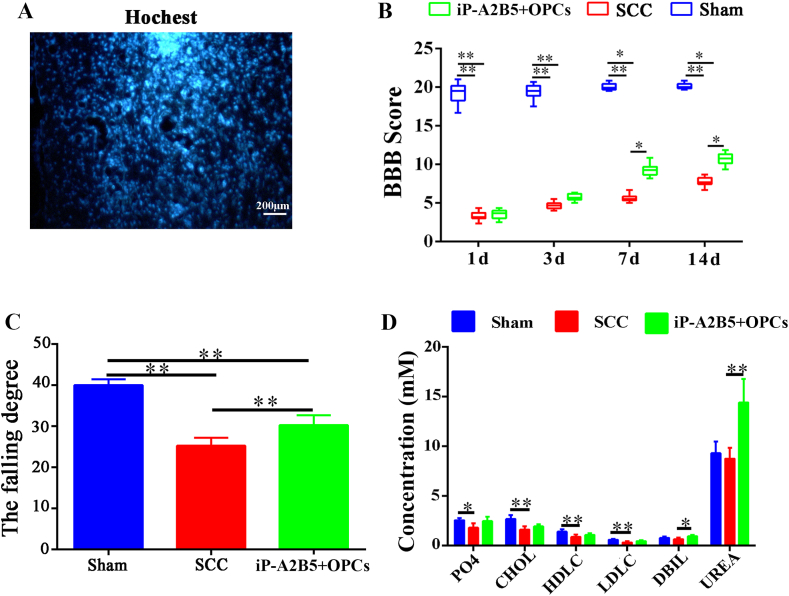
The effect of iP-A2B5+OPCs transplantation in SCC rats. (A) The iP-A2B5+OPCs in spinal cord tissues were labelled by Hoechst. Scale bar = 200 μm. (B) BBB score evaluation among the sham group, SCC group, iP-A2B5+OPCs group at 1, 3, 7, 14 days after cell transplantation. (C)The inclined test was performed at 14 days after cell transplantation. (D) The blood biochemical items, CHOL, HDLC, LDLC, PO4, DBIL and UREA in the serum of rats among sham, SCC and iP-A2B5+OPCs group. iP-A2B5+OPCs, induced pluripotent stem cells-derived A2B5+ oligodendrocyte precursor cells; SCC, spinal cord contusion; CHOL, cholesterol; HDLC, high density lipoprotein cholesterol; LDLC, low density lipoprotein cholesterol; PO4, phosphorus; DBIL, direct bilirubin. Data were expressed as means ± SD. *p < 0.05, **p < 0.01.
Fig. 5
Fig. 5
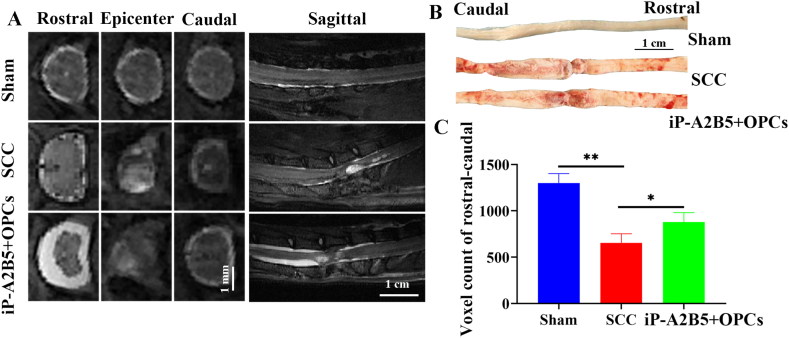
IP-A2B5+OPCs transplantation reduced the loss of spinal cord volume. (A) T2 weighted imaging of SCC rats on the 14th day post operation among sham, SCC and iP-A2B5+OPCs groups. (B) Macroscopic view of spinal cord tissues in the three groups. (C) Spared volume of injured spinal cord among the three groups. Scale bar = 1 mm for the left 3 columns of panel A, 1 cm for right column of panel A and panel B. iP-A2B5+OPCs, induced pluripotent stem cells-derived A2B5+ oligodendrocyte precursor cells; SCC, spinal cord contusion. Data were presented as mean ± SD. *p < 0.05, **p < 0.01.
Fig. 6
Fig. 6
Differentially expressed lncRNAs in the SCC group and iP-A2B5+OPCs group. (A) The clustering analysis of differentially expressed lncRNAs between sham group and SCC group. (B) The clustering analysis of differentially expressed lncRNAs between iP-A2B5+OPCs group and SCC group. (C) The intersection of differentially expressed lncRNAs in the sham group versus SCC group and SCC group versus iP-A2B5+OPCs group. (D) The location relationship of common differentially expressed lncRNAs and their potential target genes. The color intensity of A and B corresponded to the log2 expression values. Red color represents relatively high expression, and blue color represents relatively low expression. LncRNAs, long noncoding RNAs; A2B5 group indicates iP-A2B5+OPCs group, induced pluripotent stem cells-derived A2B5+ oligodendrocyte precursor cells; SCC, spinal cord contusion. (For interpretation of the references to color in this figure legend, the reader is referred to the Web version of this article.)
Fig. 7
Fig. 7
Differentially expressed mRNAs in the SCC group and iP-A2B5+OPCs group. (A) The clustering analysis of differentially expressed mRNAs between sham group and SCC group. (B) The clustering analysis of differentially expressed mRNAs between SCC group and iP-A2B5+OPCs group. (C) The intersection of differential expression mRNAs in the sham group versus SCC group and SCC group versus iP-A2B5+OPCs group. (D) The location relationship of common differentially expressed mRNAs and potential lncRNAs. The color intensity of A and B corresponded to the log2 expression values. Red color represents relatively high expression, and blue color represents relatively low expression. mRNAs, messenger RNAs; A2B5 group indicates iP-A2B5+OPCs group, induced pluripotent stem cells-derived A2B5+ oligodendrocyte precursor cells; SCC, spinal cord contusion. (For interpretation of the references to color in this figure legend, the reader is referred to the Web version of this article.)
Fig. 8
Fig. 8
GO and KEGG analysis of differentially expressed mRNAs in the iP-A2B5+OPCs group. (A) The top 10 biological processes enriched by differentially expressed mRNAs. (B) The top 10 cellular components enriched by differentially expressed mRNAs. (C) The top 10 molecular functions enriched among differential expression mRNAs. (D) The top 3 pathways enriched by differential expression mRNAs. The bar plot represents the enrichment scores. mRNAs, messenger RNAs; A2B5 group indicates iP-A2B5+OPCs group, induced pluripotent stem cells-derived A2B5+ oligodendrocyte precursor cells; SCC, spinal cord contusion.
Fig. 9
Fig. 9
The crucial lncRNA NR_037671 and mRNA Cntnap5a were validated by RT-qPCR. (A) Relative expression of lncRNA NR_037671 in Sham, SCC and iP-A2B5+OPCs groups. (B) Relative expression of mRNA Cntnap5a in Sham, SCC and iP-A2B5+OPCs groups. LncRNAs, long noncoding RNAs; iP-A2B5+OPCs group, induced pluripotent stem cells-derived A2B5+ oligodendrocyte precursor cells; SCC, spinal cord contusion. Data were presented as mean ± SD, n = 6/group, *p < 0.05, **p < 0.01.

References

    1. Ruiz I.A., et al. Incidence and natural progression of neurogenic shock after traumatic spinal cord injury. J. Neurotrauma. 2018;35(3):461–466. - PubMed
    1. Ning G.Z., et al. Epidemiology of traumatic spinal cord injury in Asia: a systematic review. J. Spinal Cord Med. 2012;35(4):229–239. - PMC - PubMed
    1. Miranda V., Sousa J., Mansilha A. Spinal cord injury in endovascular thoracoabdominal aortic aneurysm repair: prevalence, risk factors and preventive strategies. Int. Angiol. 2018;37(2):112–126. - PubMed
    1. Karsy M., Hawryluk G. Modern medical management of spinal cord injury. Curr. Neurol. Neurosci. Rep. 2019;19(9):65. - PubMed
    1. Shende P., Subedi M. Pathophysiology, mechanisms and applications of mesenchymal stem cells for the treatment of spinal cord injury. Biomed. Pharmacother. 2017;91:693–706. - PubMed