


Emergency department visits of newly diagnosed cardiovascular disease patients in Korea during the COVID-19 pandemic
- PMID: 38172246
- PMCID: PMC10764744
- DOI: 10.1038/s41598-023-50709-w
Emergency department visits of newly diagnosed cardiovascular disease patients in Korea during the COVID-19 pandemic
Abstract
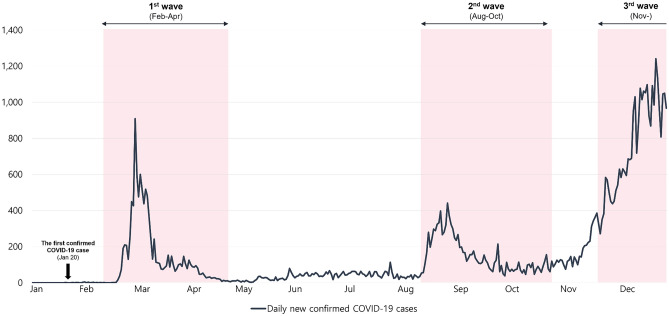
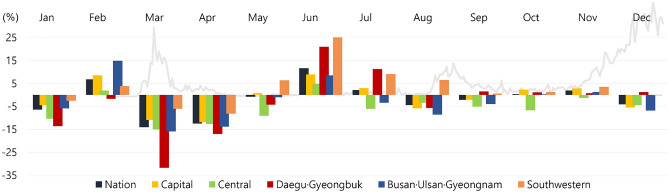
This study aimed to examine the impact of the COVID-19 pandemic on the emergency department (ED) visits of cardiovascular disease (CVD) patients. The customized data of the National Health Insurance Service (NHIS) from 2017 to 2020 were analyzed. CVD patients were defined by the code 'V192' based on the NHIS coverage benefit expansion policy. The number of ED visits of CVD patients, as well as executed procedures in 2020 (during the pandemic), were compared to the corresponding average numbers in 2018 and 2019 (prepandemic). Stratification by age group, residential area and hospital location was performed. The number of ED visits of newly diagnosed CVD patients decreased by 2.1% nationwide in 2020 (2018-2019: 97,041; 2020: 95,038) and decreased the most (by 14.1%) in March (2018-2019: 8539; 2020: 7334). However, the number of executed procedures increased by 1.1% nationwide in 2020 (2018-2019: 74,696; 2020: 75,520), while it decreased by 11.9% in April (2018-2019: 6603; 2020: 5819). The most notable decreases in the number of newly diagnosed CVD patients (31.7%) and procedures (29.2%) in March 2020 were observed in the Daegu·Gyeongbuk area. CVD patients living in the epicenter of the COVID-19 pandemic may experience difficulty accessing healthcare facilities and receiving proper treatment.
© 2024. The Author(s).
Conflict of interest statement
The authors declare no competing interests.
Figures
Similar articles
-
Coronavirus disease pandemic impact on emergency department visits for cardiovascular disease in Korea: A review.Medicine (Baltimore). 2023 Nov 24;102(47):e35992. doi: 10.1097/MD.0000000000035992. Medicine (Baltimore). 2023. PMID: 38013376 Free PMC article. Review.
-
Impact of the Early COVID-19 Pandemic on Emergency Department Visits of Adult Cancer Patients With Fever or Respiratory Symptoms: A Korean Nationwide Population-Based Study, 2016-2020.J Korean Med Sci. 2024 Jun 17;39(23):e187. doi: 10.3346/jkms.2024.39.e187. J Korean Med Sci. 2024. PMID: 38887201 Free PMC article.
-
Collateral Effect of the Coronavirus Disease 2019 Pandemic on Emergency Department Visits in Korea.Medicina (Kaunas). 2022 Dec 31;59(1):90. doi: 10.3390/medicina59010090. Medicina (Kaunas). 2022. PMID: 36676714 Free PMC article.
-
Impact of COVID-19 pandemic on patients with cardio/cerebrovascular disease who visit the emergency department.Am J Emerg Med. 2022 Aug;58:100-105. doi: 10.1016/j.ajem.2022.05.049. Epub 2022 May 30. Am J Emerg Med. 2022. PMID: 35660366 Free PMC article.
-
How emergency department visits for substance use disorders have evolved during the early COVID-19 pandemic.J Subst Abuse Treat. 2021 Oct;129:108391. doi: 10.1016/j.jsat.2021.108391. Epub 2021 Apr 9. J Subst Abuse Treat. 2021. PMID: 33994360 Free PMC article. Review.
Cited by
-
The effect of COVID-19 on cancer incidences in the U.S.Heliyon. 2024 Mar 30;10(7):e28804. doi: 10.1016/j.heliyon.2024.e28804. eCollection 2024 Apr 15. Heliyon. 2024. PMID: 38601551 Free PMC article.
References
-
- Kim Y, et al. COVID-19 1-year outbreak report as of January 19, 2021 in the Republic of Korea. Public Health Wkly. Rep. 2021;14:472–481.
-
- Central Defense Response Headquarters. Coronavirus Infection Prevention and Control in Hospital-Level Medical Institutions (Korea Disease Control and Prevention Agency, 2020). https://ncov.kdca.go.kr/shBoardView.do?brdId=2&brdGubun=24&ncvContSeq=1277.
MeSH terms
Grants and funding
LinkOut - more resources
Full Text Sources
Medical
Miscellaneous
