. 2024 Jan;625(7995):566-571.
doi: 10.1038/s41586-023-06873-0. Epub 2024 Jan 3.

A novel antibiotic class targeting the lipopolysaccharide transporter

Affiliations

A novel antibiotic class targeting the lipopolysaccharide transporter

Claudia Zampaloni et al. Nature. 2024 Jan.

Erratum in

  • Author Correction: A novel antibiotic class targeting the lipopolysaccharide transporter.
    Zampaloni C, Mattei P, Bleicher K, Winther L, Thäte C, Bucher C, Adam JM, Alanine A, Amrein KE, Baidin V, Bieniossek C, Bissantz C, Boess F, Cantrill C, Clairfeuille T, Dey F, Di Giorgio P, du Castel P, Dylus D, Dzygiel P, Felici A, García-Alcalde F, Haldimann A, Leipner M, Leyn S, Louvel S, Misson P, Osterman A, Pahil K, Rigo S, Schäublin A, Scharf S, Schmitz P, Stoll T, Trauner A, Zoffmann S, Kahne D, Young JAT, Lobritz MA, Bradley KA. Zampaloni C, et al. Nature. 2024 Jul;631(8022):E17. doi: 10.1038/s41586-024-07641-4. Nature. 2024. PMID: 38992182 Free PMC article. No abstract available.

Abstract

Carbapenem-resistant Acinetobacter baumannii (CRAB) has emerged as a major global pathogen with limited treatment options1. No new antibiotic chemical class with activity against A. baumannii has reached patients in over 50 years1. Here we report the identification and optimization of tethered macrocyclic peptide (MCP) antibiotics with potent antibacterial activity against CRAB. The mechanism of action of this molecule class involves blocking the transport of bacterial lipopolysaccharide from the inner membrane to its destination on the outer membrane, through inhibition of the LptB2FGC complex. A clinical candidate derived from the MCP class, zosurabalpin (RG6006), effectively treats highly drug-resistant contemporary isolates of CRAB both in vitro and in mouse models of infection, overcoming existing antibiotic resistance mechanisms. This chemical class represents a promising treatment paradigm for patients with invasive infections due to CRAB, for whom current treatment options are inadequate, and additionally identifies LptB2FGC as a tractable target for antimicrobial drug development.


Conflict of interest statement

C.Z., P. Mattei, K.B., L.W., J.-M.A., C. Bucher, C.T., A.A., K.E.A., C. Bieniossek, C. Bissantz, F.B., C.C., T.C., F.D., P.D.G., P.d.C., D.D., P.D., F.G.-A., A.H., M.L., S.L., P. Misson, S.R., A.S., S.S., P.S., T.S., A.T., S.Z., J.A.T.Y., M.A.L. and K.A.B. are current or former employees of F. Hoffmann-La Roche. C.Z., K.B., A.A., A.S. and T.S. are listed as inventors on the approved United States Patent US10,030,047, which covers the molecules RO7036668, RO7075573 and RO7202110. P. Mattei, K.B., P.D.G., P.S. and T.S. are listed as inventors on the pending patent application US2019/0321440, which covers the molecule zosurabalpin.

Figures
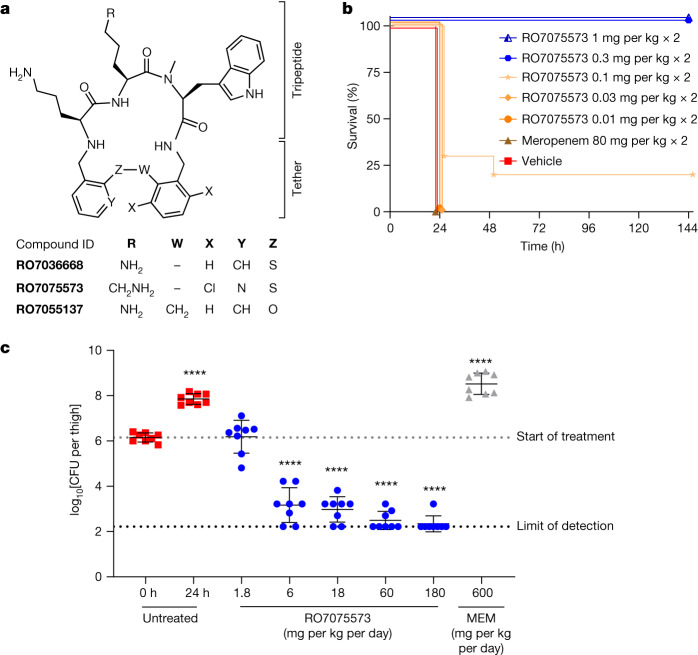
Fig. 1
Fig. 1. First-generation lead RO7075573 protects mice from A. baumannii infections.
a, The chemical structure of tethered macrocyclic peptides, from the screening hit RO7036668 to the first-generation lead RO7075573. RO7055137 is an inactive control compound (MIC > 64 mg l−1) (Fig. 3c). b,c, The in vivo efficacy of RO7075573 in a mouse model of infection induced by A. baumannii ACC00535 (RO7075573 MIC = 0.12 mg l−1 in CAMHB with 20% human serum). b, Sepsis was induced by intraperitoneal bacterial inoculation in immunocompetent mice. Doses (mg per kg) were administered subcutaneously at 1 and 5 h after infection. The Kaplan–Meier survival curve shows the percentage of mouse survival for each group treated with vehicle, meropenem (80 mg per kg) or varying doses of RO7075573 (n = 10 per group) over 6 days. c, Thigh infection was induced by bacterial intramuscular inoculation in immunocompromised mice. Starting 2 h after infection (0 h), mice were given s.c. administration of RO7075573 or meropenem (MEM) (n = 4 mice per treatment group or vehicle) every 4 h over 24 h. The dose–response curve of RO7075573 total daily doses (mg per kg per day) is shown, measured as the bacterial burden reduction (CFU) in infected thigh (8 thighs, 8 read-outs for bacterial counts). Results are presented as mean ± s.d. The statistical significance of the difference in bacterial counts between control and treated mice was calculated using one-factor analysis of variance (ANOVA) followed by Dunnett’s multiple-comparison test (P < 0.05 was considered to be significant versus T = 0 h); ****P < 0.0001. Source Data
Fig. 2
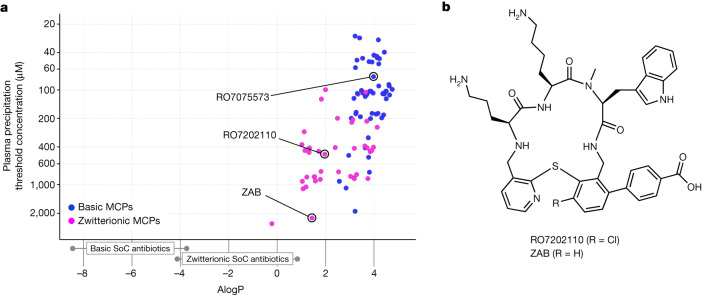
Fig. 2. The second-generation lead zosurabalpin demonstrates low lipid plasma precipitation.
a, The drug lipophilicity (AlogP) of basic MCPs and zwitterionic MCPs in correlation with plasma precipitation. The standard of care (SoC) antibiotics and their AlogP lipophilicities are described in Extended Data Table 5. b, The chemical structure of the second-generation tethered macrocyclic peptides: zwitterions RO7202110 and zosurabalpin (ZAB).
Fig. 3
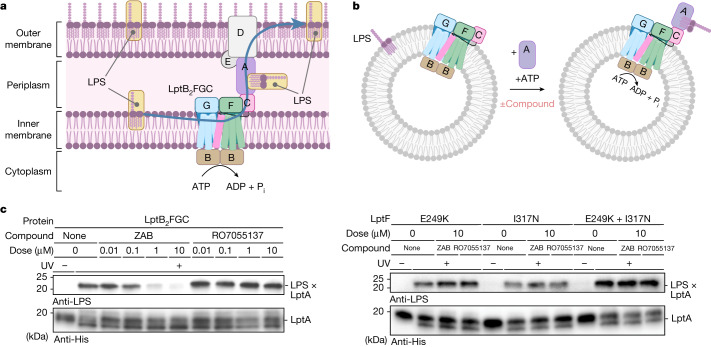
Fig. 3. Zosurabalpin kills cells by inhibiting LptB2FGC function.
a, Schematic of the trans-envelope lipopolysaccharide transporter. The inner-membrane complex LptB2FGC is an ATP-binding cassette that uses ATP hydrolysis to extract LPS from the inner membrane and transport it to the cell surface. Pi, inorganic phosphate. b, In vitro assay monitoring the release of LPS from proteoliposomes containing LptB2FGC complexes to LptAI36pBPA–His7 by ultraviolet irradiation cross-linking and detection of LPS–LptAI36pBPA–His7 adducts by LPS immunoblotting (Methods). The diagrams in a and b were created using BioRender. c, Zosurabalpin (ZAB) inhibits LPS transport in vitro by wild-type LptB2FGC to LptA, whereas the structurally related inactive control compound RO7055137 (Fig. 1a) displays no LPS transport inhibition at comparable doses. Two amino acid substitutions, LptF(E249K) and LptF(I317N), that decreased the susceptibility of Acinetobacter to zosurabalpin were tested both individually and together. All three variants were resistant to compound treatment (Extended Data Table 6). Activity assays were conducted in biological triplicate, and representative blots are shown. UV, ultraviolet irradiation.
Fig. 4
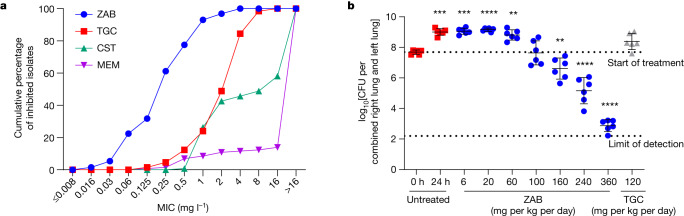
Fig. 4. In vitro activity and in vivo efficacy of zosurabalpin against clinical A. baumannii isolates.
a, In vitro MIC activity of zosurabalpin against 129 A. baumannii clinical isolates shown as the cumulative percentage (MIC90: zosurabalpin (ZAB) = 1 mg l−1; tigecycline (TGC) = 8 mg l−1; colistin (CST) > 16 mg l−1; meropenem (MEM) > 16 mg l−1). Line listing of the data is provided in Supplementary Table 7. b, The in vivo efficacy of zosurabalpin in a mouse model of infection induced by pan-drug-resistant A. baumannii ACC01073 (zosurabalpin MIC = 2 mg l−1 in CAMHB with 20% human serum). Lung infection was induced by bacterial intratracheal inoculation in immunocompromised mice. Treatment, starting 2 h after infection (0 h), was administered subcutaneously (n = 6 mice per treatment group or vehicle) every 6 h over 24 h for zosurabalpin and every 12 h for tigecycline. Dose–response curve of zosurabalpin total daily doses (mg per kg per day) measured as the bacterial burden reduction (CFU) in infected lungs. Results are presented as mean ± s.d. Statistical significance of the difference in bacterial counts between the control and treated mice was calculated using the one-factor ANOVA followed by Dunnett’s multiple-comparison test (P < 0.05 was considered to be significant versus T = 0 h); **P < 0.01, ***P < 0.001. Source Data
Extended Data Fig. 1
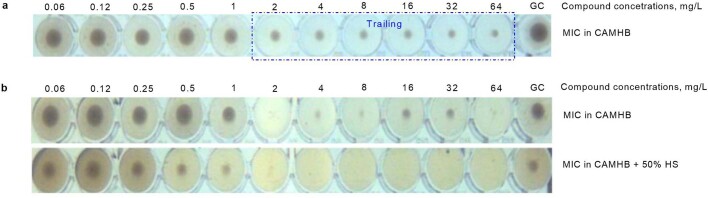
Extended Data Fig. 1. MIC of RO7075573 in CAMHB and in CAMHB supplemented with 50% human serum.
a, MIC conducted in CAMHB with reading endpoints at 80% and 100% growth inhibition corresponding to 2 mg/L and > 64 mg/L respectively. b, MIC conducted in CAMHB with and without 50% human serum showing that the MIC read at 80% growth inhibition in CAMHB is correlating to MIC read at 100% growth inhibition in CAMHB + 50% human serum. GC, growth control.
Extended Data Fig. 2
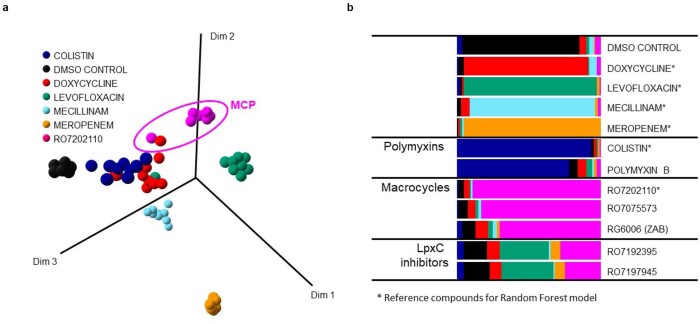
Extended Data Fig. 2. Compound induced phenotypic profile similarity derived with random forest analysis.
For the random forest model generation, analysis was applied to the reference compound set Doxycycline (Red), Levofloxacin (Green), Mecillinam (Pale blue), Meropenem (Orange), Colistin (Dark blue), RO7202110 (Magenta) as well as samples with no compound (DMSO, black) as previously described in Zoffmann et al with data from three independent experiments run in triplicates. a, In the left panel is a similarity-based projection of the correlating random forest distance matrix into 3 dimensions showing clear separation between data points belonging to different compounds and close proximity of those belonging to the same compounds, forming clusters. For the random forest analysis data proximity analysis from 4x and 8x LOED are pooled and the number of datapoints are reduced by down sampling to be equal for all reference conditions the maximal projection of the analysis. b, In the right panel an out-of-bag validation of the random forest classification model is indicated for the reference compounds. For the test compounds (MCPs RG7075573 and zosurabalpin (RG6006, ZAB), polymyxin B and the two LpxC inhibitors) a similarity score was derived from the model. The degree of frequency of matching prediction correspond to the length of the individual bar segment, where a longer segment represents a higher similarity. Thus there is a high similarity for polymyxin with >70% similarity score towards colistin fitting with the known similar MOA, while the LpxC inhibitors as expected does not have a strong correlation with any of the 6 reference compounds all known to have different MOA. For the macrocycles RG7075573 and zosurabalpin (RG6006, ZAB) > 70% similarity was seen towards the reference compound RO7202110 supporting a similar MOA for the three. Source Data
Extended Data Fig. 3
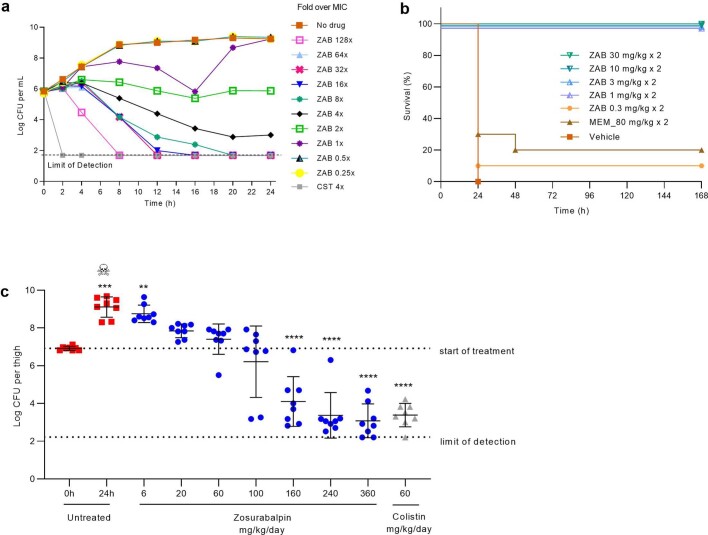
Extended Data Fig. 3. In vitro and in vivo bactericidal activity of zosurabalpin against MDR resistant A. baumannii isolates.
a, An exponential culture of ACC01073 was challenged with sub MIC, MIC (2 mg/L in CAMHB with 20% HS) and multiple MIC of zosurabalpin (ZAB) or colistin (CST) at 4x MIC. Kinetic of killing determined by sampling, plating and CFU counting at different time points over 24 h. Data from one representative replicate of 3 independent experiments displayed. b, c, In vivo efficacy of zosurabalpin in mouse model of infections induced by MDR A. baumannii. b, Sepsis induced by intraperitoneal bacterial inoculation of ACC00445 (zosurabalpin MIC = 0.25 mg/L in CAMHB with 20% HS) in immunocompetent mice. Treatment administered subcutaneously (s.c.) at 1 and 5 h post-infection. Kaplan-Meier survival curve shows percentage of mice survival for each group treated with vehicle, Meropenem (MEM, 80 mg/kg) or varying doses of zosurabalpin (n = 10/group) over 7 days. c, Thigh infection induced by bacterial intramuscular inoculation of ACC01085 (zosurabalpin MIC = 0.5 mg/L in CAMHB with 20% HS) in immunocompromised mice. Treatment, starting 2 h post-infection (0 h), administered s.c. (n = 4 mice/ treatment group or vehicle) each 6 h over 24 h for zosurabalpin and each 8 h for colistin. Dose response curve of zosurabalpin total daily doses (mg/kg/day) measured as bacterial burden reduction (colony forming units, CFU) in infected thigh (8 thighs, 8 read outs for bacterial counts). Data are expressed as scatterplot distribution. The centre bars represent the mean ± SD (error bars). Statistical significance of the difference in bacterial count between control and treated mice was calculated by using the one-factor ANOVA followed by Dunnett’s Multiple Comparison Test (p < 0.05 significant), **p < 0.01, ***p < 0.001 and ****p < 0.0001 vs T0h. The ‘skull and crossbones’ symbol indicates mortality prior to 24 h endpoint (n = 1). Source Data

Comment in

References

    1. Centers for Disease Control and Prevention. 2019 AR Threats Report. CDChttps://www.cdc.gov/DrugResistance/Biggest-Threats.html (2019).
    1. Roope LSJ, et al. The challenge of antimicrobial resistance: what economics can contribute. Science. 2019;364:eaau4679. doi: 10.1126/science.aau4679. - DOI - PubMed
    1. Cassini A, et al. Attributable deaths and disability-adjusted life-years caused by infections with antibiotic-resistant bacteria in the EU and the European Economic Area in 2015: a population-level modelling analysis. Lancet Infect. Dis. 2019;19:56–66. doi: 10.1016/S1473-3099(18)30605-4. - DOI - PMC - PubMed
    1. Tacconelli E, et al. Discovery, research, and development of new antibiotics: the WHO priority list of antibiotic-resistant bacteria and tuberculosis. Lancet Infect. Dis. 2018;18:318–327. doi: 10.1016/S1473-3099(17)30753-3. - DOI - PubMed
    1. Peleg AY, Seifert H, Paterson DL. Acinetobacter baumannii: emergence of a successful pathogen. Clin. Microbiol. Rev. 2008;21:538–582. doi: 10.1128/CMR.00058-07. - DOI - PMC - PubMed

MeSH terms