


The effectiveness of educational intervention based on the Health Action Model (HAM) in improving breast cancer screening behaviors
- PMID: 38172783
- PMCID: PMC10765812
- DOI: 10.1186/s12905-023-02816-z
The effectiveness of educational intervention based on the Health Action Model (HAM) in improving breast cancer screening behaviors
Abstract
Introduction: Breast cancer disease is known as the most common cancer among women. Lack of knowledge and awareness is a leading cause of breast cancer, and since nearly all women are increasingly susceptible to this disease, training screening behaviors for early detection is proven essential in order to reduce breast cancer mortality. Therefore, the present study was designed to determine the effect of educational intervention based on the Health Action Model in improving breast cancer screening behaviors in women aged 30 to 69 in Kashan, Iran.
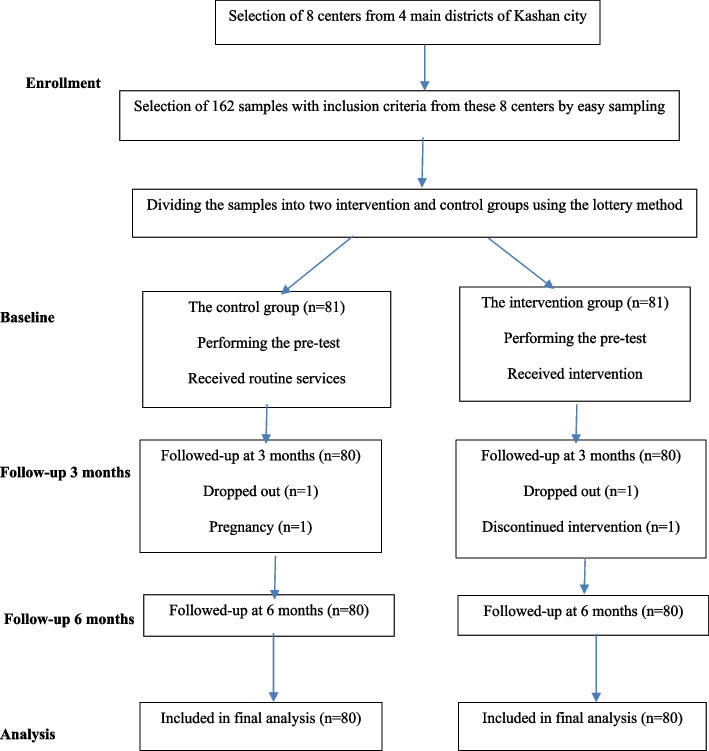
Methods: This quasi-experimental study was conducted on 162 women aged 30-69 years old among the clients of Comprehensive health service centers in Kashan, Iran and they were assigned to intervention and control groups. The research instrument included a questionnaire assessed within three phases: baseline, 3-months, and 6-months, containing Health Action Model (HAM) structures and also three screening behaviors. The intervention consisted of a model-based education package and was carried out over 2 months. To evaluate the effect of the intervention, the mean of model structures and proportion screening behaviors in the third and sixth months were compared with the baseline phase. All analyses were carried out using SPSS, version 22.
Results: The intervention and control groups were homogeneous regarding the structures of the HAM and the proportion of screening behaviors in the baseline phase (p > 0.05). In the 3-month (p < 0.05) and 6-month (p < 0.05) phases, the mean scores of the HAM constructs in the intervention group were found higher compared with the control group. Moreover, the proportion of clinical breast examinations in the intervention group was statistically higher than in the control group in the 3-month (p < 0.001) and 6-month (p < 0.001) phases. In addition, the proportion of mammography performed in the 3-month (p = 0.002) and 6-month (p < 0.001) phases were reported to be higher in the intervention group compared with the control group.
Conclusion: Overall, these results provide important insight into the effectiveness of the interventions based on the Health Action Model in promoting breast cancer screening behaviors and the determinants of such behaviors.
Keywords: Breast cancer; Breast self-examination; Clinical examination; Health action model; Mammography; Screening behaviors.
© 2023. The Author(s).
Conflict of interest statement
The authors declare no competing interests.
References
-
- Zarif Yeganeh M, Toorang F, Ebrahimipour Koujan S. Nutrition and breast cancer: what do say meta-analyses. In: 5th Tehran breast cancer conference–abstract book. 2012.
-
- Parks R, Cheung K.-L. An overview of the Nottingham Research Programme on Primary Breast Cancer in Older Women: breast cancer in older women. Liaquat Med Res J. 2021;3(3):49–52.
-
- Babu GR, et al. Breast cancer screening among females in Iran and recommendations for improved practice: a review. Asian Pac J Cancer Prev. 2011;12(7):1647–1655. - PubMed
MeSH terms
LinkOut - more resources
Full Text Sources
Medical
