. 2024 Jan 3;12(1):3.
doi: 10.1186/s40168-023-01720-w.

Methanolobus use unspecific methyltransferases to produce methane from dimethylsulphide in Baltic Sea sediments

Affiliations

Methanolobus use unspecific methyltransferases to produce methane from dimethylsulphide in Baltic Sea sediments

S L Tsola et al. Microbiome. .

Abstract

Background: In anoxic coastal and marine sediments, degradation of methylated compounds is the major route to the production of methane, a powerful greenhouse gas. Dimethylsulphide (DMS) is the most abundant biogenic organic sulphur compound in the environment and an abundant methylated compound leading to methane production in anoxic sediments. However, understanding of the microbial diversity driving DMS-dependent methanogenesis is limited, and the metabolic pathways underlying this process in the environment remain unexplored. To address this, we used anoxic incubations, amplicon sequencing, genome-centric metagenomics and metatranscriptomics of brackish sediments collected along the depth profile of the Baltic Sea with varying sulphate concentrations.

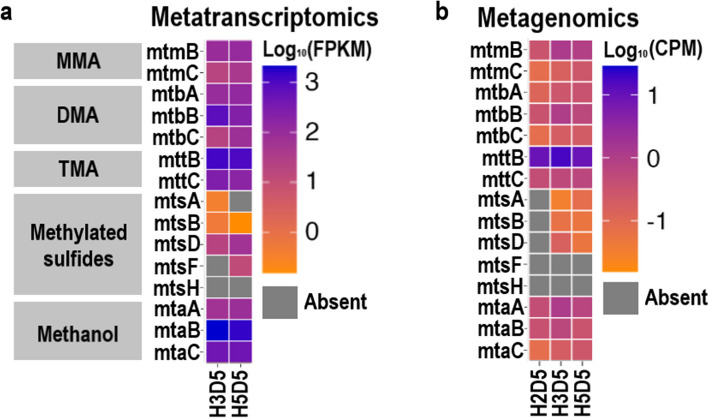
Results: We identified Methanolobus as the dominant methylotrophic methanogens in all our DMS-amended sediment incubations (61-99%) regardless of their sulphate concentrations. We also showed that the mtt and mta genes (trimethylamine- and methanol-methyltransferases) from Methanolobus were highly expressed when the sediment samples were incubated with DMS. Furthermore, we did not find mtsA and mtsB (methylsulphide-methyltransferases) in metatranscriptomes, metagenomes or in the Methanolobus MAGs, whilst mtsD and mtsF were found 2-3 orders of magnitude lower in selected samples.

Conclusions: Our study demonstrated that the Methanolobus genus is likely the key player in anaerobic DMS degradation in brackish Baltic Sea sediments. This is also the first study analysing the metabolic pathways of anaerobic DMS degradation in the environment and showing that methylotrophic methane production from DMS may not require a substrate-specific methyltransferase as was previously accepted. This highlights the versatility of the key enzymes in methane production in anoxic sediments, which would have significant implications for the global greenhouse gas budget and the methane cycle. Video Abstract.

Keywords: Dimethylsulphide; Metagenomics; Metatranscriptomics; Methanogenesis.


Conflict of interest statement

The authors declare no competing interests.

Figures
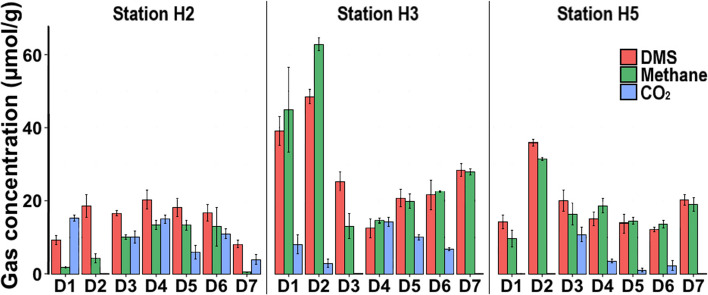
Fig. 1
Fig. 1
Average of total amount of degraded DMS, methane and CO2 per gramme of DMS-amended sediment after 82–128 days of incubation. D1 0–1 cm; D2 1–2 cm; D3 2–5 cm; D4 9–12 cm; D5 19–22 cm; D6 39–43 cm; D7 60–65 cm
Fig. 2
Fig. 2
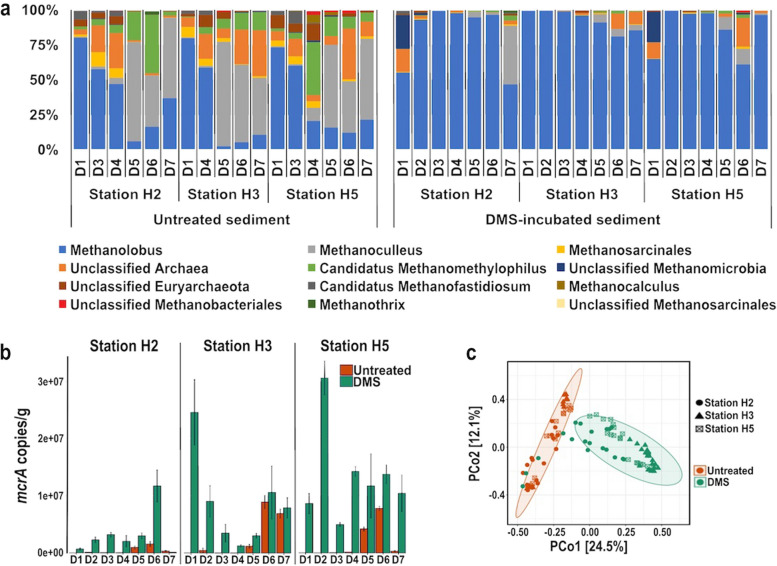
a Relative abundance of methanogens at genus level based on mcrA sequencing. Methanolobus dominated in all original sediment down to 19 cm (D1–D4) and DMS-amended sediment except for sample H2D7 where methane production was minimal. b The mcrA gene copy numbers in original and DMS-amended sediment incubations as determined by qPCR. All reactions were set up in triplicate and the average abundance and standard error are shown. c PCoA plot of the mcrA sequences based on Bray–Curtis dissimilarity metrics. Ellipses indicate 95% confidence intervals according to treatment data. Colour indicates treatment (red untreated; green DMS-amended). Shapes indicate sampling site. D1 0–1 cm; D2 1–2 cm; D3 2–5 cm; D4 9–12 cm; D5 19–22 cm; D6 39–43 cm; D7 60–65 cm
Fig. 3
Fig. 3
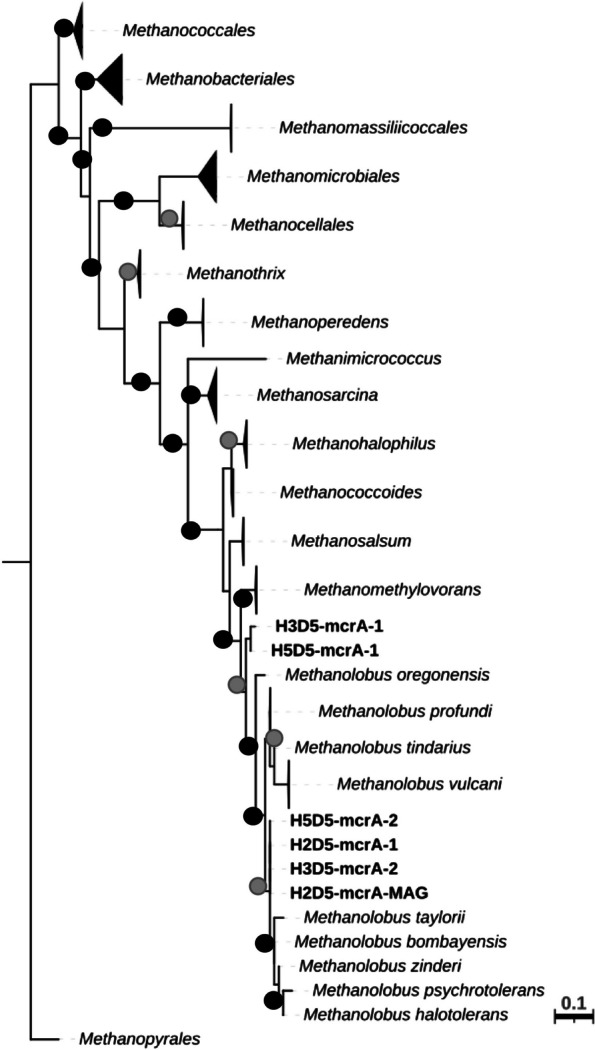
Maximum likelihood phylogenetic tree of the mcrA gene from the cultured methanogens. The tree also contains the mcrA sequences (marked in bold) from the metagenomes and the MAGs obtained within this study. ModelFinder was used to find the best-fit model for the data [52]. Bootstrap values (1000 replicates) were shown as black dots (> 80%) and grey dots (< 80%). The tree is drawn to scale, with branch lengths accounting for substitutions per site. The genus Methanopyrales was used as the outgroup
Fig. 4
Fig. 4
Heatmaps showing expression and abundance of genes involved in methylotrophic methane production. a Metatranscriptomics datasets; b metagenomics datasets. FPKM fragments per kilobase of gene per million reads, CPM copies per million reads
Fig. 5
Fig. 5
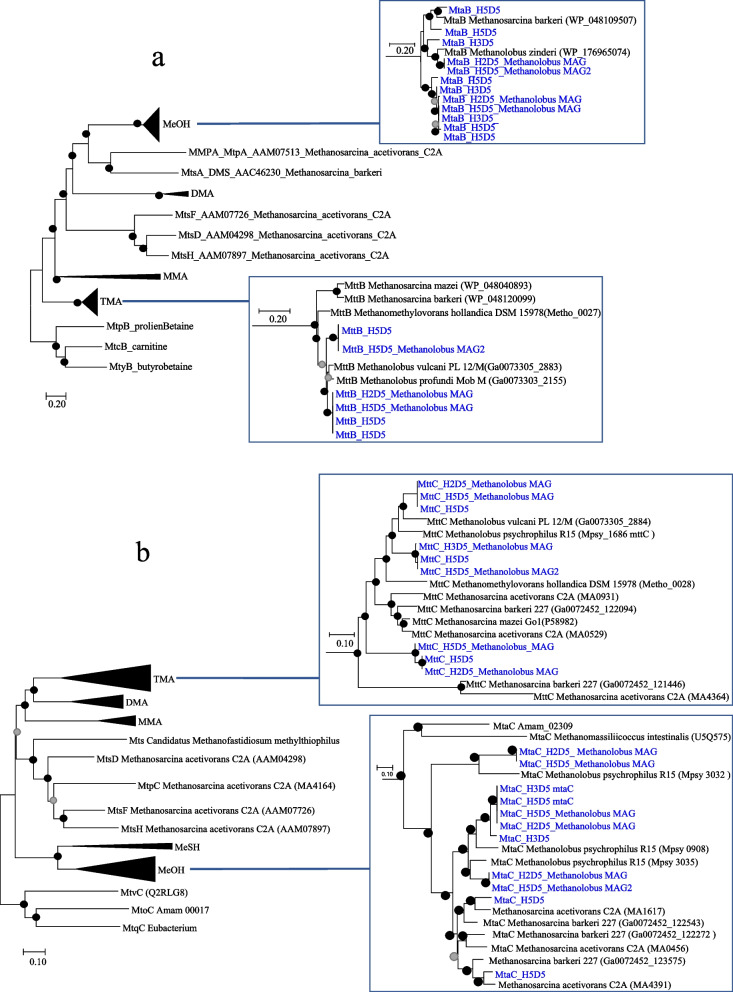
Phylogenetic tree of (a) MT1 methyltransferase and (b) corrinoid proteins including sequences from metatranscriptomics and MAGs recovered from the metagenomics datasets. The evolutionary history was inferred using the neighbour-joining method. The optimal trees with the sum of branch length of 11.7 and 11.1 are shown for methyltransferase and corrinoid proteins, respectively. Bootstrap values (100 replicates) are shown as black (> 50) and grey (< 50%) dots. The tree is drawn to scale, with branch lengths in the same units as those of the evolutionary distances used to infer the phylogenetic tree. All ambiguous positions were removed for each sequence pair. There was a total of 637 positions for methyltransferases and 217 positions for the corrinoid proteins in the final dataset

References

    1. Watts SF. The mass budgets of carbonyl sulfide, dimethyl sulfide, carbon disulfide and hydrogen sulfide. Atmos Environ. 2000;34(5):761–79. doi: 10.1016/S1352-2310(99)00342-8. - DOI
    1. Charlson RJ, Lovelock JE, Andreae MO, Warren SG. Oceanic phytoplankton, atmospheric sulphur, cloud albedo and climate. Nature. 1987;326:655–661. doi: 10.1038/326655a0. - DOI
    1. Curson ARJ, Todd JD, Sullivan MJ, Johnston AWB. Catabolism of dimethylsulphoniopropionate: microorganisms, enzymes and genes. Nat Rev Microbiol. 2011;9:849–859. doi: 10.1038/nrmicro2653. - DOI - PubMed
    1. Williams BT, et al. Bacteria are important dimethylsulfoniopropionate producers in coastal sediments. Nat Microbiol. 2019;4:1815–1825. doi: 10.1038/s41564-019-0527-1. - DOI - PubMed
    1. Zheng Y, et al. Bacteria are important dimethylsulfoniopropionate producers in marine aphotic and high-pressure environments. Nat Commun. 2020;11:4658. doi: 10.1038/s41467-020-18434-4. - DOI - PMC - PubMed

Publication types

LinkOut - more resources