Review
. 2024 Dec:66:223-235.
doi: 10.1016/j.jare.2024.01.001. Epub 2024 Jan 2.

CADASIL: A NOTCH3-associated cerebral small vessel disease

Affiliations
Review

CADASIL: A NOTCH3-associated cerebral small vessel disease

Lamei Yuan et al. J Adv Res. 2024 Dec.

Abstract

Background: Cerebral autosomal dominant arteriopathy with subcortical infarcts and leukoencephalopathy (CADASIL) is the most common hereditary cerebral small vessel disease (CSVD), pathologically characterized by a non-atherosclerotic and non-amyloid diffuse angiopathy primarily involving small to medium-sized penetrating arteries and leptomeningeal arteries. In 1996, mutation in the notch receptor 3 gene (NOTCH3) was identified as the cause of CADASIL. However, since that time other genetic CSVDs have been described, including the HtrA serine peptidase 1 gene-associated CSVD and the cathepsin A gene-associated CSVD, that clinically mimic the original phenotype. Though NOTCH3-associated CSVD is now a well-recognized hereditary disorder and the number of studies investigating this disease is increasing, the role of NOTCH3 in the pathogenesis of CADASIL remains elusive.

Aim of review: This review aims to provide insights into the pathogenesis and the diagnosis of hereditary CSVDs, as well as personalized therapy, predictive approach, and targeted prevention. In this review, we summarize the current progress in CADASIL, including the clinical, neuroimaging, pathological, genetic, diagnostic, and therapeutic aspects, as well as differential diagnosis, in which the role of NOTCH3 mutations is highlighted.

Key scientific concepts of review: In this review, CADASIL is revisited as a NOTCH3-associated CSVD along with other hereditary CSVDs.

Keywords: CADASIL; Hereditary cerebral small vessel disease; NOTCH3; Predictive approach; Targeted prevention.


Conflict of interest statement

Declaration of competing interest The authors declare that they have no known competing financial interests or personal relationships that could have appeared to influence the work reported in this paper.

Figures
None
Graphical abstract
Fig. 1
Fig. 1
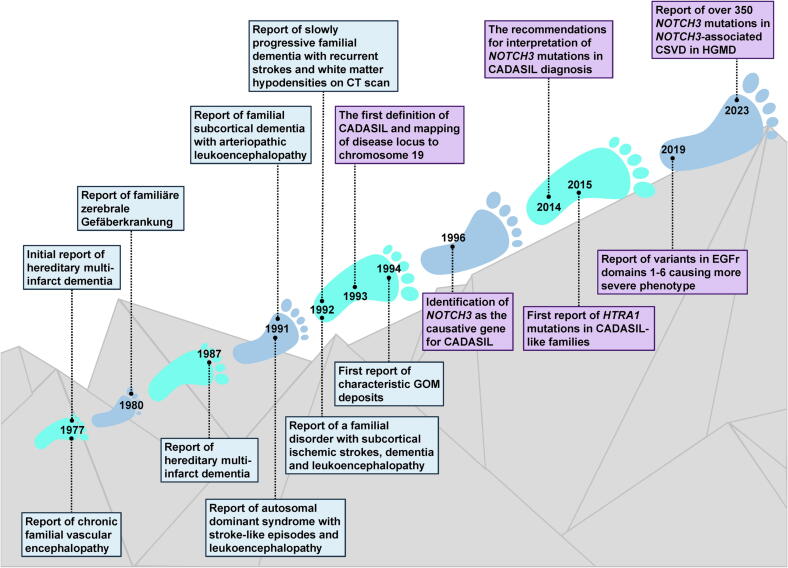
Milestones in understanding of NOTCH3-associated CSVD.
Fig. 2
Fig. 2
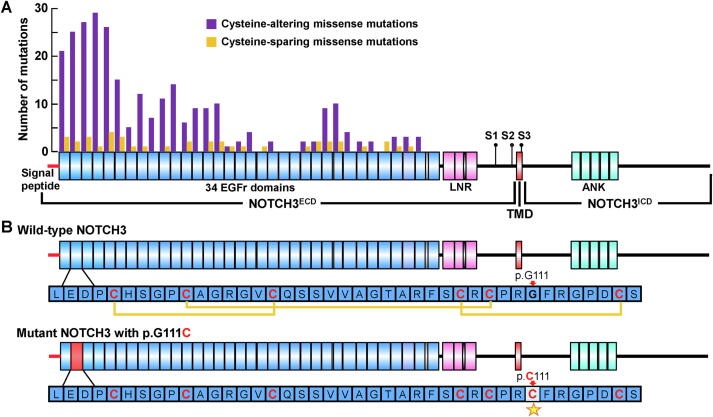
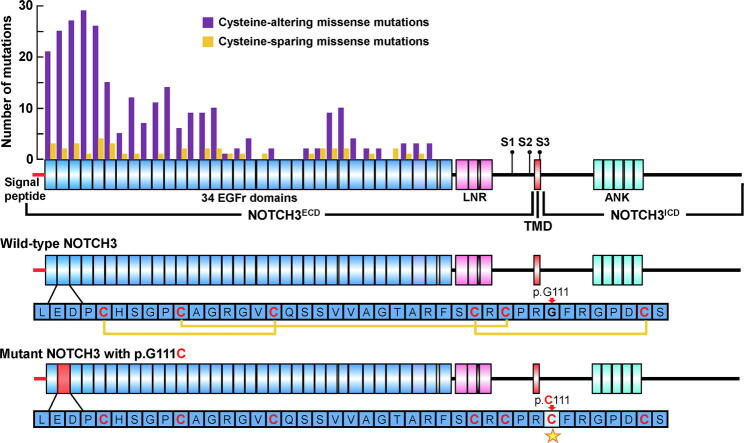
Schematic representation of the wild-type and mutant NOTCH3 protein, and missense NOTCH3 mutations in 34 EGFr domains. Schematic diagrams were created by Illustrator for Biological Sequences software (version 1.0, https://ibs.biocuckoo.org/) referred to Universal Protein Knowledgebase Q9UM47. (A) Main conserved domains of human NOTCH3 protein and distribution of missense NOTCH3 mutations causing NOTCH3-associated CSVD in 34 EGFr domains. NOTCH3ECD contains a signal peptide and 34 EGFr domains followed by LNR. NOTCH3ICD contains ANK repeats. Locations of S1, S2, and S3 cleavage sites as well as TMD are indicated. The cysteine-altering and cysteine-sparing missense mutations from Human Gene Mutation Database are shown. (B) The cysteine-altering missense mutation (e.g., previously identified p.G111C mutation in EGFr domain 2 [22]) results in an unpaired cysteine residue and is predicted to disrupt disulphide bridge formation in the EGFr domain by ScanProsite (https://prosite.expasy.org/scanprosite/). ANK, ankyrin; LNR, lin12/notch repeat; TMD, transmembrane domain.
Fig. 3
Fig. 3
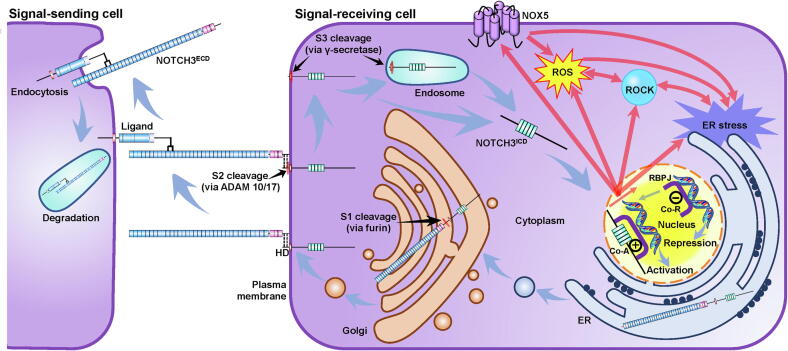
Schematic representation of the canonical NOTCH3 signaling pathway and aberrant NOTCH3-NOX5/ER stress/ROCK signaling pathway in CADASIL. After synthesized in ER, NOTCH3 is cleaved by furin at S1 in the trans-Golgi. NOTCH3ECD is non-covalently linked to NOTCH3TMIC at HD. Upon ligand (DLL1, 3, and 4/JAG 1 and 2) binding at EGFr domains 10–11, the NOTCH3 receptor is activated. The bound ligand and NOTCH3ECD are trans-endocytosed into the signal-sending cell, which perhaps dissociates the HD and exposes S2 to ADAM 10/17 cleavage. The γ-secretase cleavage occurs at the intramembranous S3 and releases NOTCH3ICD which translocates to the nucleus. In the absence of NOTCH3ICD, RBPJ interacts with transcription Co-Rs to repress transcription of target genes. NOTCH3ICD displaces the co-repressor complex from RBPJ and recruits transcription Co-As, resulting in transcriptional activation of target genes. Increased NOTCH3 signaling promotes ROCK activity, and increases ER stress through inducing NOX5-derived ROS. ADAM, a disintegrin and metalloproteinase domain-containing protein; Co-As, co-activators; Co-Rs, co-repressors; DLL, delta like canonical notch ligand; HD, heterodimerization domain; JAG, jagged canonical notch ligand; NOTCH3TMIC, NOTCH3 transmembrane and intracellular domain; RBPJ, recombination signal binding protein for immunoglobulin kappa J region; ROS, reactive oxygen species.

References

    1. Bordes C., Sargurupremraj M., Mishra A., Debette S. Genetics of common cerebral small vessel disease. Nat Rev Neurol. 2022;18:84–101. - PubMed
    1. Gorelick P.B., Sorond F.A. Advancing our knowledge about cerebral small vessel diseases. Lancet Neurol. 2023;22:972–973. - PMC - PubMed
    1. Yamamoto Y., Liao Y.C., Lee Y.C., Ihara M., Choi J.C. Update on the epidemiology, pathogenesis, and biomarkers of cerebral autosomal dominant arteriopathy with subcortical infarcts and leukoencephalopathy. J Clin Neurol. 2023;19:12–27. - PMC - PubMed
    1. Locatelli M., Padovani A., Pezzini A. Pathophysiological mechanisms and potential therapeutic targets in cerebral autosomal dominant arteriopathy with subcortical infarcts and leukoencephalopathy (CADASIL) Front Pharmacol. 2020;11:321. - PMC - PubMed
    1. Muiño E, Fernández-Cadenas I, Arboix A. Contribution of “omic” studies to the understanding of Cadasil. A systematic review. Int J Mol Sci 2021;22:7357. - PMC - PubMed

LinkOut - more resources