


New HIV Infections Among Key Populations and Their Partners in 2010 and 2022, by World Region: A Multisources Estimation
- PMID: 38180737
- PMCID: PMC10769164
- DOI: 10.1097/QAI.0000000000003340
New HIV Infections Among Key Populations and Their Partners in 2010 and 2022, by World Region: A Multisources Estimation
Abstract
Background: Previously, The Joint United Nations Programme on HIV/AIDS estimated proportions of adult new HIV infections among key populations (KPs) in the last calendar year, globally and in 8 regions. We refined and updated these, for 2010 and 2022, using country-level trend models informed by national data.
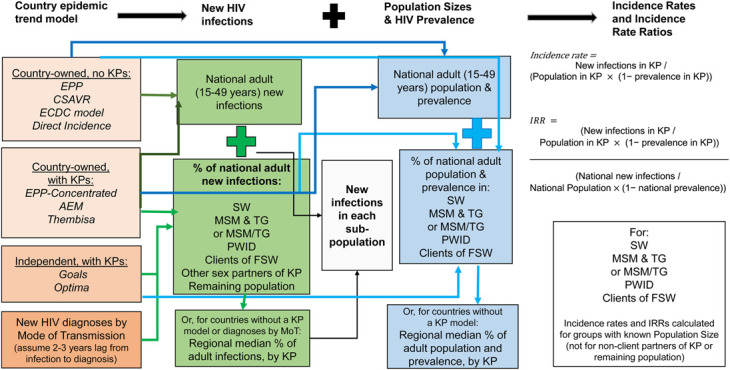
Methods: Infections among 15-49 year olds were estimated for sex workers (SWs), male clients of female SW, men who have sex with men (MSM), people who inject drugs (PWID), transgender women (TGW), and non-KP sex partners of these groups. Transmission models used were Goals (71 countries), AIDS Epidemic Model (13 Asian countries), Optima (9 European and Central Asian countries), and Thembisa (South Africa). Statistical Estimation and Projection Package fits were used for 15 countries. For 40 countries, new infections in 1 or more KPs were approximated from first-time diagnoses by the mode of transmission. Infection proportions among nonclient partners came from Goals, Optima, AIDS Epidemic Model, and Thembisa. For remaining countries and groups not represented in models, median proportions by KP were extrapolated from countries modeled within the same region.
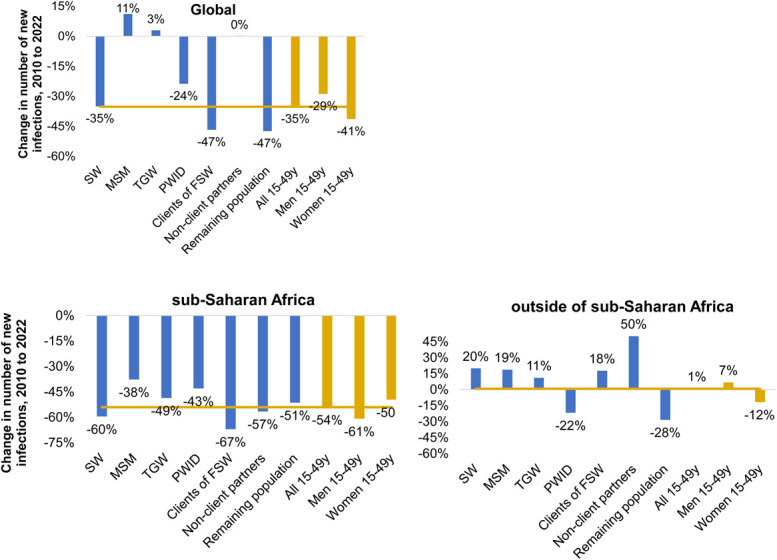
Results: Across 172 countries, estimated proportions of new adult infections in 2010 and 2022 were both 7.7% for SW, 11% and 20% for MSM, 0.72% and 1.1% for TGW, 6.8% and 8.0% for PWID, 12% and 10% for clients, and 5.3% and 8.2% for nonclient partners. In sub-Saharan Africa, proportions of new HIV infections decreased among SW, clients, and non-KP partners but increased for PWID; elsewhere these groups' 2010-to-2022 differences were opposite. For MSM and TGW, the proportions increased across all regions.
Conclusions: KPs continue to have disproportionately high HIV incidence.
Copyright © 2024 The Author(s). Published by Wolters Kluwer Health, Inc.
Conflict of interest statement
The authors have no funding or conflicts of interest to disclose.
Figures
References
-
- UNAIDS. In Danger: UNAIDS Global AIDS Update 2022. Geneva, Switzerland: UNAIDS; 2022.
-
- United Nations Population Division. World Population Prospects 2022 Revision. New York, NY: United Nations Population Division; 2022.
-
- UNAIDS. Indicators and Questions for Monitoring Progress on the 2021 Political Declaration on HIV and AIDS: Global AIDS Monitoring 2023. Geneva, Switzerland: UNAIDS; 2022.
Publication types
MeSH terms
Grants and funding
LinkOut - more resources
Full Text Sources
Medical
