. 2024 Jan 5;14(1):673.
doi: 10.1038/s41598-023-51010-6.

Nonlinearity association between hyperuricemia and all-cause mortality in patients with chronic kidney disease

Affiliations

Nonlinearity association between hyperuricemia and all-cause mortality in patients with chronic kidney disease

Ya-Fei Liu et al. Sci Rep. .

Abstract

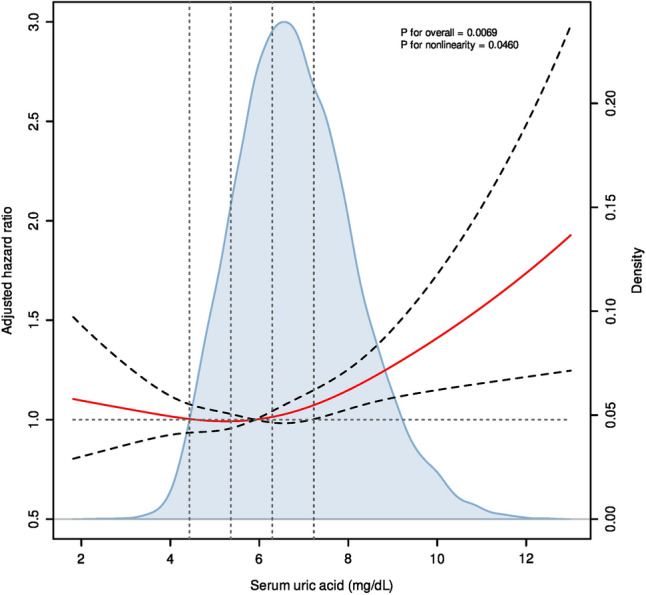
Controversy surrounds the role of serum uric acid and whether treatment intervention is favorable in retarding the progression of chronic kidney disease (CKD). The association of serum uric acid levels and CKD patient mortality risk needs to be further determined by large sample cohort studies. The National Health and Nutrition Examination Survey participants with CKD from 1998 to 2017 were enrolled in the study. Multivariable Cox regression models were used to reveal the association of serum uric acid concentrations and CKD mortality risks. A total of 9891 CKD patients were enrolled in the study, and 3698 individuals died during the follow-up. Increasing serum uric acid levels are independently relevant to higher mortality risks of CKD patients (HR per SD increase). A restricted cubic spline curve showed a nonlinear association between serum uric acid and CKD mortality risks (p for nonlinearity = 0.046). CKD patients with higher levels of serum uric acid (≥ 5.900 mg/dL) show a significant increase in mortality risks (HR = 1.102, 95% CI 1.043-1.165). Sensitivity analysis demonstrated that the results were stable and robust. High serum uric acid levels (≥ 5.900 mg/dL) may be associated with increased mortality risks in CKD patients.


Conflict of interest statement

The authors declare no competing interests.

Figures
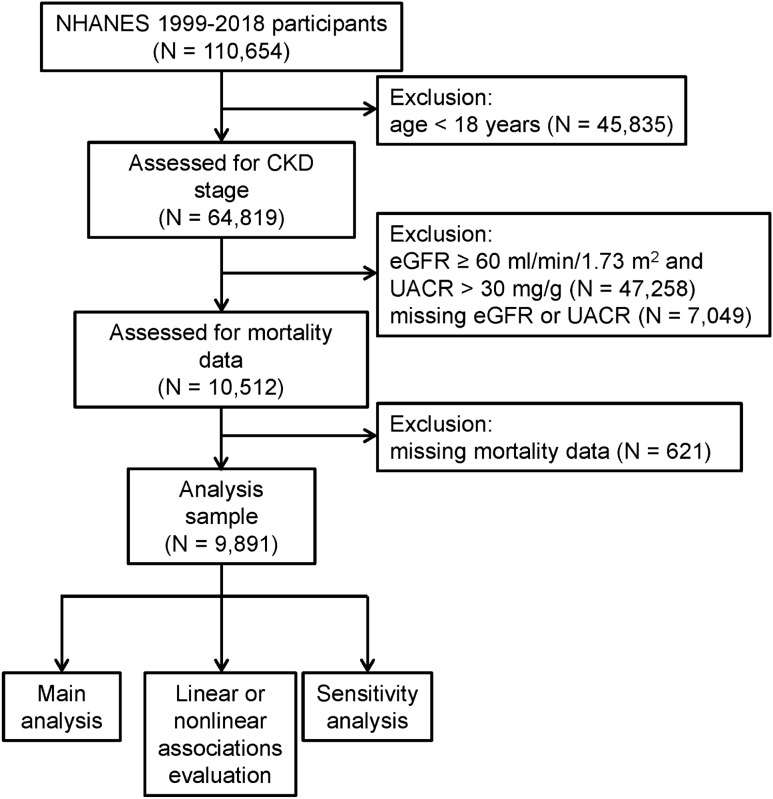
Figure 1
Figure 1
Flowchart of study participants. NHANES: National Health and Nutrition Examination Survey, CKD: chronic kidney disease, eGFR: estimated glomerular filtration rate, UACR: urinary albumin‒creatinine ratio.
Figure 2
Figure 2
Dose‒response curves for serum uric acid levels and mortality. Hazard ratio (HR) (labeled as red curves) and 95% confidence intervals (labeled as black dashed curves) were adjusted for age, sex, race, body mass index (categorial), hypertension, diabetes, albumin (categorial), albumin/globulin ratio (categorial), chronic kidney disease stages (categorial) and National Health and Nutrition Examination Survey cycle. The horizontal dotted line represents the reference HR, and vertical dotted lines are illustrated according to the quintile of serum uric acid concentrations. The blue-shaded area indicates the probability density distribution of serum uric acid concentrations. To decrease the influence of outliers, individuals with the ten largest and ten smallest serum uric acid concentrations were removed before illustration.

References

    1. Dalbeth N, Gosling AL, Gaffo A, Abhishek A. Gout. Lancet (London England) 2021;397(10287):1843–1855. doi: 10.1016/S0140-6736(21)00569-9. - DOI - PubMed
    1. Li C, Hsieh MC, Chang SJ. Metabolic syndrome, diabetes, and hyperuricemia. Curr. Opin. Rheumatol. 2013;25(2):210–216. doi: 10.1097/BOR.0b013e32835d951e. - DOI - PubMed
    1. Amiya E. Link between hyperuricemia, renal dysfunction, and hypertension. J. Clin. Hypertens. (Greenwich) 2021;23(12):2078–2079. doi: 10.1111/jch.14389. - DOI - PMC - PubMed
    1. Zhang S, Wang Y, Cheng J, Huangfu N, Zhao R, Xu Z, et al. Hyperuricemia and cardiovascular disease. Curr. Pharm. Des. 2019;25(6):700–709. doi: 10.2174/1381612825666190408122557. - DOI - PubMed
    1. Ramirez-Sandoval JC, Madero M. Treatment of hyperuricemia in chronic kidney disease. Contrib. Nephrol. 2018;192:135–146. doi: 10.1159/000484288. - DOI - PubMed