


Global, regional, and national lifetime risks of developing and dying from gastrointestinal cancers in 185 countries: a population-based systematic analysis of GLOBOCAN
- PMID: 38185129
- PMCID: PMC10849975
- DOI: 10.1016/S2468-1253(23)00366-7
Global, regional, and national lifetime risks of developing and dying from gastrointestinal cancers in 185 countries: a population-based systematic analysis of GLOBOCAN
Abstract
Background: Gastrointestinal cancers account for a quarter of the global cancer incidence and a third of cancer-related deaths. We sought to estimate the lifetime risks of developing and dying from gastrointestinal cancers at the country, world region, and global levels in 2020.
Methods: For this population-based systematic analysis, we obtained estimates of gastrointestinal cancer incidence and mortality rates from GLOBOCAN for 185 countries, alongside all-cause mortality and population data from the UN. Countries were categorised into quartiles of the Human Development Index (HDI). The lifetime risk of gastrointestinal cancers was estimated with a standard method that adjusts for multiple primaries, taking into account competing risks of death from causes other than cancer and life expectancy.
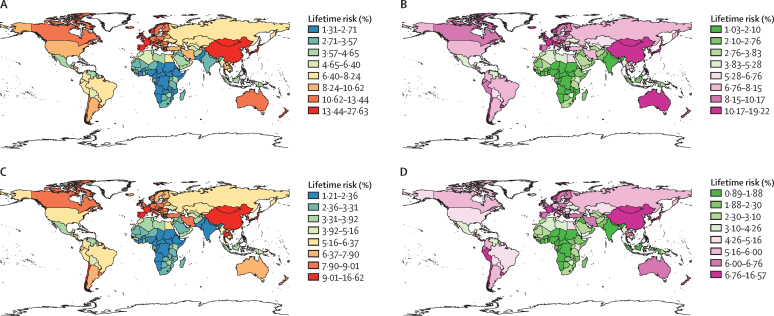
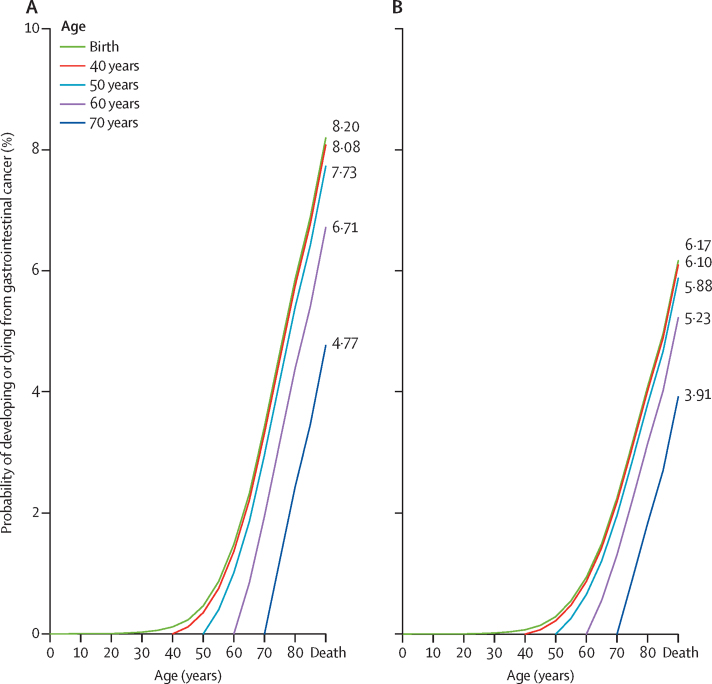
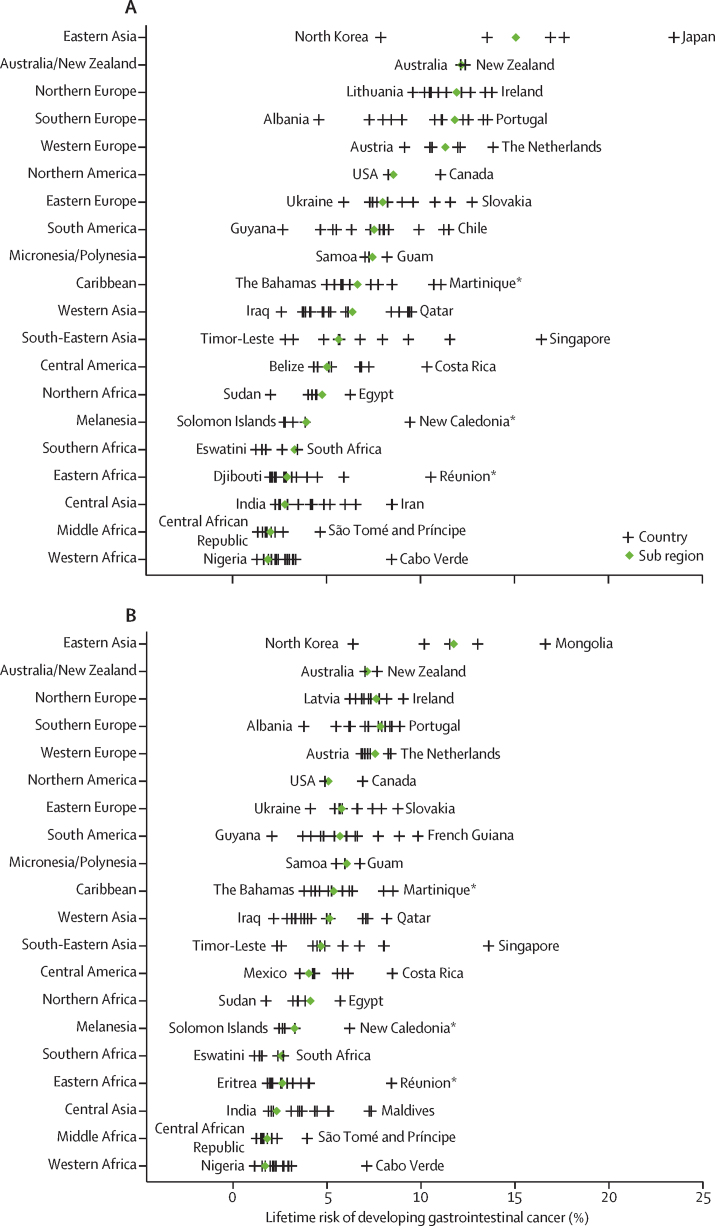
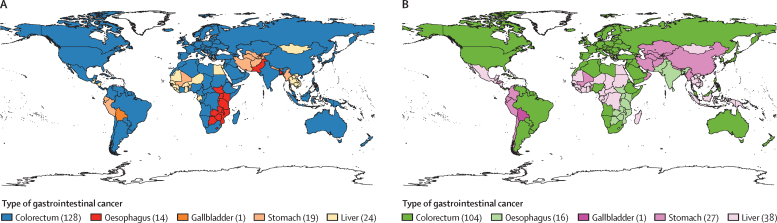
Findings: The global lifetime risks of developing and dying from gastrointestinal cancers from birth to death was 8·20% (95% CI 8·18-8·21) and 6·17% (6·16-6·18) in 2020. For men, the risk of developing gastrointestinal cancers was 9·53% (95% CI 9·51-9·55) and of dying from them 7·23% (7·22-7·25); for women, the risk of developing gastrointestinal cancers was 6·84% (6·82-6·85) and of dying from them 5·09% (5·08-5·10). Colorectal cancer presented the highest risk, accounting for 38·5% of the total lifetime risk of developing, and 28·2% of dying from, gastrointestinal cancers, followed by cancers of the stomach, liver, oesophagus, pancreas, and gallbladder. Eastern Asia has the highest lifetime risks for cancers of the stomach, liver, oesophagus, and gallbladder, Australia and New Zealand for colorectal cancer, and Western Europe for pancreatic cancer. The lifetime risk of gastrointestinal cancers increased consistently with increasing level of HDI; however, high HDI countries (the third HDI quartile) had the highest death risk.
Interpretation: The global lifetime risk of gastrointestinal cancers translates to one in 12 people developing, and one in 16 people dying from, gastrointestinal cancers. The identified high risk and observed disparities across countries warrants context-specific targeted gastrointestinal cancer control and health systems planning.
Funding: Beijing Nova Program, CAMS Innovation Fund for Medical Sciences, and Talent Incentive Program of Cancer Hospital, CAMS (Hope Star).
Copyright © 2024 The Author(s). Published by Elsevier Ltd. This is an Open Access article under the CC BY-NC-ND 4.0 license. Published by Elsevier Ltd.. All rights reserved.
Conflict of interest statement
Declaration of interests We declare no competing interests.
Figures
Comment in
-
Charting the path forward to combat gastrointestinal cancers.Lancet Gastroenterol Hepatol. 2024 Mar;9(3):189-191. doi: 10.1016/S2468-1253(23)00399-0. Epub 2024 Jan 4. Lancet Gastroenterol Hepatol. 2024. PMID: 38185128 No abstract available.
References
-
- Sung H, Ferlay J, Siegel RL, et al. Global cancer statistics 2020: GLOBOCAN estimates of incidence and mortality worldwide for 36 cancers in 185 countries. CA Cancer J Clin. 2021;71:209–249. - PubMed
-
- Ferlay J, Ervik M, Lam F, et al. Global Cancer Observatory: cancer today. 2020. https://gco.iarc.fr/today
Publication types
MeSH terms
Grants and funding
LinkOut - more resources
Full Text Sources
Medical
