


Ketogenic metabolic therapy for chronic kidney disease - the pro part
- PMID: 38186906
- PMCID: PMC10768757
- DOI: 10.1093/ckj/sfad273
Ketogenic metabolic therapy for chronic kidney disease - the pro part
Abstract
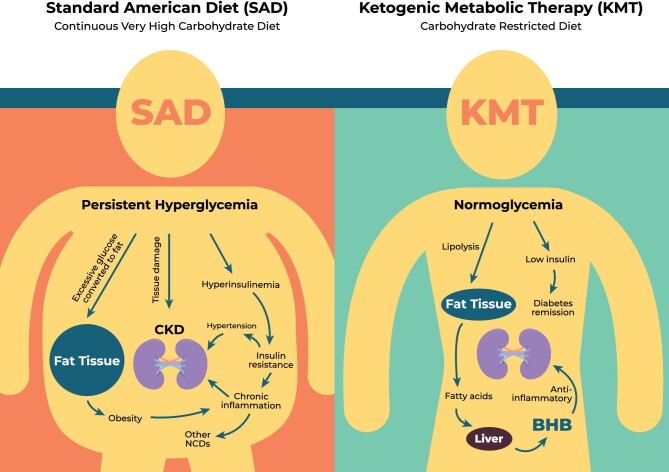
Ketogenic metabolic therapy (KMT) is a medical nutrition therapy to address certain health and disease conditions. It is increasingly used for many non-communicable diseases that are rooted in abnormal metabolic health. Since chronic kidney disease (CKD) is commonly caused by overnutrition leading to hyperglycemia, insulin resistance and diabetes mellitus, the carbohydrate restriction inherent in KMT may offer a therapeutic option. Numerous studies have found that various forms of KMT are safe for individuals with CKD and may lead to improvement of renal function. This is in contrast to the current standard pharmacological approach to CKD that only slows the relentless progression towards renal failure. Kidney care providers, including physicians and dietitians, are usually not aware of non-standard dietary interventions, including KMT, and often criticize KMT due to common misconceptions and uncertainty about the underlying science, including the common misconception that KMT must involve high protein or meat consumption. This review article discusses the rationales for using KMT, including plant-dominant KMT, for treatment of CKD, clarifies common misconceptions, summarizes the results of clinical studies and discusses why KMT is emerging as an effective medical nutrition therapy (MNT) to consider for patients with kidney disease. KMT, including its plant-dominant versions, can expand a practitioner's kidney health toolbox and will likely become a first-line therapy for CKD in certain CKD-associated conditions such as obesity, metabolic syndrome and polycystic kidney disease.
Keywords: diabetic kidney disease; ketosis; nutrition; obesity; polycystic kidney disease.
© The Author(s) 2023. Published by Oxford University Press on behalf of the ERA.
Conflict of interest statement
T.W. is an inventor on issued and pending patents filed by UCSB, is a shareholder and president of Santa Barbara Nutrients, served on the scientific advisory board of Chinook Therapeutics and has received research funding from Chinook Therapeutics unrelated to the scope of this article. J.S. is the owner of Kidney Nutrition Institute and is a shareholder and serves on the advisory board of Santa Barbara Nutrients. K.K.-Z. has received commercial honoraria and/or support from ACI Clinical (Cara Therapeutics), Akebia, Alexion, Ardelyx, AstraZeneca, Chugai, Daiichi, DaVita, Fresenius, GlaxoSmithKline, Haymarket Media, Kabi, Novartis, Novo Nordisk, Pfizer, Resverlogix, Sanofi, Vifor and UpToDate.
Figures
References
-
- Morgan W. Diabetes Mellitus: Its History, Chemistry, Anatomy, Pathology, Physiology, and Treatment. London: Homoeopathic Publishing, 1877.
-
- Zhou T, Cheng X, He Yet al. . Function and mechanism of histone β-hydroxybutyrylation in health and disease. Front Immunol 2022;13:981285. https://www.frontiersin.org/articles/10.3389/fimmu.2022.981285 - DOI - PMC - PubMed
