[Preprint]. 2024 Feb 8:2023.12.23.573205.
doi: 10.1101/2023.12.23.573205.

Distinct ancient structural polymorphisms control heterodichogamy in walnuts and hickories

Affiliations

Distinct ancient structural polymorphisms control heterodichogamy in walnuts and hickories

Jeffrey S Groh et al. bioRxiv. .

Abstract

The maintenance of stable mating type polymorphisms is a classic example of balancing selection, underlying the nearly ubiquitous 50/50 sex ratio in species with separate sexes. One lesser known but intriguing example of a balanced mating polymorphism in angiosperms is heterodichogamy - polymorphism for opposing directions of dichogamy (temporal separation of male and female function in hermaphrodites) within a flowering season. This mating system is common throughout Juglandaceae, the family that includes globally important and iconic nut and timber crops - walnuts (Juglans), as well as pecan and other hickories (Carya). In both genera, heterodichogamy is controlled by a single dominant allele. We fine-map the locus in each genus, and find two ancient (>50 Mya) structural variants involving different genes that both segregate as genus-wide trans-species polymorphisms. The Juglans locus maps to a ca. 20 kb structural variant adjacent to a probable trehalose phosphate phosphatase (TPPD-1), homologs of which regulate floral development in model systems. TPPD-1 is differentially expressed between morphs in developing male flowers, with increased allele-specific expression of the dominant haplotype copy. Across species, the dominant haplotype contains a tandem array of duplicated sequence motifs, part of which is an inverted copy of the TPPD-1 3' UTR. These repeats generate various distinct small RNAs matching sequences within the 3' UTR and further downstream. In contrast to the single-gene Juglans locus, the Carya heterodichogamy locus maps to a ca. 200-450 kb cluster of tightly linked polymorphisms across 20 genes, some of which have known roles in flowering and are differentially expressed between morphs in developing flowers. The dominant haplotype in pecan, which is nearly always heterozygous and appears to rarely recombine, shows markedly reduced genetic diversity and is over twice as long as its recessive counterpart due to accumulation of various types of transposable elements. We did not detect either genetic system in other heterodichogamous genera within Juglandaceae, suggesting that additional genetic systems for heterodichogamy may yet remain undiscovered.

Keywords: Carya; Juglandaceae; Juglans; T6P; balanced polymorphism; flowering time; heterodichogamy; pecan; structural variation; supergene; trans-species polymorphism; trehalose phosphate phosphatase; walnut.


Figures
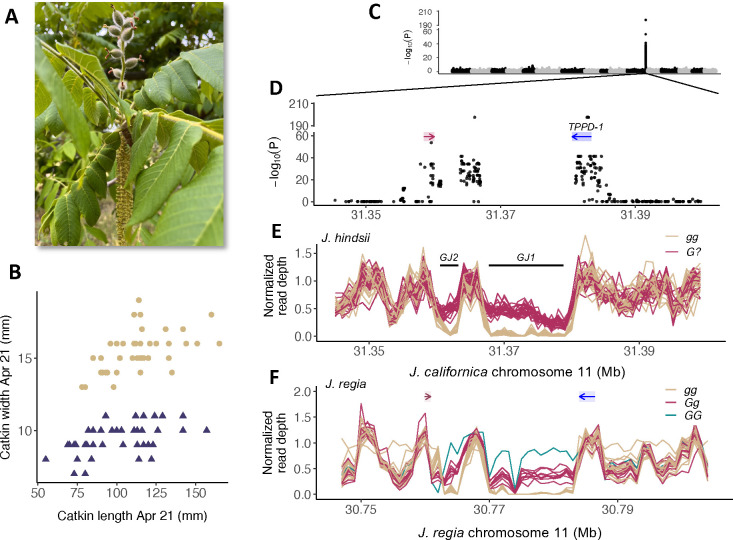
Figure 1:
Figure 1:
A) A protogynous individual of J. ailantifolia with developing fruits and catkins that are shedding pollen. Photo by JSG. B) Protandrous (tan) and protogynous (dark blue) morphs of J. hindsii are readily distinguished by catkin size in the first half of the flowering season. C) GWAS of flowering type in 44 individuals of J. hindsii from a natural population, against a long-read assembly of the sister species, J. californica. D) The GWAS peak occurs across and in the 3’ region of TPPD-1, a probable trehalose-6-phosphate phosphatase gene (blue rectangle, arrow indicates direction of transcription). Red bar shows the position of a NDR1/HIN1 -like gene. E) Normalized average read depth in 1 kb windows for 44 J. hindsii from a natural population against a genome assembly for J. californica. Black bars show positions of identified indels. F) Normalized average read depth in 1 kb windows for 26 J. regia individuals in the region syntenic with the J. hindsii G-locus. Colored bars and arrows indicate positions of orthologous genes bordering the G-locus.
Figure 2:
Figure 2:
A) Schematic of the G-locus structural variant in Juglans. Presence/absence of indels are indicated by continuous lines vs. open parentheses. Maroon and blue bars show bordering genes. Black arrow across TPPD-1 indicates direction of transcription. Colored arrows represent subunits of the repeat motif within the GJ1 indel and paralogous sequence outside of the indel. Each repeat motif (numbered 1,2,...) is comprised of subunits a, b, and c. Subunit a, which is homologous with the 3’ UTR of TPPD-1, is inverted within the indel. B) Dotplots showing pairwise alignment of alternate haplotypes for three species representing the major clades within the genus. Maroon and blue rectangles indicate the locations of the genes bordering the G-locus as in (A). C) Phylogeny of GJ1 repeats. Sample codes from L-R indicate: haplotype (for Juglans only), abbreviated binomial, optional additional identifier, and repeat number (as in A) (see Table S3 for full taxon list and data sources). Sequences from g haplotypes (gold) and G haplotypes (blue) form two sister clades (*, 99% bootstrap support) whose most recent common ancestor predates the radiation of Juglans. Daggers and diamonds highlight representative sequences from J. californica and J. regia that show the trans-species polymorphism. D) Average nucleotide divergence in 500 bp windows between alternate G-locus haplotypes for three within-species comparisons. Dotted gray lines indicate the chromosome-wide average, and shaded gray regions indicate 95% quantiles. Maroon and blue bars indicate positions of genes as in (A).
Figure 3:
Figure 3:
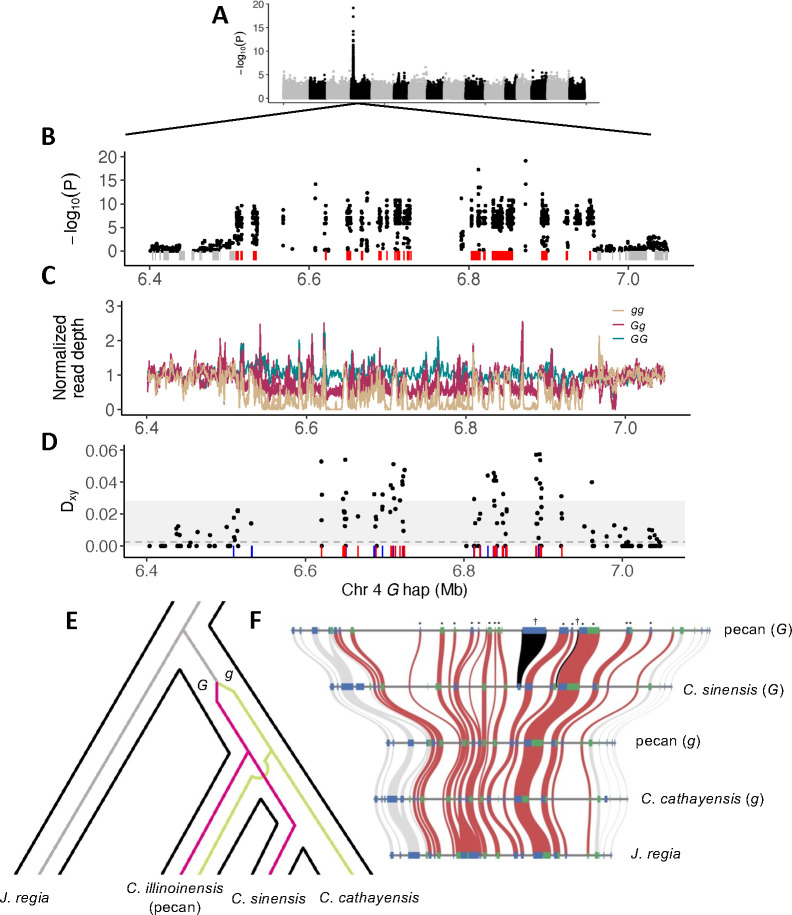
The G-locus in Carya. A) GWAS for dichogamy type in 30 pecan varieties identifies a single peak of strong association on chromosome 4. B) Zoomed in view of the GWAS peak. Boxes underneath plot indicate positions of predicted genes. Red boxes are those that fall within the region of strong association. C) Normalized average read depth in 1 kb windows across the location of the GWAS hit reveals a structural variant segregating in perfect association with dichogamy type. D) Nucleotide divergence between G-locus haplotypes within coding sequence is strongly elevated against the genome-wide background. Dotted line shows the genome-wide average for coding sequence, shaded interval shows 99% quantile. Colored tick marks at bottom show locations where other Carya species are heterozygous for SNPs that are fixed between pecan G-locus haplotypes. Blue - North American, red - East Asian. E) The phylogeny of the G-locus is discordant with the species tree, reflecting trans-species polymorphism. Carya G-locus haplotypes diverged after the split with Juglans and were present in the most recent common ancestor of Carya. F) Gene-level synteny for assemblies of both G-locus haplotypes in pecan and East Asian Carya, and J. regia. G haplotypes are longer than g haplotypes in both major Carya clades due to accumulation of transposable elements. Colored boxes show positions of genes in each assembly, with color indicating the strand (blue - plus, green - minus). Red bands connect orthologous genes that fall within the GWAS peak in pecan; gray bands connect genes outside the region. Individual gene trees that support the trans-species polymorphism are indicated with asterisks along the top. Black bands and daggers indicate two genes that appear to be uniquely shared by North American and East Asian G haplotypes.

References

    1. Akagi T, Henry IM, Tao R, Comai L. 2014. A Y-chromosome–encoded small RNA acts as a sex determinant in persimmons. Science. 346:646–650. - PubMed
    1. Altschul SF, Gish W, Miller W, Myers EW, Lipman DJ. 1990. Basic local alignment search tool. Journal of Molecular Biology. 215:403–410. - PubMed
    1. Bachtrog D. 2013. Y-chromosome evolution: Emerging insights into processes of Y-chromosome degeneration. Nature Reviews Genetics. 14:113–124. - PMC - PubMed
    1. Bai WN, Zeng YF, Zhang DY. 2007. Mating patterns and pollen dispersal in a heterodichogamous tree, Juglans mandshurica (Juglandaceae). New Phytologist. 176:699–707. - PubMed
    1. Barrett SC. 2010. Darwin’s legacy: the forms, function and sexual diversity of flowers. Philosophical Transactions of the Royal Society B: Biological Sciences. 365:351–368. - PMC - PubMed

Publication types