


Adolescents' beliefs about what symptoms constitute depression: Are more expansive definitions helpful or harmful?
- PMID: 38188868
- PMCID: PMC10768966
- DOI: 10.1016/j.ssmmh.2023.100259
Adolescents' beliefs about what symptoms constitute depression: Are more expansive definitions helpful or harmful?
Abstract
Purpose: What symptoms do people think constitute "depression"? In a mental health literacy framework, knowing more of depression's nine core symptoms (per formal psychiatric diagnostic criteria) is thought to help people identify and seek help for depression. However, the common-sense model of self-regulation suggests that more expansive beliefs about what symptoms constitute an illness may be maladaptive, whereby viewing more symptoms as characterizing a disorder predicts greater functional impairment.
Methods: We collected data from N = 281 U.S. adolescents experiencing elevated depression symptoms, recruited via social media. Symptom beliefs were assessed descriptively and with a latent profile analysis to test associations with other variables.
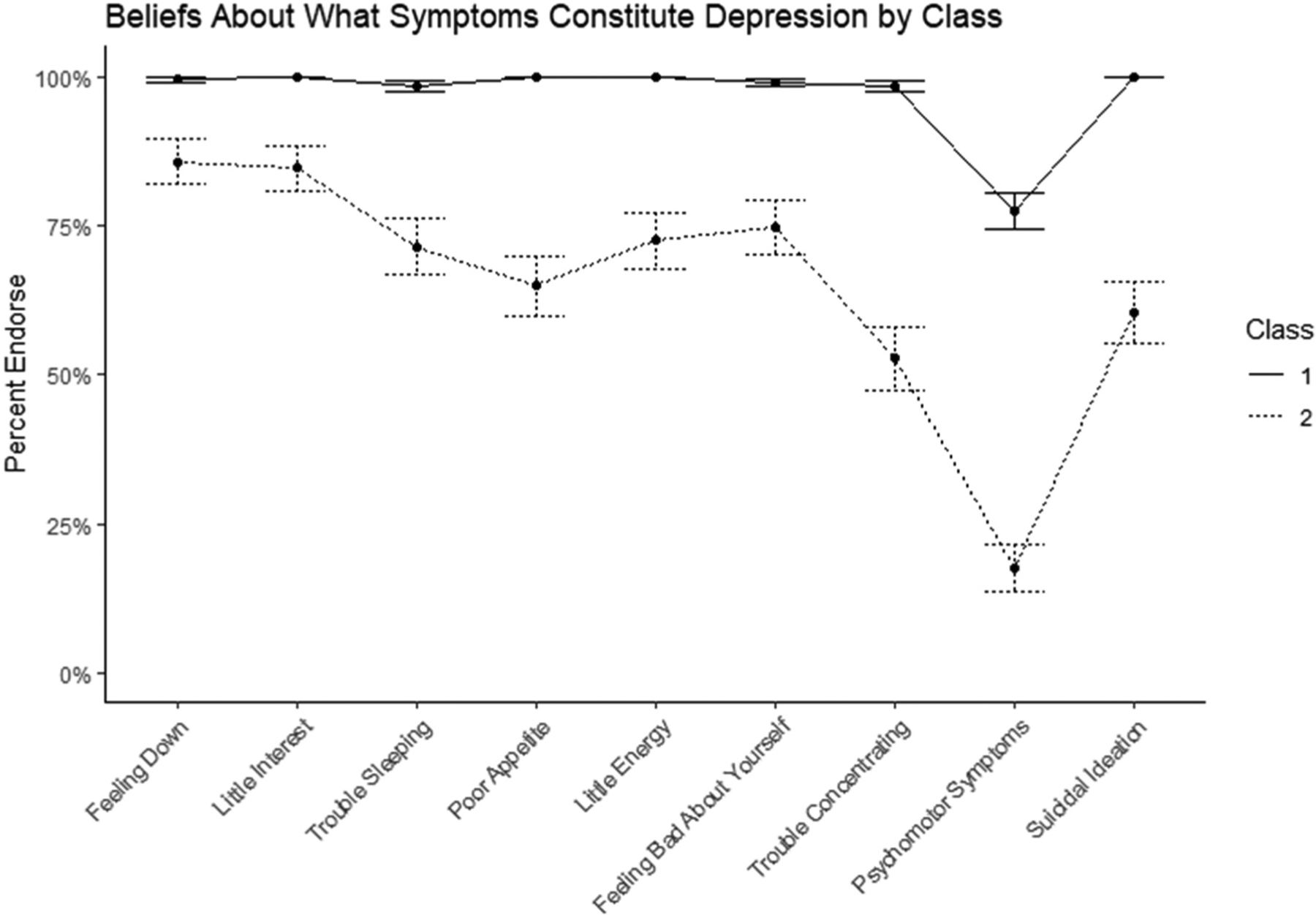
Results: Adolescents' beliefs about what symptoms constitute depression varied widely, and only 49% endorsed all DSM-5 depression symptoms as characterizing the disorder. Adolescents who identified more symptoms as belonging to depression had more severe depression symptoms (p = .004), reported more hopelessness (p = .021), and were more pessimistic about the permanence of depression (p = .007); they were also more likely to rate medication as potentially helpful (p = .001).
Conclusion: These findings simultaneously support and challenge elements of both the common-sense model and the mental health literacy framework. Future research on mental health literacy may examine why adolescents with more psychiatrically-accurate understandings of depression experience worse clinical outcomes. Likewise, future research on the common sense model should explore whether more expansive depression symptom beliefs may be adaptive as well as maladaptive.
Keywords: Adolescence; Common-sense model; Depression; Illness beliefs; Mental health literacy.
Conflict of interest statement
Declaration of competing interest Authors report no conflicts of interest to disclose.
Figures

Similar articles
-
Letter to the Editor: CONVERGENCES AND DIVERGENCES IN THE ICD-11 VS. DSM-5 CLASSIFICATION OF MOOD DISORDERS.Turk Psikiyatri Derg. 2021;32(4):293-295. doi: 10.5080/u26899. Turk Psikiyatri Derg. 2021. PMID: 34964106 English, Turkish.
-
Analyzing User-Generated Web-Based Posts of Adolescents' Emotional, Behavioral, and Symptom Responses to Beliefs About Depression: Qualitative Thematic Analysis.J Med Internet Res. 2023 Jan 24;25:e37289. doi: 10.2196/37289. J Med Internet Res. 2023. PMID: 36692944 Free PMC article.
-
Investigating the relationship of COVID-19 related stress and media consumption with schizotypy, depression, and anxiety in cross-sectional surveys repeated throughout the pandemic in Germany and the UK.Elife. 2022 Jul 4;11:e75893. doi: 10.7554/eLife.75893. Elife. 2022. PMID: 35781372 Free PMC article.
-
Depression presentations, stigma, and mental health literacy: A critical review and YouTube content analysis.Clin Psychol Rev. 2020 Jun;78:101843. doi: 10.1016/j.cpr.2020.101843. Epub 2020 Mar 6. Clin Psychol Rev. 2020. PMID: 32304914 Review.
-
Treatment of culturally diverse children and adolescents with depression.J Child Adolesc Psychopharmacol. 2012 Feb;22(1):72-9. doi: 10.1089/cap.2011.0051. Epub 2012 Jan 17. J Child Adolesc Psychopharmacol. 2012. PMID: 22251021 Review.
References
-
- Ahuvia IL, Fox KR, Schleider JL, 2022. Depression Beliefs Among High-Symptom Adolescents: Correlates, Parent-Child Agreement, and Stability over Time. 10.31234/osf.io/sqt8g. - DOI
-
- Bear H, Moon Z, Wasil A, Ahuvia I, Edbrooke-Childs J, Wolpert M, 2023. Development and validation of the illness perceptions questionnaire for youth anxiety and depression. Counseling Psychology Quarterly. 10.1080/09515070.2023.2232320. - DOI
-
- Bonabi H, Müller M, Ajdacic-Gross V, Eisele J, Rodgers S, Seifritz E, Rössler W, Rüsch N, 2016. Mental health literacy, attitudes to help seeking, and perceived need as predictors of mental health service use: a longitudinal study. J. Nerv. Ment. Dis 204 (4), 321–324. - PubMed
-
- Broadbent E, Petrie KJ, Main J, Weinman J, 2006. The brief illness perception questionnaire. J. Psychosom. Res 60 (6), 631–637. - PubMed
Grants and funding
LinkOut - more resources
Full Text Sources