. 2024 Feb;177(2):189-195.
doi: 10.7326/M23-2023. Epub 2024 Jan 9.

Effectiveness of Recombinant Zoster Vaccine Against Herpes Zoster in a Real-World Setting

Affiliations

Effectiveness of Recombinant Zoster Vaccine Against Herpes Zoster in a Real-World Setting

Ousseny Zerbo et al. Ann Intern Med. 2024 Feb.

Abstract

Background: A 2-dose series of recombinant zoster vaccine (RZV) was 97% effective against herpes zoster (HZ) in a pivotal clinical trial.

Objective: To evaluate real-world effectiveness of RZV against HZ.

Design: Prospective cohort study.

Setting: Four health care systems in the Vaccine Safety Datalink.

Participants: Persons aged 50 years or older.

Measurements: The outcome was incident HZ defined by a diagnosis with an antiviral prescription. Cox regression was used to estimate the hazard of HZ in vaccinated persons compared with unvaccinated persons, with adjustment for covariates. Vaccine effectiveness (VE) was calculated as 1 minus the adjusted hazard ratio and was estimated by time since the last RZV dose and by corticosteroid use.

Results: The study included nearly 2.0 million persons who contributed 7.6 million person-years of follow-up. After adjustment, VE of 1 dose was 64% and VE of 2 doses was 76%. After 1 dose only, VE was 70% during the first year, 45% during the second year, 48% during the third year, and 52% after the third year. After 2 doses, VE was 79% during the first year, 75% during the second year, and 73% during the third and fourth years. Vaccine effectiveness was 65% in persons who received corticosteroids before vaccination and 77% in those who did not.

Limitation: Herpes zoster could not be identified as accurately in these observational data as in the previous clinical trials.

Conclusion: Two doses of RZV were highly effective, although less effective than in the previous clinical trials. Two-dose effectiveness waned very little during the 4 years of follow-up. However, 1-dose effectiveness waned substantially after 1 year, underscoring the importance of the second dose.

Primary funding source: Centers for Disease Control and Prevention.


Conflict of interest statement

Disclosures: Disclosures can be viewed at www.acponline.org/authors/icmje/ConflictOfInterestForms.do?msNum=M23-2023.

Figures

Figure 1.
Figure 1.. Effectiveness of RZV against HZ, January 2018 to December 2022.
The figure shows the VE estimates obtained from the first model with a 5-level measure of RZV vaccination status. The model was conditioned on Vaccine Safety Datalink site and calendar time and adjusted for age; sex; racial or ethnic group; zoster vaccine live status; corticosteroid use; influenza vaccination; hospital admission; outpatient visit frequency; and diagnoses of diabetes, chronic obstructive pulmonary disease, coronary heart disease, obesity, and hypertension. HZ = herpes zoster; RZV = recombinant zoster vaccine; VE = vaccine effectiveness.
Figure 2.
Figure 2.. Effectiveness of RZV against HZ, January 2018 to December 2022, by vaccine dose and time since vaccination.
The figure shows the VE estimates obtained from the second model with an 11-level measure of RZV vaccination status. The model was conditioned on Vaccine Safety Datalink site and calendar time and adjusted for age; sex; racial or ethnic group; zoster vaccine live status; corticosteroid use; influenza vaccination; hospital admission; outpatient visit frequency; and diagnoses of diabetes, chronic obstructive pulmonary disease, coronary heart disease, obesity, and hypertension. HZ = herpes zoster; RZV = recombinant zoster vaccine; VE = vaccine effectiveness.
Figure 3.
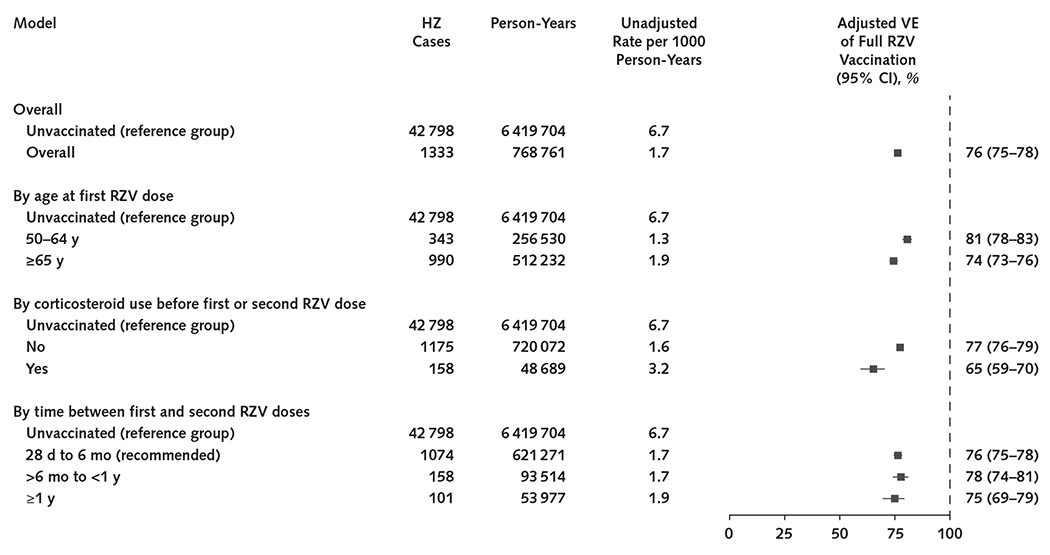
Figure 3.. Effectiveness of full vaccination with RZV (≥30 days after second dose) against HZ overall, by age at first dose, by corticosteroid use before vaccination, and by time between doses, January 2018 to December 2022.
The figure summarizes the VE estimates for fully vaccinated persons obtained from 4 models: 1 with a 5-level measure of RZV vaccination status (results shown in Figure 2), and the other 3 similar to the first model except that fully vaccinated persons were divided into subgroups based on age at the first dose, corticosteroid use before vaccination, and time between doses. All models were conditioned on Vaccine Safety Datalink site and calendar time and adjusted for age; sex; racial or ethnic group; zoster vaccine live status; corticosteroid use; influenza vaccination; hospital admission; outpatient visit frequency; and diagnoses of diabetes, chronic obstructive pulmonary disease, coronary heart disease, obesity, and hypertension. HZ = herpes zoster; RZV = recombinant zoster vaccine; VE = vaccine effectiveness.

References

    1. Cohen JI. Clinical practice: herpes zoster. N Engl J Med. 2013;369:255–263. doi:10.1056/NEJMcp1302674 - DOI - PMC - PubMed
    1. Johnson RW, Wasner G, Saddier P, et al. Postherpetic neuralgia: epidemiology, pathophysiology and management. Expert Rev Neurother. 2007;7:1581–1595. doi:10.1586/14737175.7.11.1581 - DOI - PubMed
    1. Kawai K, Gebremeskel BG, Acosta CJ. Systematic review of incidence and complications of herpes zoster: towards a global perspective. BMJ Open. 2014;4:e004833. doi:10.1136/bmjopen-2014-004833 - DOI - PMC - PubMed
    1. Johnson BH, Palmer L, Gatwood J, et al. Annual incidence rates of herpes zoster among an immunocompetent population in the United States. BMC Infect Dis. 2015;15:502. doi:10.1186/s12879-015-1262-8 - DOI - PMC - PubMed
    1. Yawn BP, Saddier P, Wollan PC, et al. A population-based study of the incidence and complication rates of herpes zoster before zoster vaccine introduction. Mayo Clin Proc. 2007;82:1341–1349. doi:10.4065/82.11.1341 - DOI - PubMed

Publication types