


Determinants of preventive sexual behaviours among first year university students in Beira city, central Mozambique: a cross-sectional study
- PMID: 38191405
- PMCID: PMC10773135
- DOI: 10.1186/s12978-023-01733-6
Determinants of preventive sexual behaviours among first year university students in Beira city, central Mozambique: a cross-sectional study
Abstract
Background: Understanding determinants of preventive sexual behaviours is important for intervention efforts to support these behaviours and, thereby, reduce STIs and HIV burden. In general, there is limited insight into determinants of preventive behaviours among university students in Mozambique. Therefore, this study set out to assess both the prevalence and the determinants of condom use and voluntary counselling and testing (VCT) service use in first year university students.
Methods: We conducted a cross-sectional study in May-September 2021, at the Universidade Católica de Moçambique and the Universidade Licungo, in Beira central Mozambique. We collected data on sociodemographic characteristics, heterosexual relationship experiences and personal determinants posited to be associated with condom use and VCT service use. We included 819 participants, who were selected using a clustered and random sampling design. We used Pearson's chi-square test to compare proportion and estimate the crude odd ratio as the effect size measure at 95% confidence interval, and Confidence Interval-Based Estimation of Relevance to determine correlation coefficients of means and the behaviours of interest at 95% confidence interval.
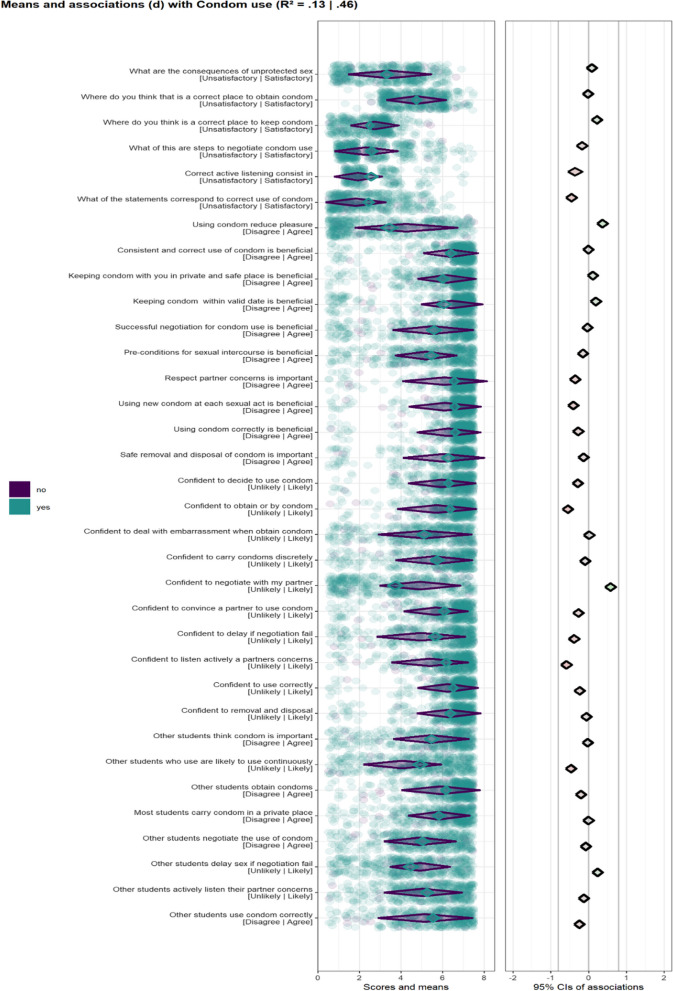
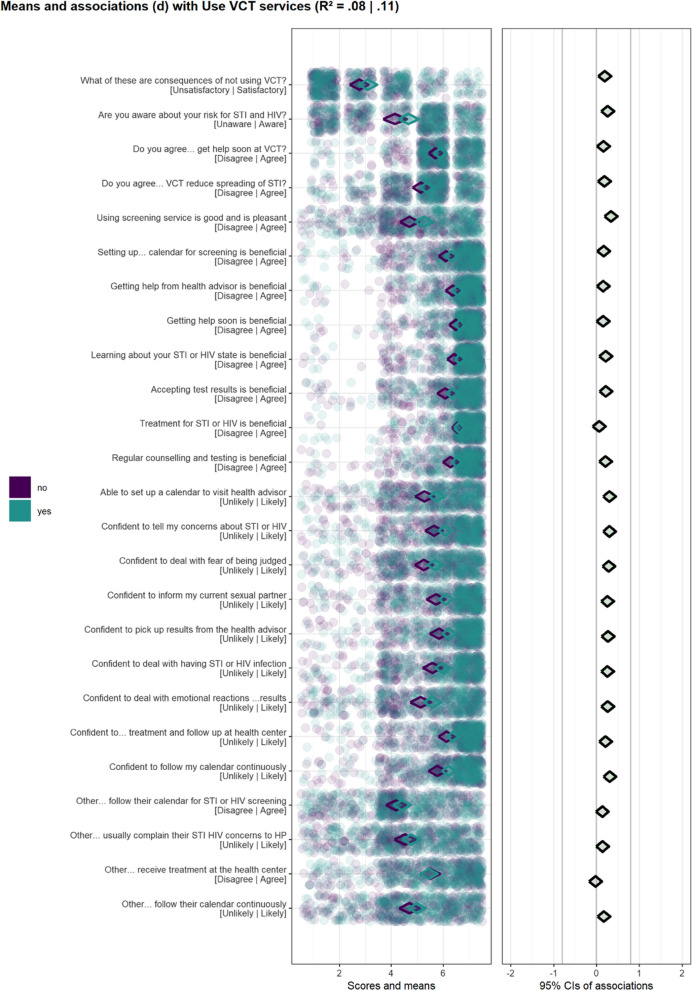
Results: Condoms were used by 96.1% of male participants and 95.0% of female participants. Additionally, 55.1% of male participants and 57.5% of female participants had previously used VCT services. Condom use was associated with discussing sexuality with mother, and self-efficacy for condom use negotiation, and negatively associated with attitudes that condoms reduce pleasure. VCT service use was associated with discussing sexuality with mother, sexual debut, having a sexual partner, and being in what they consider an important heterosexual relationship. Knowledge, attitude, self-efficacy and subjective norms were weakly associated with VCT service use.
Conclusion: In first year university students in Mozambique, reported condom use was high but VCT services were only used by about half of the participants. Interventions aiming to increase VCT service use should focus on improving communication between parents and their adolescent or young adult children, providing personalized risk information, demonstrating that VCT service use is pleasant and non-judgmental, improving users' confidence to schedule a visit, and preparing users for possible positive testing results.
INTRODUçãO: Compreender os determinantes de comportamentos sexuais preventivos é importante para guiar o desenvolvimento de intervenções que reforçam e apoiam estes comportamentos e, assim, reduzir a carga das infecções transmitida sexualmente (ITSs) e do Vírus de Imunodeficiência Humana (HIV). Em geral, informação sobre os determinantes de comportamentos preventivos entre os estudantes universitários é limitada em Moçambique. Portanto, este estudo teve como objetivo avaliar a prevalência e os determinantes do uso de preservativos e uso dos serviços de aconselhamento e testagem em saúde (ATS) em estudantes universitários do primeiro ano. MéTODOS: Realizamos um estudo transversal em Maio—Setembro de 2021, na Universidade Católica de Moçambique e na Universidade Licungo, na Beira centro de Moçambique. Coletamos dados sobre características sociodemográficas, experiências de relacionamento heterossexual e determinantes pessoais considerados associados ao uso de preservativo e ao uso dos serviços de ATS. Foram incluídos 819 participantes, estes foram selecionados usando o desenho amostral de conglomerado e aleatório. Utilizamos o teste qui-quadrado para comparar as proporções, usamos odd ratio para estimativa de tamanho do efeito a 95% de intervalo de confiança. e para identificar os determinantes relevantes usamos a abordagem da estimativa de relevância baseada no intervalos de confiança (CIBER). RESULTADOS: O uso do preservativo foi declarado por cerca de 96,1% dos participantes homens e 95,0% de participantes mulheres. Mas apenas 55,1% dos participantes homens e 57,5% das participantes mulheres referiram terem usado o serviço de ATS. O uso do preservativo foi associado à discussão da sexualidade com a mãe e positivamente associado à autoconfiança para negociação do uso do preservativo, e negativamente associado à atitude de que, o preservativo reduz o prazer. O uso dos serviços de ATS foi associado à discussão da sexualidade com a mãe, início da vida sexual, ter um parceiro sexual e estar num relacionamento heterossexual que consideram importante. Conhecimento, atitude, autoconfiança e normas subjetivas mostraram-se fracamente associados ao uso de serviços de ATS. CONCLUSãO: Em estudantes universitários do primeiro ano em Moçambique, o relatado de uso do preservativo foi elevado, mas os serviços de ATS foram usados por apenas cerca de metade dos participantes. Intervenções que visam aumentar a visita e utilização dos serviços ATS devem centrar-se na melhoria da comunicação entre os pais e os seus filhos adolescentes ou jovens adultos, fornecendo informações personalizadas sobre riscos, demonstrando que a utilização dos serviços de ATS é agradável e sem julgamentos, incentivar a autoconfiança dos utentes para agendar uma visita à ATS e preparar usuários para possíveis resultados de testes positivos.
Keywords: HIV; Mozambique; Sexual health; Sexually transmitted infections; Young adults.
© 2024. The Author(s).
Conflict of interest statement
No competing interests were disclosed.
Figures
References
-
- WHO . Progress report on HIV, viral hepatitis and sexually transmitted infections, 2019. Accountability for the global health sector strategies, 2016–2021. Geneva: Wolrd Health Organization; 2019.
-
- Newman L, Rowley J, Vander Hoorn S, Wijesooriya NS, Unemo M, Low N, et al. Global estimates of the prevalence and incidence of four curable sexually transmitted infections in 2012 based on systematic review and global reporting. PLoS ONE. 2015;10(12):e0143304. doi: 10.1371/journal.pone.0143304. - DOI - PMC - PubMed
-
- WHO . Global progress report on HIV, viral hepatitis and sexually transmitted infections, 2021. Accountability for the global health sector strategies 2016–2021: actions for impact. Geneva: Wolrd Health Organization; 2021.
-
- Torrone EA, Morrison CS, Chen PL, Kwok C, Francis SC, Hayes RJ, et al. Prevalence of sexually transmitted infections and bacterial vaginosis among women in sub-Saharan Africa: an individual participant data meta-analysis of 18 HIV prevention studies. PLoS Med. 2018;15(2):e1002511. doi: 10.1371/journal.pmed.1002511. - DOI - PMC - PubMed
MeSH terms
LinkOut - more resources
Full Text Sources
