


Efficacy and Safety of Dupilumab Treatment with Concomitant Topical Corticosteroids in Children Aged 6 Months to 5 Years with Severe Atopic Dermatitis
- PMID: 38194047
- PMCID: PMC10879230
- DOI: 10.1007/s12325-023-02753-1
Efficacy and Safety of Dupilumab Treatment with Concomitant Topical Corticosteroids in Children Aged 6 Months to 5 Years with Severe Atopic Dermatitis
Erratum in
-
Correction to: Efficacy and Safety of Dupilumab Treatment with Concomitant Topical Corticosteroids in Children Aged 6 Months to 5 Years with Severe Atopic Dermatitis.Adv Ther. 2024 Jun;41(6):2536-2539. doi: 10.1007/s12325-024-02866-1. Adv Ther. 2024. PMID: 38698171 Free PMC article. No abstract available.
Abstract
Introduction: Treatment options for children younger than 6 years with severe atopic dermatitis (AD) are limited, as systemic immunosuppressants may present safety concerns in this young age group. Dupilumab is the first systemic treatment option approved for infants and young children with severe AD in the European Union. This study reports the efficacy and safety of dupilumab with concomitant low-potency corticosteroids in children aged 6 months to 5 years with severe AD.
Methods: This was a pre-specified subgroup analysis of data for patients aged 6 months to 5 years with severe AD at baseline (Investigator's Global Assessment [IGA] = 4) from a randomised, double-blind, placebo-controlled, phase III trial of dupilumab. Patients were randomised to either subcutaneously administered dupilumab (200/300 mg) or matched placebo every 4 weeks, plus low-potency topical corticosteroids for 16 weeks. Co-primary endpoints at week 16 were the proportion of patients with IGA ≤ 1 (clear or almost clear skin) and the proportion of patients with ≥ 75% improvement from baseline in Eczema Area and Severity Index (EASI-75). Secondary endpoints at week 16 included mean changes in EASI, pruritus, skin pain, sleep loss and quality of life.
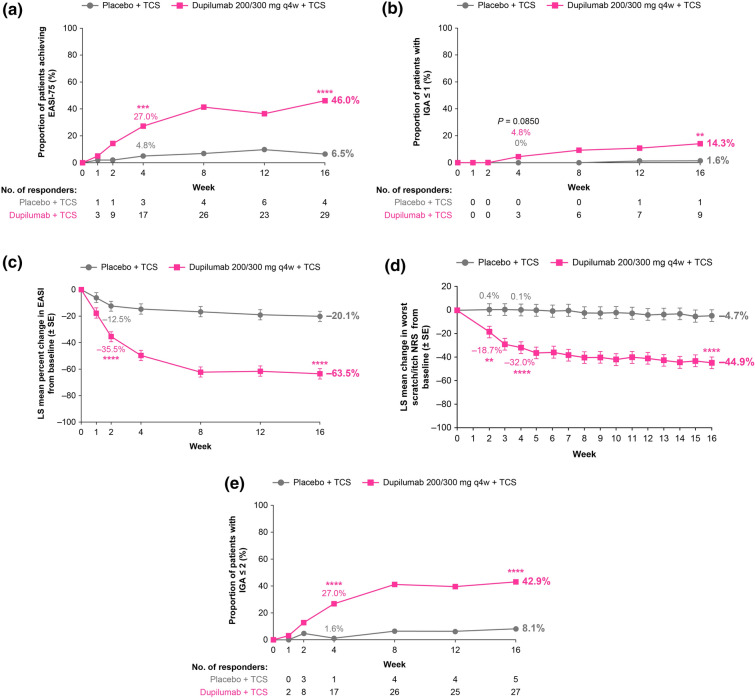
Results: The analysis included 125 patients (63 receiving dupilumab vs. 62 placebo). At week 16, significantly more patients receiving dupilumab vs. placebo had achieved IGA ≤ 1 (14.3% vs. 1.6%; P = 0.0085) and EASI-75 (46.0% vs. 6.6%; P < 0.0001). Significant improvements with dupilumab were observed in all secondary endpoints, including a least squares mean 48.9% reduction in pruritus. The overall incidence of adverse events (AEs) was similar between the dupilumab and placebo groups (66.7% vs. 73.8%). No dupilumab-related AEs were serious or led to treatment discontinuation.
Conclusion: Dupilumab significantly improved AD signs, symptoms and quality of life in children aged 6 months to 5 years with severe AD with acceptable safety.
Trial registration: The trial was registered with ClinicalTrials.gov with ID number NCT03346434, part B.
Keywords: Atopic dermatitis; Dupilumab; Eczema; Pediatric dermatology.
Plain language summary
Atopic dermatitis (AD) is a chronic skin disease that is relatively common in infants and young children worldwide. Severe AD causes skin rashes and intense itch that strongly interfere with sleep quality and normal daily activities, thereby affecting the quality of life of patients and their families. When therapies for AD that are applied to the skin do not work, limited options are available to treat severe AD in children younger than 6 years. In this study, we evaluated the efficacy and safety of dupilumab in children aged 6 months to 5 years with severe AD, recruited from various sites in Europe and North America. Patients received 200 or 300 mg of dupilumab (based on the child’s weight) or placebo, together with mild steroids applied to the skin, every 4 weeks for 16 weeks. At the end of treatment, AD severity was greatly improved in patients receiving dupilumab, with 14% of patients achieving almost clear skin. Patients receiving dupilumab also experienced significant improvements in itch intensity, sleep quality, skin pain, and quality of life. Furthermore, dupilumab did not increase the risk of infections. This study demonstrates that dupilumab can be effective at treating severe AD in infants and young children, with important benefits for the quality of life of patients and their families.
© 2024. The Author(s).
Conflict of interest statement
Amy S. Paller reports serving as an investigator, consultant and/or data and safety monitoring board member for AbbVie, Abeona Therapeutics, Amryt Pharma, Azitra, BioCryst, BMS, Boehringer Ingelheim, Castle Creek Biosciences, Catawba Research, Dermavant, Eli Lilly, Galderma, InMed Pharmaceuticals, Incyte, Janssen, Krystal Biotech, LEO Pharma, Novartis, Regeneron Pharmaceuticals Inc., Sanofi, Seanergy, TWi Biotechnology and UCB. Andreas Pinter reports working for AbbVie, Almirall Hermal, Amgen, Biogen Idec, BioNTech, Boehringer Ingelheim, Celgene, Celltrion, Eli Lilly, Galderma, GSK, Hexal, Janssen, Klinge Pharma, LEO Pharma, MC2 Pharma, Medac, Merck-Serono, Mitsubishi Tanabe Pharma, MSD, Novartis, Pascoe, Pfizer, Tigercat Pharma, Regeneron Pharmaceuticals Inc., Roche, Sandoz, Sanofi, Schering-Plough and UCB Pharma. Lara Wine Lee reports acting as an advisory board member consultant, investigator and/or speaker for AbbVie, Amgen, Amryt Pharma, Arcutis Biotherapeutics, Avita, Castle Creek Biosciences, Celgene, Eli Lilly, Galderma, Incyte, Janssen, Kimberly Clark, Kiniksa Pharmaceuticals, Krystal Biotech, Mayne Pharma, MoonLake Immunotherapeutics, Novartis, Pfizer, Regeneron Pharmaceuticals Inc., Sanofi, Target Pharma, Timber Pharmaceuticals, Trevi Therapeutics and UCB. Roland Aschoff reports working for AbbVie, Almirall Hermal, Biofrontera, Boehringer Ingelheim, BMS, BSN medical, Galderma, Janssen-Cilag, LEO Pharma, Lilly, Novartis, Pfizer, Sanofi and UCB. Jacek Zdybski reports serving as an investigator for Almirall, Amgen, BMS, Galderma, Incyte, Innovaderm, Pfizer, Regeneron Pharmaceuticals Inc. and Syneos Health. Christina Schnopp reports serving as lecturer and/or consultant for AbbVie, Amgen, Beiersdorf, Benevi, Celgene, Fortbildungskolleg GmbH, GSK, Galderma, HiPP Organic, InfectoPharm, La Roche-Posay, LEO Pharma, Leti Pharma, Lilly, MSD, Nestlé, Novartis, Nutricia, Pierre Fabre, Sanofi and Unna-Akademie. Amy Praestgaard, Randy Prescilla, and Mike Bastian are employees of and may hold stock and/or stock options in Sanofi. Ashish Bansal and Brad Shumel are employees and shareholders of Regeneron Pharmaceuticals Inc.
Figures
References
Publication types
MeSH terms
Substances
Associated data
LinkOut - more resources
Full Text Sources
Medical
Research Materials
Miscellaneous
