


Transcription factor Tcf21 modulates urinary bladder size and differentiation
- PMID: 38197329
- PMCID: PMC11457511
- DOI: 10.1111/dgd.12906
Transcription factor Tcf21 modulates urinary bladder size and differentiation
Abstract
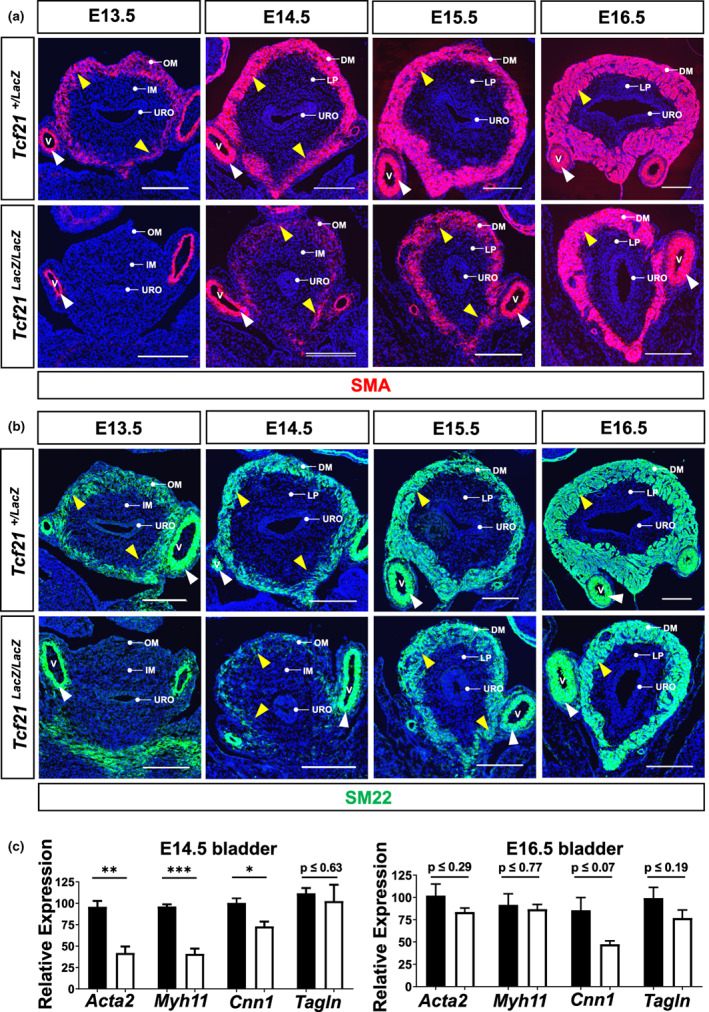
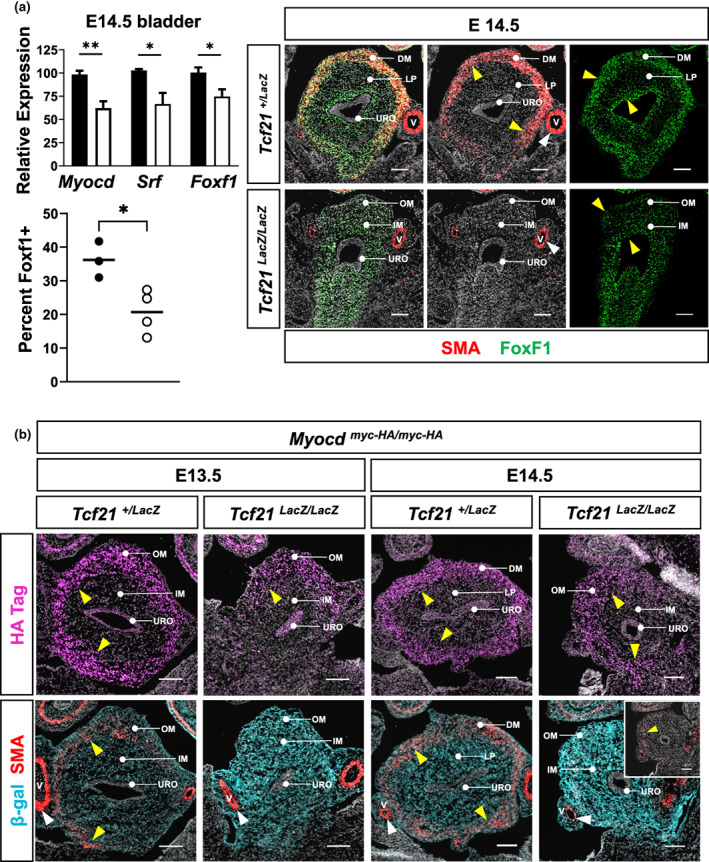
Urinary bladder organogenesis requires coordinated cell growth, specification, and patterning of both mesenchymal and epithelial compartments. Tcf21, a gene that encodes a helix-loop-helix transcription factor, is specifically expressed in the mesenchyme of the bladder during development. Here we show that Tcf21 is required for normal development of the bladder. We found that the bladders of mice lacking Tcf21 were notably hypoplastic and that the Tcf21 mutant mesenchyme showed increased apoptosis. There was also a marked delay in the formation of visceral smooth muscle, accompanied by a defect in myocardin (Myocd) expression. Interestingly, there was also a marked delay in the formation of the basal cell layer of the urothelium, distinguished by diminished expression of Krt5 and Krt14. Our findings suggest that Tcf21 regulates the survival and differentiation of mesenchyme cell-autonomously and the maturation of the adjacent urothelium non-cell-autonomously during bladder development.
Keywords: bladder; development; smooth muscle; transcription factor Tcf21; urothelium.
© 2024 The Authors. Development, Growth & Differentiation published by John Wiley & Sons Australia, Ltd on behalf of Japanese Society of Developmental Biologists.
Figures



References
-
- Acharya, A. , Baek, S. T. , Huang, G. , Eskiocak, B. , Goetsch, S. , Sung, C. Y. , Banfi, S. , Sauer, M. F. , Olsen, G. S. , Duffield, J. S. , Olson, E. N. , & Tallquist, M. D. (2012). The bHLH transcription factor Tcf21 is required for lineage‐specific EMT of cardiac fibroblast progenitors. Development, 139(12), 2139–2149. 10.1242/dev.079970 - DOI - PMC - PubMed
-
- Braitsch, C. M. , Combs, M. D. , Quaggin, S. E. , & Yutzey, K. E. (2012). Pod1/Tcf21 is regulated by retinoic acid signaling and inhibits differentiation of epicardium‐derived cells into smooth muscle in the developing heart. Developmental Biology, 368(2), 345–357. 10.1016/j.ydbio.2012.06.002 - DOI - PMC - PubMed
MeSH terms
Substances
LinkOut - more resources
Full Text Sources
Research Materials
Miscellaneous
