


Effects of MDMA-assisted therapy for PTSD on self-experience
- PMID: 38198456
- PMCID: PMC10781106
- DOI: 10.1371/journal.pone.0295926
Effects of MDMA-assisted therapy for PTSD on self-experience
Abstract
Introduction: There is a resurgence of interest in the therapeutic potential of psychedelic substances such as 3,4-methylenedioxymethamphetamine (MDMA). Primary findings from our randomized, double-blind, placebo-controlled, multi-site Phase 3 clinical trial of participants with severe PTSD (NCT03537014) showed that MDMA-assisted therapy induced significant attenuation in the Clinician-Administered PTSD Scale for DSM-5 compared to Therapy with placebo. Deficits in emotional coping skills and altered self-capacities constitute major obstacles to successful completion of available treatments. The current analysis evaluated the differential effects of MDMA-assisted therapy and Therapy with placebo on 3 transdiagnostic outcome measures and explored the contribution of changes in self-experience to improvement in PTSD scores.
Methods: Participants were randomized to receive manualized therapy with either MDMA or placebo during 3 experimental sessions in combination with 3 preparation and 9 integration therapy visits. Symptoms were measured at baseline and 2 months after the last experimental session using the 20-item Toronto Alexithymia Scale (TAS-20), the 26-item Self Compassion Scale (SCS), and the 63-item Inventory of Altered Self-Capacities (IASC).
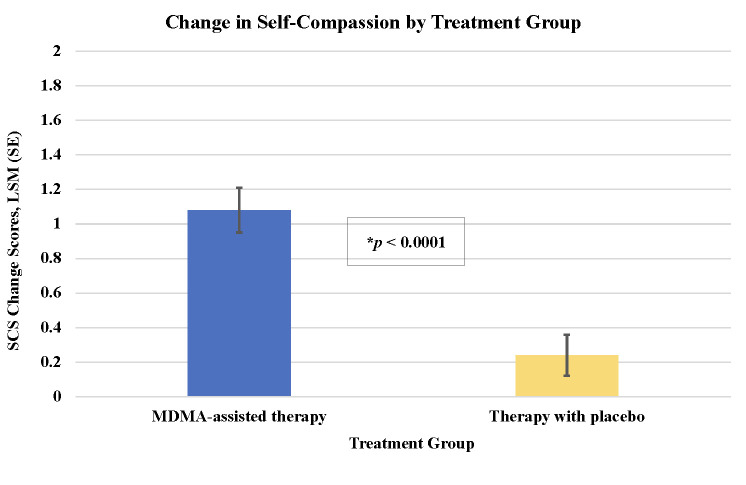
Results: 90 participants were randomized and dosed (MDMA-assisted therapy, n = 46; Therapy with placebo, n = 44); 84.4% (76/90) had histories of developmental trauma, and 87.8% (79/90) had suffered multiple traumas. MDMA-assisted therapy facilitated statistically significant greater improvement on the TAS-20, the SCS, and most IASC factors of interpersonal conflicts; idealization disillusionment; abandonment concerns; identity impairment; self-awareness; susceptibility to influence; affect dysregulation; affect instability; affect skill deficit; tension reduction activities; the only exception was identity diffusion.
Conclusion: Compared with Therapy with placebo, MDMA-assisted therapy had significant positive effects on transdiagnostic mental processes of self-experience which are often associated with poor treatment outcome. This provides a possible window into understanding the psychological capacities facilitated by psychedelic agents that may result in significant improvements in PTSD symptomatology.
Copyright: This is an open access article, free of all copyright, and may be freely reproduced, distributed, transmitted, modified, built upon, or otherwise used by anyone for any lawful purpose. The work is made available under the Creative Commons CC0 public domain dedication.
Conflict of interest statement
The authors have declared that no competing interests exist.
Figures



References
-
- Oehen P, Traber R, Widmer V, Schnyder U. A randomized, controlled pilot study of MDMA (+/- 3,4-Methylenedioxymethamphetamine)-assisted psychotherapy for treatment of resistant, chronic Post-Traumatic Stress Disorder (PTSD). Journal of psychopharmacology (Oxford, England). 2013;27(1):40–52. Epub 2012/11/03. doi: 10.1177/0269881112464827 . - DOI - PubMed
-
- Jerome L, Feduccia AA, Wang JB, Hamilton S, Yazar-Klosinski B, Emerson A, et al.. Long-term follow-up outcomes of MDMA-assisted psychotherapy for treatment of PTSD: a longitudinal pooled analysis of six phase 2 trials. Psychopharmacology. 2020;237(8):2485–97. Epub 2020/06/06. doi: 10.1007/s00213-020-05548-2 . - DOI - PMC - PubMed
