. 2024 Jan 10;14(1):21.
doi: 10.1038/s41398-023-02707-9.

Targeting suicidal ideation in major depressive disorder with MRI-navigated Stanford accelerated intelligent neuromodulation therapy

Affiliations

Targeting suicidal ideation in major depressive disorder with MRI-navigated Stanford accelerated intelligent neuromodulation therapy

Baojuan Li et al. Transl Psychiatry. .

Abstract

High suicide risk represents a serious problem in patients with major depressive disorder (MDD), yet treatment options that could safely and rapidly ameliorate suicidal ideation remain elusive. Here, we tested the feasibility and preliminary efficacy of the Stanford Accelerated Intelligent Neuromodulation Therapy (SAINT) in reducing suicidal ideation in patients with MDD. Thirty-two MDD patients with moderate to severe suicidal ideation participated in the current study. Suicidal ideation and depression symptoms were assessed before and after 5 days of open-label SAINT. The neural pathways supporting rapid-acting antidepressant and suicide prevention effects were identified with dynamic causal modelling based on resting-state functional magnetic resonance imaging. We found that 5 days of SAINT effectively alleviated suicidal ideation in patients with MDD with a high response rate of 65.63%. Moreover, the response rates achieved 78.13% and 90.63% with 2 weeks and 4 weeks after SAINT, respectively. In addition, we found that the suicide prevention effects of SAINT were associated with the effective connectivity involving the insula and hippocampus, while the antidepressant effects were related to connections of the subgenual anterior cingulate cortex (sgACC). These results show that SAINT is a rapid-acting and effective way to reduce suicidal ideation. Our findings further suggest that distinct neural mechanisms may contribute to the rapid-acting effects on the relief of suicidal ideation and depression, respectively.


Conflict of interest statement

The authors declare no competing interests.

Figures
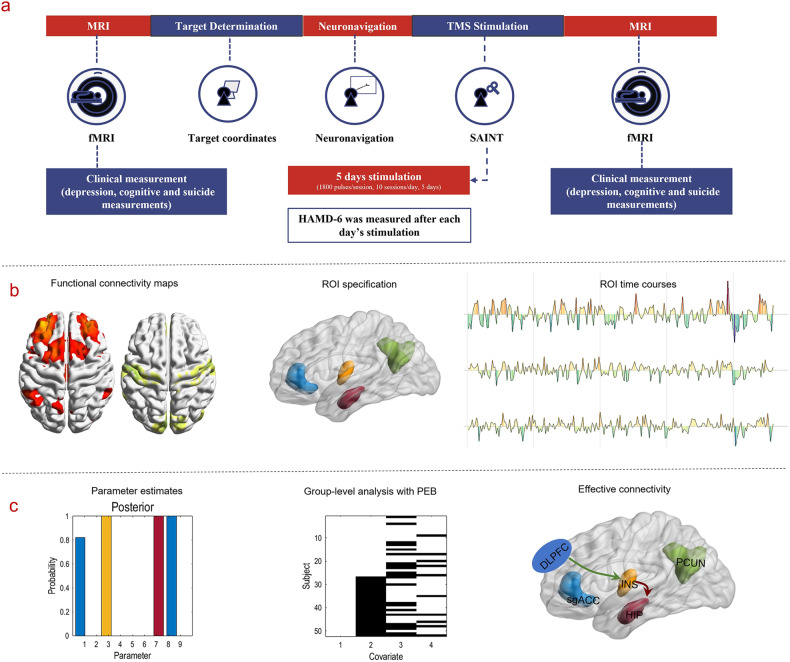
Fig. 1
Fig. 1. Workflow for the whole study.
a Flowchart of the trial. b Target-based functional connectivity profiles and ROIs selection for the following effective connectivity analysis. c Illustrations of dynamic causal modeling for effective connectivity analysis.
Fig. 2
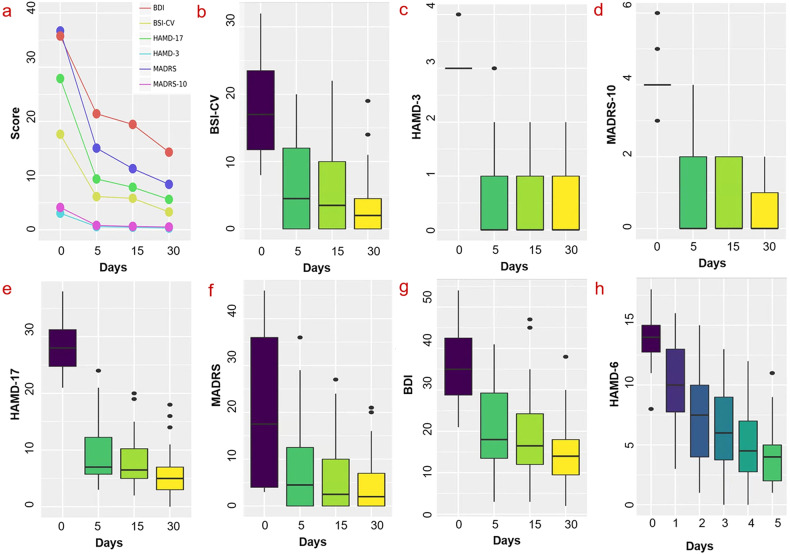
Fig. 2. Changes in scale score during and after SAINT in MDD patients with suicidal ideation.
a, b Significant decrease in the BSI-CV (F = 81.34, df = 2, 61, p < 0.001). a, c Significant decrease in item 3 of the HAMD-17 (F = 317.90, df = 2, 66, p < 0.001). a, d Significant decrease in item 10 of the MADRS (F = 314.72, df = 2, 64, p < 0.001). a, e Significant decrease in HAMD-17 (F = 267.30, df = 3, 93, p < 0.001). a, f Significant decrease in MADRS (F = 351.73, df = 2, 68, p < 0.001). a, g Significant decrease in BDI (F = 67.99, df = 3, 93, p < 0.001). a, h A significant effect of day on mean HAMD-6 scores (F = 102.67, df = 3, 95, p < 0.001). ***p < 0.001; BSI-CV: Chinese Version of the Beck Scale for Suicidal Ideation. HAMD-3: the 3rd item of HAMD-17; MADRS-10: the 10th item of Montgomery–Asberg Depression Rating Scale; HAMD-17: 17-item HAMD; MADRS: Montgomery–Asberg Depression Rating Scale; BDI: Beck Depression Inventory; HAMD-6: 6-item Hamilton Depression Rating Scale.
Fig. 3
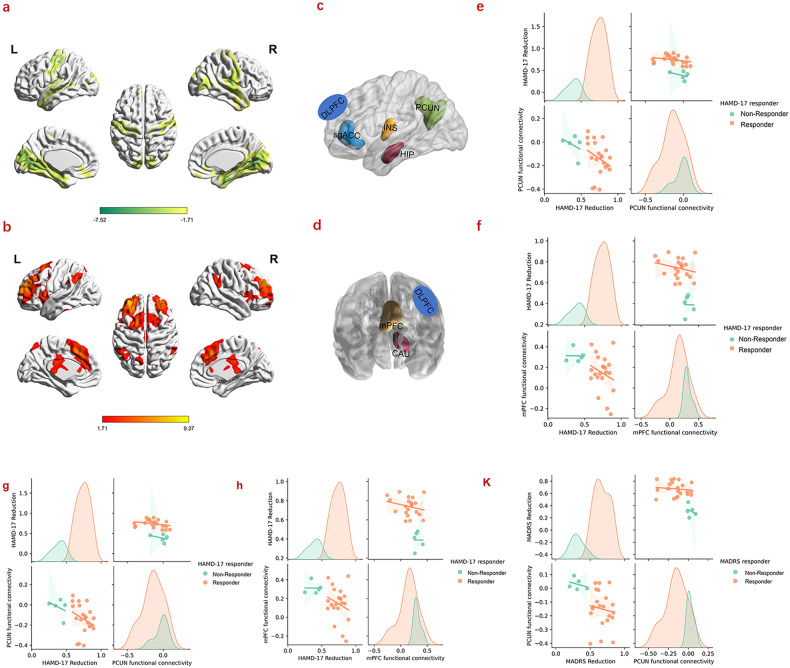
Fig. 3. Target-based functional connectivity profiles and the correlations between functional connectivity and clinical scores.
a Positive functional connectivity profiles of stimulation target. b Negative functional connectivity profiles of stimulation target. c Selected negative connectivity ROIs based on BNA templates. d Selected positive functional connectivity ROIs based on BNA templates. e, f Correlations between the baseline functional connectivity of the PCUN and mPFC and reductions in HAMD-17 scores. g, h Correlations between the reductions in HAMD-17 and the functional connectivity of the PCUN (p = 0.033) and mPFC (p = 0.030) after treatment. K Correlation between the reduction in MADRS and the functional connectivity of the PCUN (p = 0.015); to directly visualize the differences of the correlations between responders and non-responders, the correlation distributions of responders and non-responders were also plotted, respectively. BNA: Brainnetome Atlas.
Fig. 4
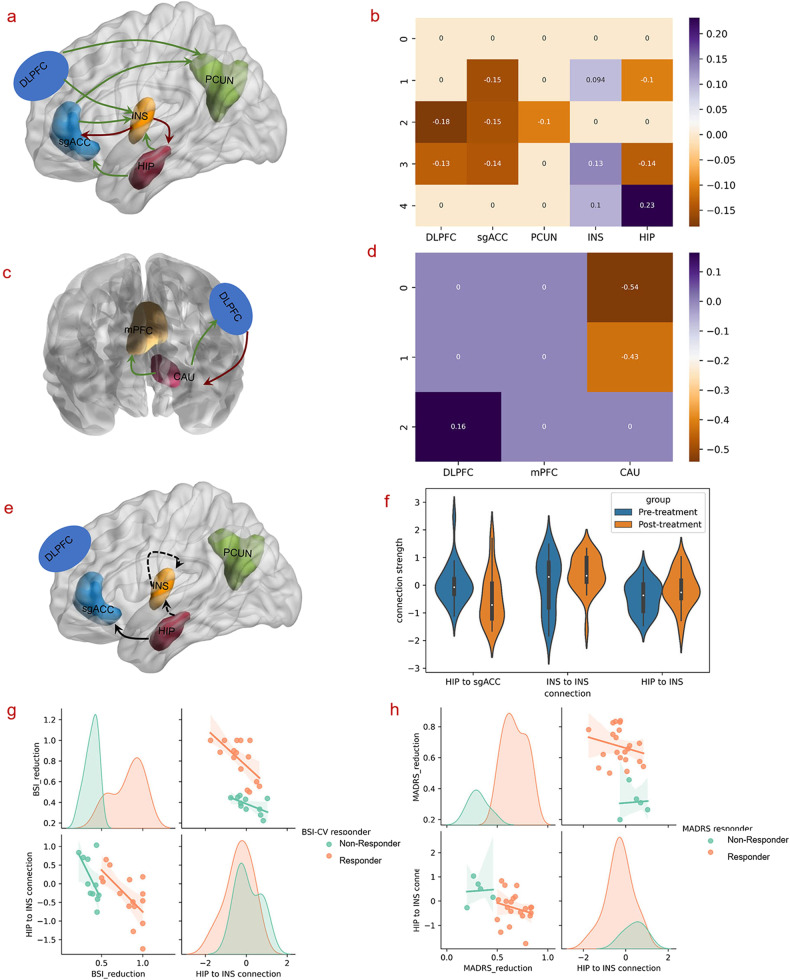
Fig. 4. The commonalities and differences of effective connectivity and correlations between effective connectivity and clinical scores; negative value represents inhibitory effects, while positive value indicates excitatory influences.
a, b Commonalities of the effective connectivity between the pre- and pot-treatment in NCECM. c, d Commonalities of the effective connectivity between the pre- and post-treatment in PCECM. e, f Significant differences of the effective connectivity between the pre- and post-treatment in NCECM. g Anti-correlation between the reduction in BSI-CV scores and the effective connectivity from the HIP to the INS (p = 0.001). h Anti-correlation between the reduction in MADRS scores and the effective connectivity from the HIP to the INS (p = 0.021); same as Fig. 3, to directly visualize the differences of the correlations between responders and non-responders, the correlation distributions of responders and non-responders were also plotted, respectively (g, h).
Fig. 5
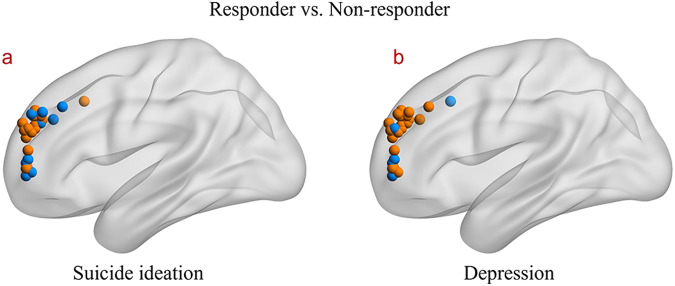
Fig. 5. The distribution of the stimulation targets.
a The distribution of the stimulation targets for responders and non-responders to suicidal ideation. b The distribution of the stimulation targets for responders and non-responders to depression. Color orange represents the stimulation targets of responders, while the blue indicates non-responders.
Fig. 6
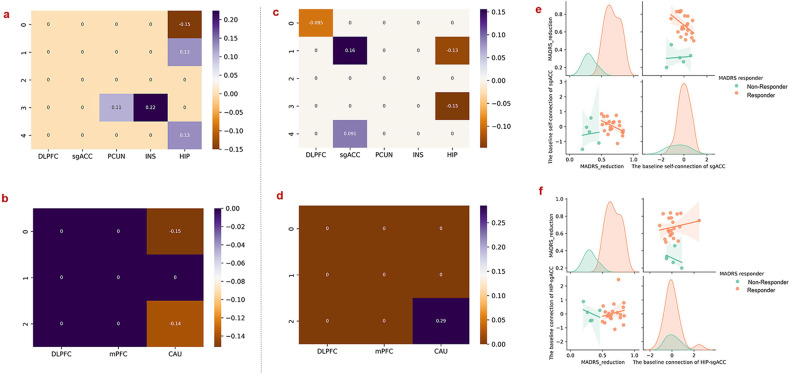
Fig. 6. Differences in effective connectivity between responders and non-responders to suicidal ideation and depression symptoms, respectively and the correlations between effective connectivity and clinical scores.
a, b Differences in effective connectivity of the responders and non-responders to suicidal ideation in NCECM and PCECM. c, d Correlations between the reductions in MADRS score and the effective connectivity after 5-day treatment. e, f Correlations between the reduction in MADRS scores and the baseline self-connection of the sgACC (p = 0.033) and the connection of HIP-sgACC (p = 0.040); same as Fig. 3 and Fig. 4, to directly visualize the differences of the correlations between responders and non-responders, the correlation distributions of responders and non-responders were also plotted, respectively (e, f).

References

    1. Otte C, Gold SM, Penninx BW, Pariante CM, Etkin A, Fava M, et al. Major depressive disorder. Nat Rev Dis Prim. 2016;2:16065. doi: 10.1038/nrdp.2016.65. - DOI - PubMed
    1. Otte C, Gold SM, Penninx BW, Pariante CM, Etkin A, Fava M, et al. Major depressive disorder. Nat Rev Dis Prim. 2016;2:1–20. - PubMed
    1. Association AP. Diagnostic and statistical manual of mental disorders. 5th ed. Arlington, VA: American Psychiatric Publishing; 2013.
    1. Dong M, Zeng LN, Lu L, Li XH, Ungvari GS, Ng CH, et al. Prevalence of suicide attempt in individuals with major depressive disorder: a meta-analysis of observational surveys. Psychol Med. 2019;49:1691–704. doi: 10.1017/S0033291718002301. - DOI - PubMed
    1. Sokero TP, Melartin TK, Rytsälä HJ, Leskelä US, Lestelä-Mielonen PS, Isometsä ET. Suicidal ideation and attempts among psychiatric patients with major depressive disorder. J Clin Psychiatry. 2003;64:1094–1100. doi: 10.4088/JCP.v64n0916. - DOI - PubMed

MeSH terms

Substances