


Retinopathy of Prematurity in Very Low Birthweight Neonates of Gestation Less Than 32 weeks in Malaysia
- PMID: 38200381
- PMCID: PMC11845399
- DOI: 10.1007/s12098-023-04997-9
Retinopathy of Prematurity in Very Low Birthweight Neonates of Gestation Less Than 32 weeks in Malaysia
Abstract
Objectives: To determine the screening rates and incidence of retinopathy of prematurity (ROP), and risk factors associated with ROP in very low birthweight (VLBW, <1500 g) neonates of gestation <32 wk admitted to neonatal intensive care units (NICUs) in a middle-income country.
Methods: It was a retrospective cohort study of prospectively submitted data by 44 Malaysian NICUs participating in the Malaysian National Neonatal Registry. All VLBW neonates of gestation <32 wk born in 2015-2020 and survived to discharge were included.
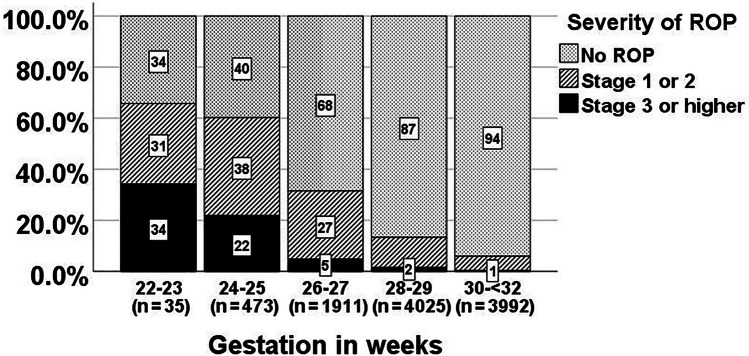
Results: Of 11768 survivors, 90.5% (n = 10436) had ROP screening; 16.1% (1685/10436) had ROP. ROP was significantly more common in neonates <28 wk gestation (extremely preterm, EPT) than ≥28 wk gestation (37.7% vs. 9.7%; p <0.001), and more common in those with birthweight <1000 g (extremely low birthweight, ELBW) than ≥1000 g (32.9% vs. 9.1%; p <0.001). Multiple logistic regression analysis showed that the significant independent factors associated with increased risk of ROP were ELBW, EPT, Indian ethnic group, vaginal delivery, mechanical ventilation >5 d, high frequency ventilation, total parenteral nutrition, late-onset sepsis, bronchopulmonary dysplasia, and intraventricular hemorrhage. Receiving oxygen therapy at birth was associated with significantly lower risk of ROP.
Conclusions: The incidence and severity of ROP increased with decreasing gestation and birthweight. Prolonged duration of oxygen therapy, infection, invasive respiratory support, and conditions commonly causing fluctuations of oxygenation were significant factors associated with increased risk of ROP. Receiving oxygen at birth did not increase risk.
Keywords: Extremely preterm; Malaysia; Retinopathy of prematurity; Risk factors; Very low birthweight; Very preterm.
© 2024. The Author(s).
Conflict of interest statement
Declarations. Conflict of Interest: None.
Figures

References
-
- Harrell SN, Brandon DH. Retinopathy of prematurity: the disease process, classifications, screening, treatment, and outcome. Neonatal Netw. 2007;26:371–8. - PubMed
-
- Rahi JS, Cable N; British Childhood Visual Impairment Study Group (BCVISG). Severe visual impairment and blindness in children in the UK. Lancet. 2003;362:1359–65. - PubMed
-
- Phleps DL. Retinopathy of prematurity: history, classification, and pathophysiology. NeoReviews. 2001;2:e153–66.
-
- Darlow BA, Hutchinson JL, Henderson-Smart DJ, Donoghue DA, Simpson JM, Evans NJ; Australian and New Zealand Neonatal Network. Prenatal risk factors for severe retinopathy of prematurity among very preterm infants of the Australian and New Zealand Neonatal Network. Pediatrics. 2005;115:990–6. - PubMed
MeSH terms
LinkOut - more resources
Full Text Sources
