


Post-Thaw Storage Temperature Influenced Boar Sperm Quality and Lifespan through Apoptosis and Lipid Peroxidation
- PMID: 38200818
- PMCID: PMC10778526
- DOI: 10.3390/ani14010087
Post-Thaw Storage Temperature Influenced Boar Sperm Quality and Lifespan through Apoptosis and Lipid Peroxidation
Abstract
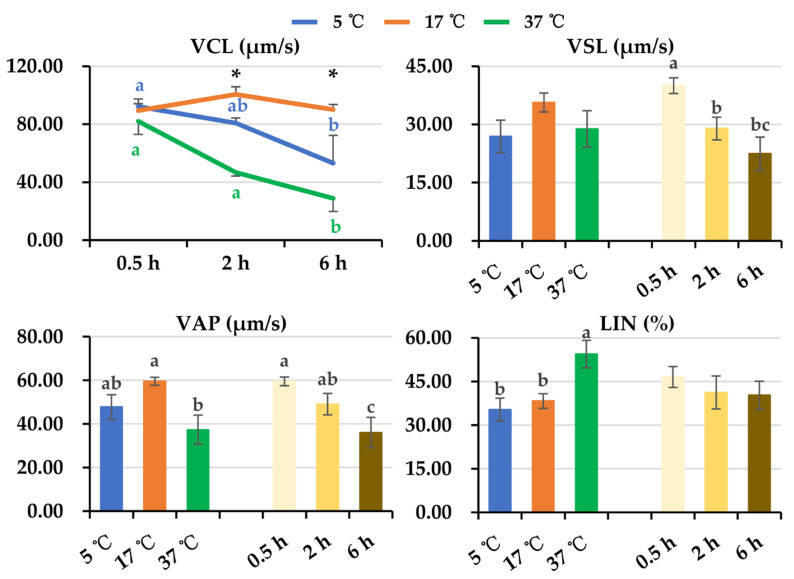
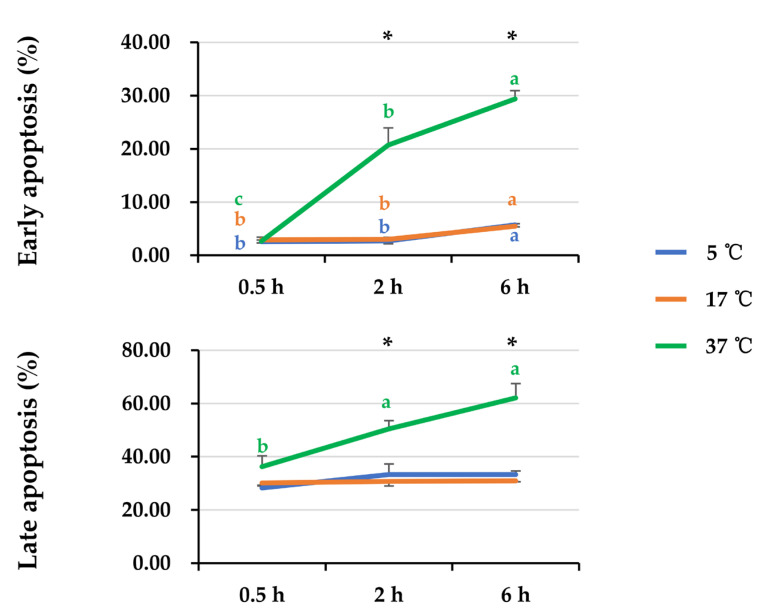
Cryopreservation deteriorates boar sperm quality and lifespan, which restricts the use of artificial insemination with frozen-thawed boar semen in field conditions. The objective of this study was to test the effects of post-thaw storage time and temperature on boar sperm survival. Semen ejaculates from five Landrace boars (one ejaculate per boar) were collected and frozen following a 0.5 mL-straw protocol. Straws from the five boars were thawed and diluted 1:1 (v:v) in BTS. The frozen-thawed semen samples were aliquoted into three parts and respectively stored at 5 °C, 17 °C, and 37 °C for up to 6 h. At 0.5, 2, and 6 h of storage, sperm motility, viability, mitochondrial membrane potential, and intracellular reactive oxygen species (ROS) levels and apoptotic changes were measured. Antioxidant and oxidant levels were tested in boar sperm (SPZ) and their surrounding environment (SN) at each timepoint. The results showed significant effects of post-thaw storage time and temperature and an impact on boar sperm quality (total and progressive motility, VCL, viability, acrosome integrity), early and late sperm apoptotic changes, and changes in MDA levels in SPZ and SN. Compared to storage at 5 °C and 37 °C, frozen-thawed semen samples stored at 17 °C displayed better sperm quality, less apoptotic levels, and lower levels of SPZ MDA and SN MDA. Notably, post-thaw storage at 17 °C extended boar sperm lifespan up to 6 h without obvious reduction in sperm quality. In conclusion, storage of frozen-thawed boar semen at 17 °C preserves sperm quality for up to 6 h, which facilitates the use of cryopreserved boar semen for field artificial insemination.
Keywords: apoptosis; boar semen cryopreservation; oxidative stress; post-thaw storage; sperm survival.
Conflict of interest statement
Author Shuaibiao Wang was employed by the company DanAg Agritech Consulting (Zhengzhou) Co., Ltd. The remaining authors declare that the research was conducted in the absence of any commercial or financial relationships that could be construed as a potential conflict of interest. The funders had no role in the design of the study; the collection, analysis, or interpretation of data; writing the manuscript; or the decision to publish the results.
Figures





References
-
- Masuda Y., Kheawkanha T., Nagahama A., Kawasaki K., Konno T., Yamanaka K., Tatemoto H. Antifreeze protein type III addition to freezing extender comprehensively improves post-thaw sperm properties in Okinawan native Agu pig. Anim. Reprod. Sci. 2023;252:107232. doi: 10.1016/j.anireprosci.2023.107232. - DOI - PubMed
-
- Pedrosa A.C., Andrade Torres M., Vilela Alkmin D., Pinzon J.E.P., Kitamura Martins S.M.M., Coelho da Silveira J., Furugen Cesar de Andrade A. Spermatozoa and seminal plasma small extracellular vesicles miRNAs as biomarkers of boar semen cryotolerance. Theriogenology. 2021;174:60–72. doi: 10.1016/j.theriogenology.2021.07.022. - DOI - PubMed
Grants and funding
- 32002355/National Natural Science Foundation of China
- BK20200933/Jiangsu Provincial Natural Science Foundation of China
- JSSCTD202224/Jiangsu Shuangchuang Innovation Group Project
- 2020SY003YD12/Jiangsu Province Modern Agriculture Development Project
- PAPD/A Project Funded by the Priority Academic Program Development of Jiangsu Higher Education Institutions
LinkOut - more resources
Full Text Sources
Miscellaneous
