


Dose-Dependent Effects of Supplementing a Two-Strain Bacillus subtilis Probiotic on Growth Performance, Blood Parameters, Fecal Metabolites, and Microbiome in Nursery Pigs
- PMID: 38200840
- PMCID: PMC10777967
- DOI: 10.3390/ani14010109
Dose-Dependent Effects of Supplementing a Two-Strain Bacillus subtilis Probiotic on Growth Performance, Blood Parameters, Fecal Metabolites, and Microbiome in Nursery Pigs
Abstract
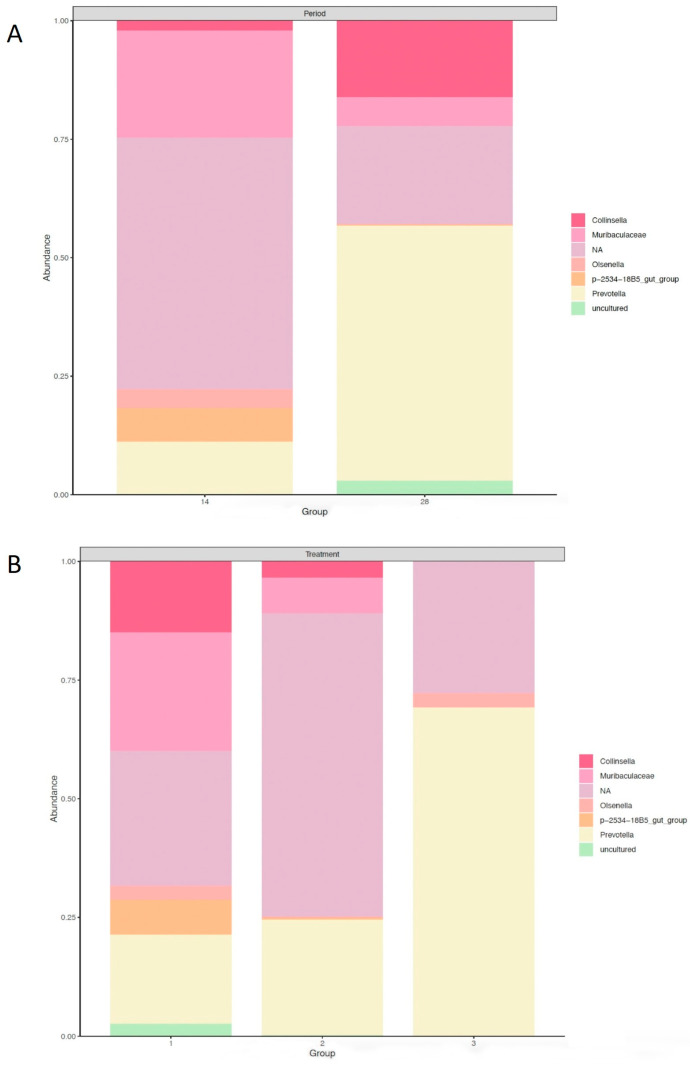
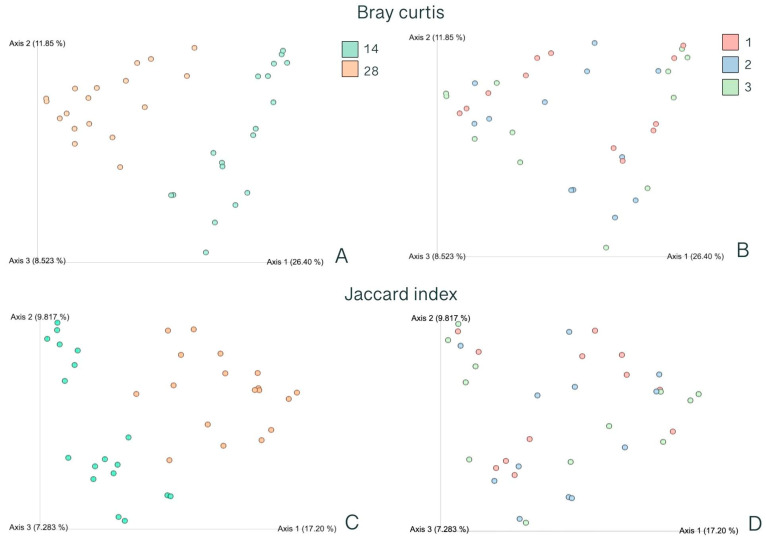
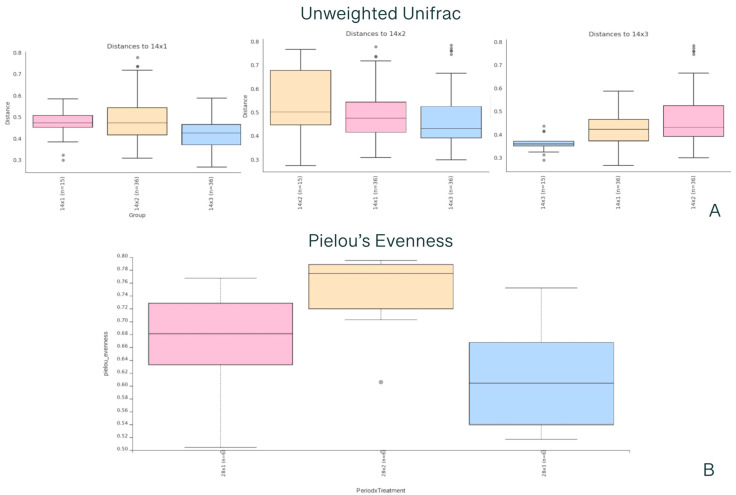
This experiment was conducted to evaluate the effects of dietary supplementation level of a two-strain Bacillus subtilis probiotic on growth performance, blood parameters, fecal metabolites, and microbiome in nursery pigs. A total of 54 weaned piglets were allotted to three treatments in three replicate pens with six pigs/pen for a 28 d feeding trial. The treatments were as follows: control: no probiotic supplementation; Pro1x: B. subtilis supplementation at 1.875 × 10⁵ CFU/g diet; and Pro10x: B. subtilis supplementation at 1.875 × 10⁶ CFU/g diet. Body weight at d 14 postweaning (p = 0.06) and average daily gain for d 0 to 14 postweaning (p < 0.05) were greater in the Pro1x treatment than in the other treatments. Blood glucose levels were greater in both probiotic treatments than in the control treatment at d 14 postweaning (p < 0.05). In the fecal short-chain fatty acid (SCFA) concentrations, the butyrate concentrations were greater in the Pro1x treatment than in the other treatments (p < 0.05), and the acetate, propionate, and total SCFA concentrations were greater in the Pro1x treatment than in the Pro10x treatment (p < 0.05). The beta diversity of fecal microbiome composition at d 14 postweaning based on Unweighted Unifrac analysis was dissimilar between the Pro1x and Pro10x treatments (p < 0.05). In conclusion, dietary B. subtilis supplementation of two strains selected to reduce effects of pathogenic Escherichia coli to nursery diets at 1.875 × 10⁵ CFU/g diet improved the growth rate in the early postweaning period, increased fecal SCFA concentrations and altered the fecal microbial community composition. A higher dose of B. subtilis did not improve the performance parameters over those of the control piglets.
Keywords: Bacillus subtilis; growth; pigs; short-chain fatty acids; supplementation level; weaning.
Conflict of interest statement
The authors declare no conflict of interest except that A.H.S., S.H. and S.J.W. are employees of Arm & Hammer Animal and Food Production.
Figures
References
-
- Vieira A.M., Sessin A.P., Soratto T.A.T., Pires P.G.D.S., Cardinal K.M., Wagner G., Hauptli L., Lima A.L.F., Dahlke F., Netto D.P., et al. Effect of functional oils or probiotics on performance and microbiota profile of newly weaned piglets. Sci. Rep. 2021;11:19457. doi: 10.1038/s41598-021-98549-w. - DOI - PMC - PubMed
-
- Jang Y.D., Oh H.K., Piao L.G., Choi H.B., Yun J.H., Kim Y.Y. Evaluation of probiotics as an alternative to antibiotic on growth performance, nutrient digestibility, occurrence of diarrhea and immune response in weaning pigs. J. Anim. Sci. Technol. 2009;51:25–32. doi: 10.5187/JAST.2009.51.1.025. - DOI
Grants and funding
LinkOut - more resources
Full Text Sources
Medical
