


Effects of Immunocastration and Amino Acid Supplementation on Yearling Fallow Deer (Dama dama) Testes Development
- PMID: 38200846
- PMCID: PMC10778327
- DOI: 10.3390/ani14010115
Effects of Immunocastration and Amino Acid Supplementation on Yearling Fallow Deer (Dama dama) Testes Development
Abstract
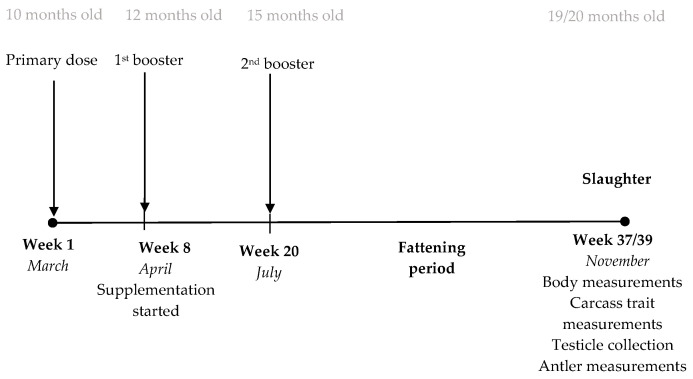
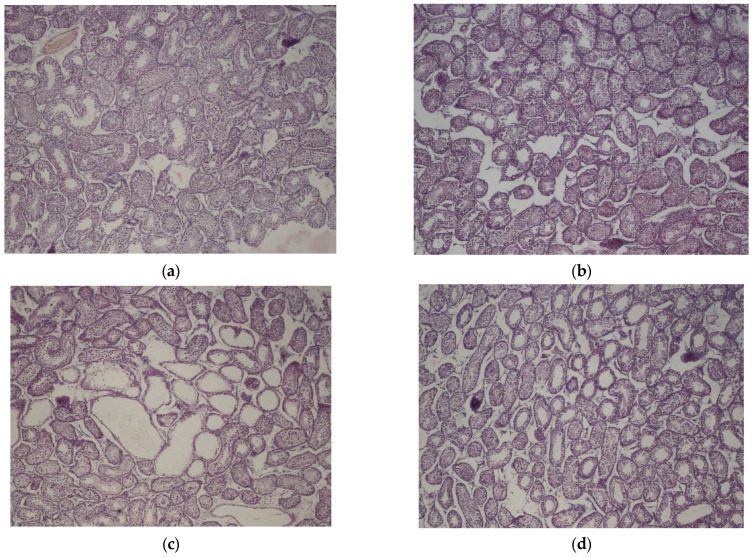
Forty-four fallow deer bucks (10 months old; 22.9 ± 2.4 kg) were utilized to investigate the effects of immunocastration and amino acid supplementation on testes development. Immunocastrated bucks were administered Improvac® at weeks 1, 8, and 20 of this study (control group: intact males). Starting at week 8, half of each sex received rumen-protected lysine and methionine (3:1) supplementation. At slaughter (week 37/39), body size, internal fat deposits, antler size parameters, testes weight, testes surface color, cauda epididymal sperm viability and morphology, and seminiferous tubule circumference and epithelium thickness were determined. Animals with larger body sizes, greater forequarter development, and antler growth also had greater testes development. Whilst the result of immunocastration on testes size is unexpected, testes tissue showed impaired development (atrophied seminiferous tubules), decreased sperm viability, and normal morphology. Testes tissue from immunocastrated deer was less red, possibly indicating reduced blood supply. Conversely, amino acid supplementation increased testes' redness and sperm viability, and intact males fed amino acids showed the greatest seminiferous tubule development. Thus, immunocastration may be a welfare-friendly alternative for venison production. Whilst the results support findings from the literature that testes size is not a reliable indicator of immunocastration success, this warrants further investigation in deer over different physiological development stages.
Keywords: castration; cervid; nutrition; sperm; venison; welfare.
Conflict of interest statement
The authors state that there are no existing financial or personal conflicts of interest; additionally, the funders had no role in the design of this study; in the collection, analyses, or interpretation of data; in the writing of the manuscript; or in the decision to publish the results.
Figures
References
-
- Dahlan I., Norfarizan Hanoon N.A. Chemical composition, palatability, and physical characteristics of venison from farmed deer. Anim. Sci. J. 2008;79:498–503. doi: 10.1111/j.1740-0929.2008.00555.x. - DOI
-
- Castration of Male Deer—Fact Sheet. [(accessed on 13 March 2023)]. Available online: https://www.deerfarming.com.au/wp-content/uploads/2016/11/14-Castration.pdf.
-
- Bykowska M. Influence of selected factors on meat quality from farm-raised and wild fallow deer (Dama dama): A review. Can. J. Anim. Sci. 2018;98:405–415. doi: 10.1139/cjas-2017-0146. - DOI
-
- Langbein J., Chapman N. Fallow Deer. The Mammal Society and The British Deer Society; London, UK: 2003.
Grants and funding
LinkOut - more resources
Full Text Sources
