


Evaluation of Long-Read Sequencing Simulators to Assess Real-World Applications for Food Safety
- PMID: 38201044
- PMCID: PMC10778541
- DOI: 10.3390/foods13010016
Evaluation of Long-Read Sequencing Simulators to Assess Real-World Applications for Food Safety
Abstract
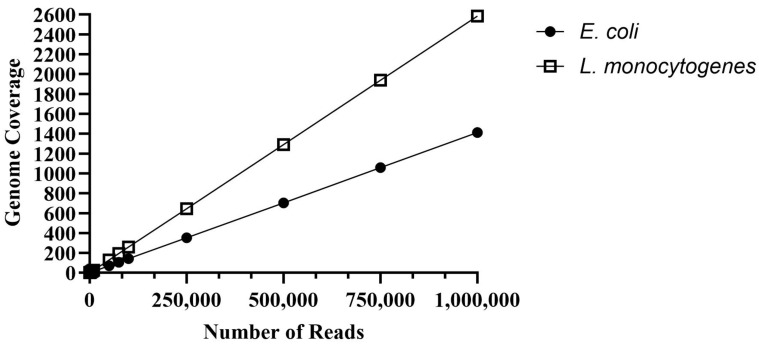
Shiga toxin-producing Escherichia coli (STEC) and Listeria monocytogenes are routinely responsible for severe foodborne illnesses in the United States. Current identification methods utilized by the U.S. Food Safety Inspection Service require at least four days to identify STEC and six days for L. monocytogenes. Adoption of long-read, whole genome sequencing for food safety testing could significantly reduce the time needed for identification, but method development costs are high. Therefore, the goal of this project was to use NanoSim-H software to simulate Oxford Nanopore sequencing reads to assess the feasibility of sequencing-based foodborne pathogen detection and guide experimental design. Sequencing reads were simulated for STEC, L. monocytogenes, and a 1:1 combination of STEC and Bos taurus genomes using NanoSim-H. At least 2500 simulated reads were needed to identify the seven genes of interest targeted in STEC, and at least 500 reads were needed to detect the gene targeted in L. monocytogenes. Genome coverage of 30x was estimated at 21,521, and 11,802 reads for STEC and L. monocytogenes, respectively. Approximately 5-6% of reads simulated from both bacteria did not align with their respective reference genomes due to the introduction of errors. For the STEC and B. taurus 1:1 genome mixture, all genes of interest were detected with 1,000,000 reads, but less than 1x coverage was obtained. The results suggested sample enrichment would be necessary to detect foodborne pathogens with long-read sequencing, but this would still decrease the time needed from current methods. Additionally, simulation data will be useful for reducing the time and expense associated with laboratory experimentation.
Keywords: Bos taurus; Listeria monocytogenes; Shiga toxin-producing Escherichia coli O157:H7; foodborne pathogens; virulence genes.
Conflict of interest statement
The authors declare no conflict of interest.
Figures
References
-
- Questions and Answers. E. coli Homepage. [(accessed on 11 May 2023)];2014 Available online: https://www.cdc.gov/ecoli/general/index.html.
-
- Summary of Recall Cases in Calendar Year 2021. Food Safety. [(accessed on 11 May 2023)];2022 Available online: https://www.fsis.usda.gov/food-safety/recalls-public-health-alerts/annua....
-
- Hoffmann S., Ahn J. Economic Cost of Major Foodborne Illnesses Increased $2 Billion from 2013 to 2018. [(accessed on 11 May 2023)];2021 Available online: https://www.ers.usda.gov/amber-waves/2021/april/economic-cost-of-major-f...
Grants and funding
LinkOut - more resources
Full Text Sources
