


GLP1 Receptor Agonists-Effects beyond Obesity and Diabetes
- PMID: 38201269
- PMCID: PMC10778154
- DOI: 10.3390/cells13010065
GLP1 Receptor Agonists-Effects beyond Obesity and Diabetes
Abstract
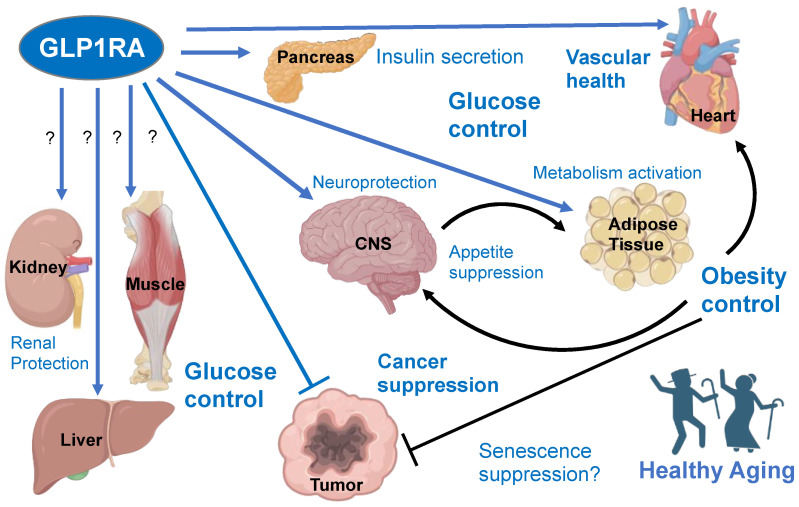
Glucagon-like peptide-1 receptor agonists (GLP1RA) have been transformative for patients and clinicians in treating type-2 diabetes and obesity. Drugs of this class, the bioavailability of which is continuously improving, enable weight loss and control blood glucose with minimal unwanted side effects. Since adopting GLP1RA for treating metabolic diseases, animal and clinical studies have revealed their beneficial effects on several other pathologies, including cardiovascular diseases, neurodegeneration, kidney disease, and cancer. A notable commonality between these diseases is their association with older age. Clinical trials and preclinical data suggest that GLP1RA may improve outcomes in these aging-related diseases. Some of the benefits of GLP1RA may be indirect due to their effects on obesity and glucose metabolism. However, there is building evidence that GLP1RA may also act directly on multiple organs implicated in aging-related pathology. This review aims to compile the studies reporting the effects of GLP1RA on aging-related diseases and discuss potential underlying mechanisms.
Keywords: GLP-1 receptor agonist; aging; cancer; cardiovascular disease; diabetes; incretin; neurodegenerative disease; obesity.
Conflict of interest statement
The authors declare no conflict of interest.
Figures
References
-
- Knudsen L.B., Nielsen P.F., Huusfeldt P.O., Johansen N.L., Madsen K., Pedersen F.Z., Thogersen H., Wilken M., Agerso H. Potent derivatives of glucagon-like peptide-1 with pharmacokinetic properties suitable for once daily administration. J. Med. Chem. 2000;43:1664–1669. doi: 10.1021/jm9909645. - DOI - PubMed
Publication types
MeSH terms
Substances
Grants and funding
LinkOut - more resources
Full Text Sources
Medical
