


Combining State-of-the-Art Pre-Trained Deep Learning Models: A Noble Approach for Skin Cancer Detection Using Max Voting Ensemble
- PMID: 38201399
- PMCID: PMC10795598
- DOI: 10.3390/diagnostics14010089
Combining State-of-the-Art Pre-Trained Deep Learning Models: A Noble Approach for Skin Cancer Detection Using Max Voting Ensemble
Abstract
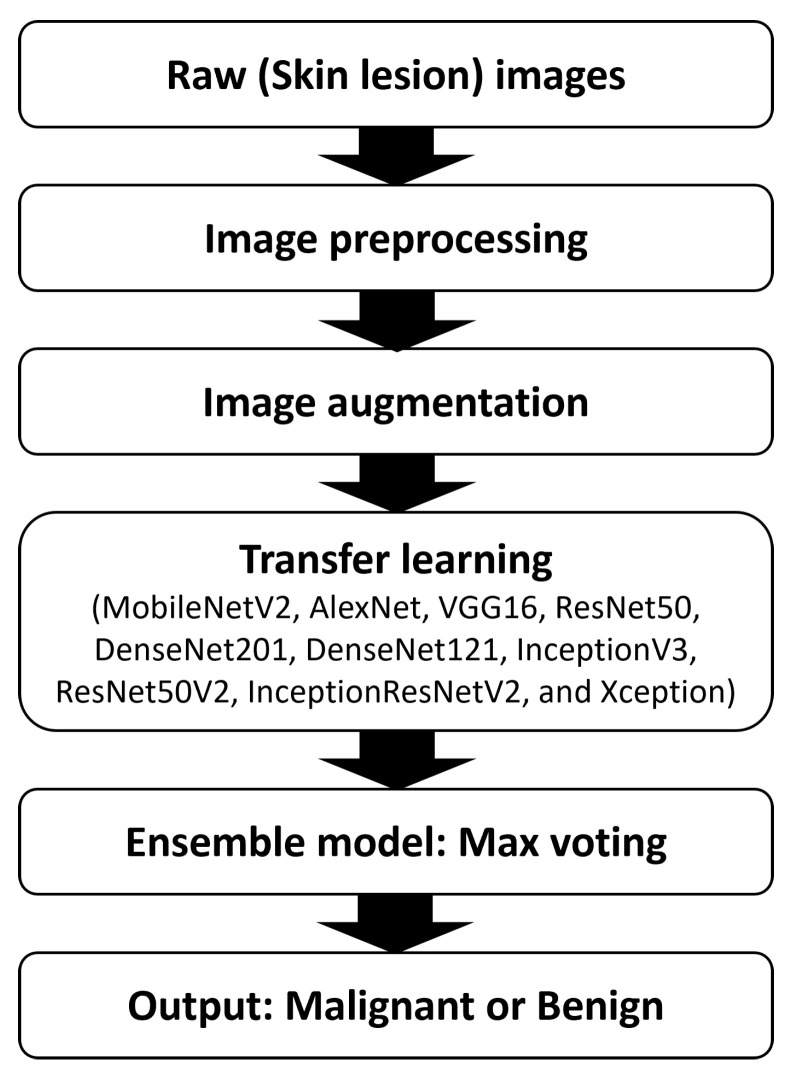
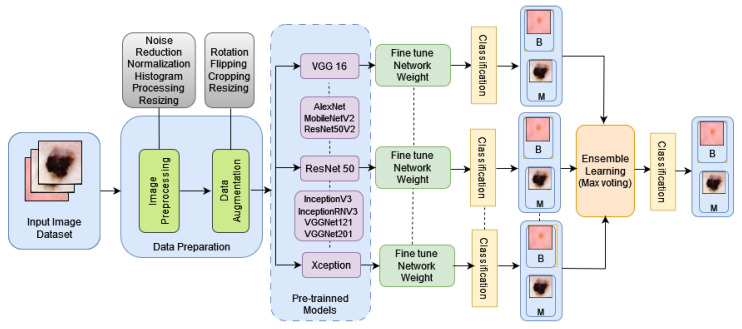
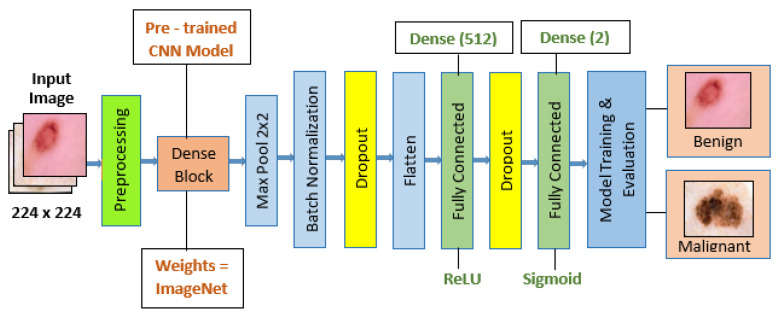
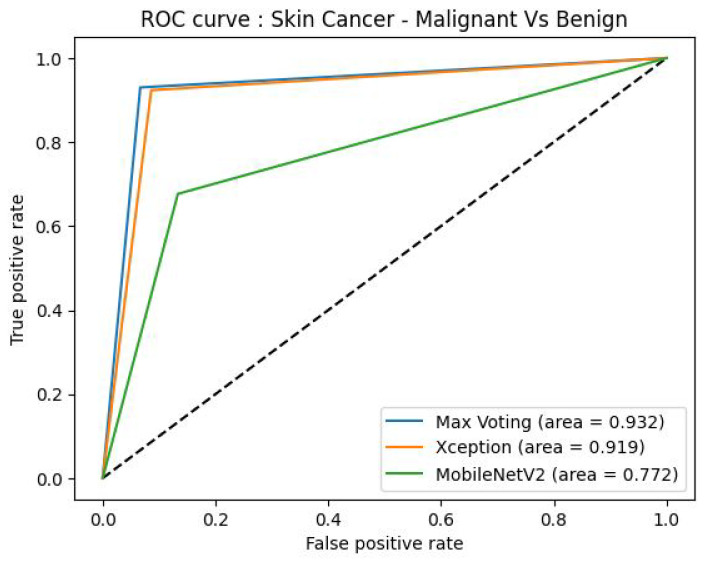
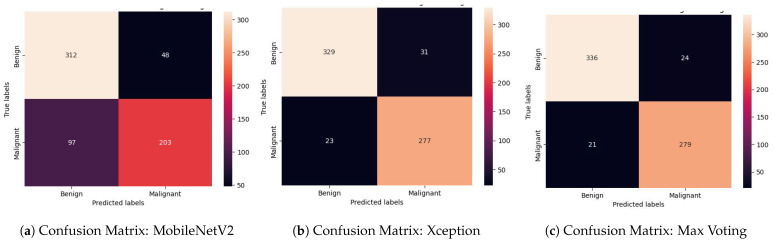
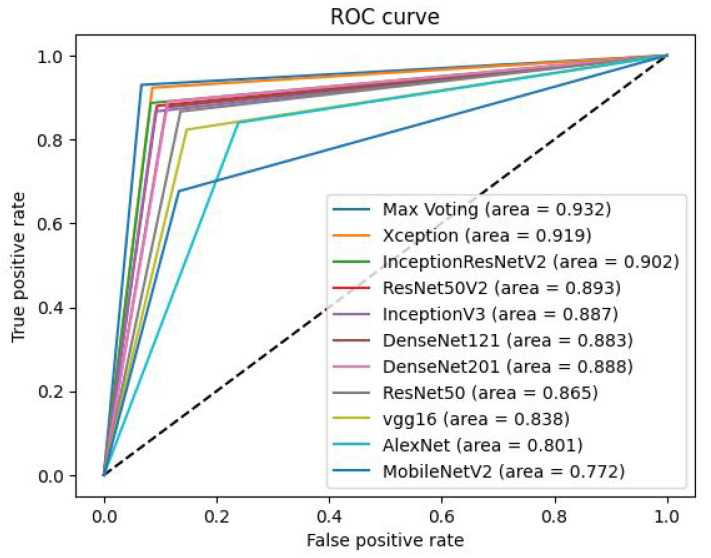
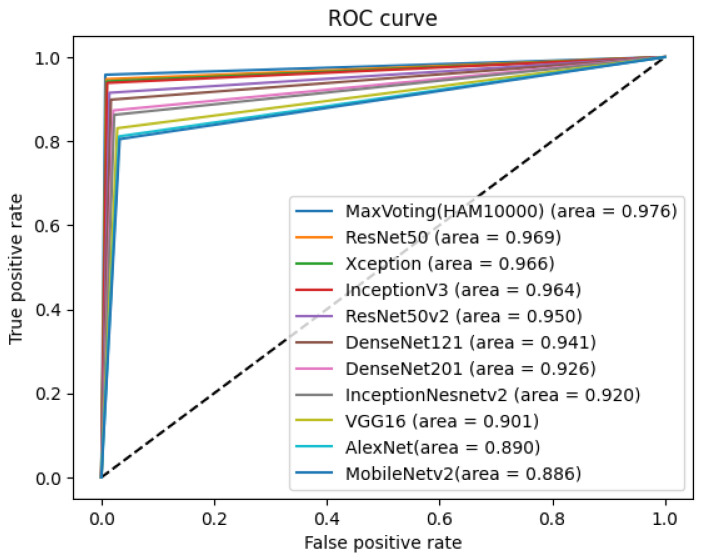
Skin cancer poses a significant healthcare challenge, requiring precise and prompt diagnosis for effective treatment. While recent advances in deep learning have dramatically improved medical image analysis, including skin cancer classification, ensemble methods offer a pathway for further enhancing diagnostic accuracy. This study introduces a cutting-edge approach employing the Max Voting Ensemble Technique for robust skin cancer classification on ISIC 2018: Task 1-2 dataset. We incorporate a range of cutting-edge, pre-trained deep neural networks, including MobileNetV2, AlexNet, VGG16, ResNet50, DenseNet201, DenseNet121, InceptionV3, ResNet50V2, InceptionResNetV2, and Xception. These models have been extensively trained on skin cancer datasets, achieving individual accuracies ranging from 77.20% to 91.90%. Our method leverages the synergistic capabilities of these models by combining their complementary features to elevate classification performance further. In our approach, input images undergo preprocessing for model compatibility. The ensemble integrates the pre-trained models with their architectures and weights preserved. For each skin lesion image under examination, every model produces a prediction. These are subsequently aggregated using the max voting ensemble technique to yield the final classification, with the majority-voted class serving as the conclusive prediction. Through comprehensive testing on a diverse dataset, our ensemble outperformed individual models, attaining an accuracy of 93.18% and an AUC score of 0.9320, thus demonstrating superior diagnostic reliability and accuracy. We evaluated the effectiveness of our proposed method on the HAM10000 dataset to ensure its generalizability. Our ensemble method delivers a robust, reliable, and effective tool for the classification of skin cancer. By utilizing the power of advanced deep neural networks, we aim to assist healthcare professionals in achieving timely and accurate diagnoses, ultimately reducing mortality rates and enhancing patient outcomes.
Keywords: classification; deep learning; max voting; medical imaging; skin cancer; transfer learning.
Conflict of interest statement
The authors declare no conflict of interest.
Figures
References
-
- Zelin E., Zalaudek I., Agozzino M., Dianzani C., Dri A., Di Meo N., Giuffrida R., Marangi G.F., Neagu N., Persichetti P., et al. Neoadjuvant therapy for non-melanoma skin cancer: Updated therapeutic approaches for basal, squamous, and merkel cell carcinoma. Curr. Treat. Options Oncol. 2021;22:1–24. doi: 10.1007/s11864-021-00826-3. - DOI - PMC - PubMed
-
- US Department of Health and Human Services . The Surgeon General’s Call to Action to Prevent Skin Cancer. Office of the Surgeon General (US); Washington, DC, USA: 2014. [(accessed on 22 August 2023)]. Skin Cancer as a Major Public Health Problem. Available online: https://www.ncbi.nlm.nih.gov/books/NBK247164/
-
- Zhang B., Zhou X., Luo Y., Zhang H., Yang H., Ma J., Ma L. Opportunities and challenges: Classification of skin disease based on deep learning. Chin. J. Mech. Eng. 2021;34:112. doi: 10.1186/s10033-021-00629-5. - DOI
LinkOut - more resources
Full Text Sources
