


Antitumoral Agent-Induced Constipation: A Systematic Review
- PMID: 38201526
- PMCID: PMC10778329
- DOI: 10.3390/cancers16010099
Antitumoral Agent-Induced Constipation: A Systematic Review
Abstract
Background: Constipation is a common symptom in patients receiving antitumoral treatment. The mechanisms underlying antitumoral agent-induced constipation (ATAIC) are poorly defined. This systematic review aimed to analyze and synthesize the available information related to the prevalence, etiology, and treatment of ATAIC.
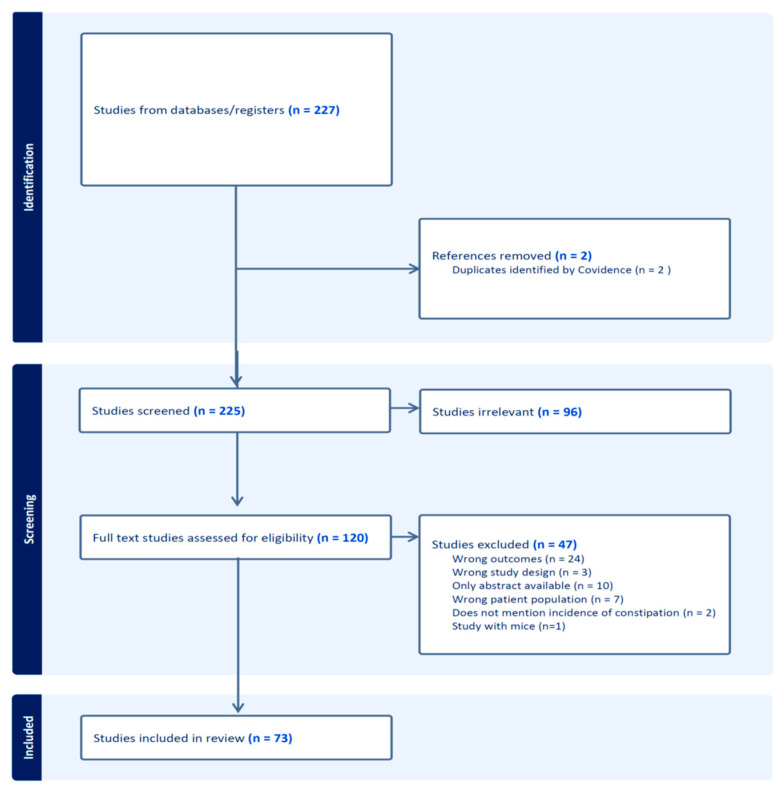
Methods: A systematic review following the Preferred Reporting Items for Systematic Reviews and Meta-Analysis (PRISMA) guidelines was conducted. The review included human studies written in English, French, or Spanish involving patients with cancer and containing information about the prevalence, etiology, and treatment of ATAIC.
Results: A total of 73 articles were included. The reported prevalence ranged from 0.8% to 86.6%. Six studies reported an ATAIC prevalence of over 50%. The prevalence rates of constipation of grades 3 and 4 ranged between 0 and 11%. The importance of enteric neuronal integrity in gastrointestinal function was reported. The articles with the highest levels of evidence in relation to ATAIC treatment obtained in this systematic review studied treatments with acupuncture, sweet potato, osteopath, probiotics, and moxibustion.
Conclusions: The prevalence of constipation in patients undergoing antitumoral treatment is very diverse. Studies specifically designed to report the prevalence of antineoplastic treatment-induced constipation are needed. The importance of enteric neuronal integrity in gastrointestinal function was described. Thus, neuroprotection could be an area of research for the treatment of chemotherapy-induced gastrointestinal disorders.
Keywords: antineoplastic agents; constipation; neoplasms.
Conflict of interest statement
The authors declare no conflict of interests.
Figures
Similar articles
-
Effectiveness and safety of acupuncture for treating functional constipation: An overview of systematic reviews.J Integr Med. 2022 Jan;20(1):13-25. doi: 10.1016/j.joim.2021.11.001. Epub 2021 Nov 7. J Integr Med. 2022. PMID: 34838459 Review.
-
When poorly conducted systematic reviews and meta-analyses can mislead: a critical appraisal and update of systematic reviews and meta-analyses examining the effects of probiotics in the treatment of functional constipation in children.Am J Clin Nutr. 2019 Jul 1;110(1):177-195. doi: 10.1093/ajcn/nqz071. Am J Clin Nutr. 2019. PMID: 31127810 Review.
-
Prevalence of constipation in cystic fibrosis patients: a systematic review of observational studies.J Pediatr (Rio J). 2020 Nov-Dec;96(6):686-692. doi: 10.1016/j.jped.2020.03.004. Epub 2020 May 8. J Pediatr (Rio J). 2020. PMID: 32389617 Free PMC article.
-
The effect of probiotics used as a single therapy on functional constipation: Study protocol for a systematic review and meta-analysis.Medicine (Baltimore). 2020 Apr;99(17):e19824. doi: 10.1097/MD.0000000000019824. Medicine (Baltimore). 2020. PMID: 32332627 Free PMC article.
-
Clinical therapeutic effects of probiotics in patients with constipation associated with Parkinson disease: A protocol for systematic review and meta-analysis.Medicine (Baltimore). 2021 Nov 5;100(44):e27705. doi: 10.1097/MD.0000000000027705. Medicine (Baltimore). 2021. PMID: 34871259 Free PMC article.
Cited by
-
Exploring the top 30 drugs associated with drug-induced constipation based on the FDA adverse event reporting system.Front Pharmacol. 2024 Sep 2;15:1443555. doi: 10.3389/fphar.2024.1443555. eCollection 2024. Front Pharmacol. 2024. PMID: 39286628 Free PMC article.
References
Publication types
LinkOut - more resources
Full Text Sources
