


Nutritional Assessments by Bioimpedance Technique in Dialysis Patients
- PMID: 38201845
- PMCID: PMC10780416
- DOI: 10.3390/nu16010015
Nutritional Assessments by Bioimpedance Technique in Dialysis Patients
Abstract
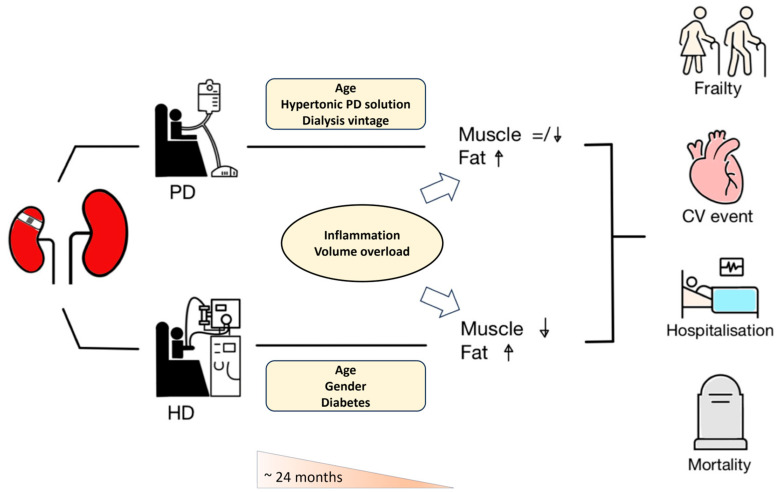
Bioelectrical impedance analysis (BIA) has been extensively applied in nutritional assessments on the general population, and it is recommended in establishing the diagnosis of malnutrition and sarcopenia. The bioimpedance technique has become a promising modality through which to measure the whole-body composition in dialysis patients, where the presence of subclinical volume overload and sarcopenic obesity may be overlooked by assessing body weight alone. In the past two decades, bioimpedance devices have evolved from applying a single frequency to a range of frequencies (bioimpedance spectroscopy, BIS), in which the latter is incorporated with a three-compartment model that allows for the simultaneous measurement of the volume of overhydration, adipose tissue mass (ATM), and lean tissue mass (LTM). However, clinicians should be aware of common potential limitations, such as the adoption of population-specific prediction equations in some BIA devices. Inherent prediction error does exist in the bioimpedance technique, but the extent to which this error becomes clinically significant remains to be determined. Importantly, reduction in LTM has been associated with increased risk of frailty, hospitalization, and mortality in dialysis patients, whereas the prognostic value of ATM remains debatable. Further studies are needed to determine whether modifications of bioimpedance-derived body composition parameters through nutrition intervention can result in clinical benefits.
Keywords: bioimpedance; dialysis; end-stage kidney disease; nutrition; protein-energy wasting.
Conflict of interest statement
The authors declare no conflict of interest.
Figures
References
-
- Bikbov B., Purcell C.A., Levey A.S., Smith M., Abdoli A., Abebe M., Adebayo O.M., Afarideh M., Agarwal S.K., Agudelo-Botero M., et al. Global, regional, and national burden of chronic kidney disease, 1990–2017: A systematic analysis for the Global Burden of Disease Study 2017. Lancet. 2020;395:709–733. doi: 10.1016/S0140-6736(20)30045-3. - DOI - PMC - PubMed
-
- Kalantar-Zadeh K., Kilpatrick R.D., Kuwae N., McAllister C.J., Alcorn H., Kopple J.D., Jr., Greenland S. Revisiting mortality predictability of serum albumin in the dialysis population: Time dependency, longitudinal changes and population-attributable fraction. Nephrol. Dial. Transplant. 2005;20:1880–1888. doi: 10.1093/ndt/gfh941. - DOI - PubMed
Publication types
MeSH terms
Grants and funding
LinkOut - more resources
Full Text Sources
Medical
Research Materials
Miscellaneous
