


Compositional Aspects of Beverages Designed to Promote Hydration Before, During, and After Exercise: Concepts Revisited
- PMID: 38201848
- PMCID: PMC10781183
- DOI: 10.3390/nu16010017
Compositional Aspects of Beverages Designed to Promote Hydration Before, During, and After Exercise: Concepts Revisited
Abstract
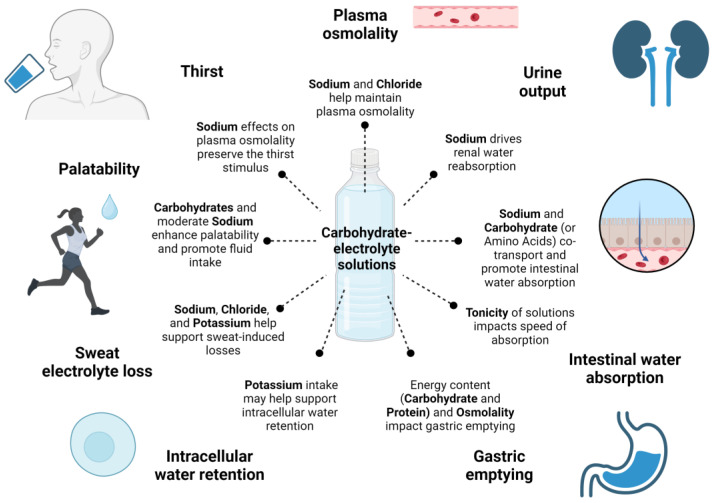
Hypohydration can impair aerobic performance and deteriorate cognitive function during exercise. To minimize hypohydration, athletes are recommended to commence exercise at least euhydrated, ingest fluids containing sodium during long-duration and/or high-intensity exercise to prevent body mass loss over 2% and maintain elevated plasma osmolality, and rapidly restore and retain fluid and electrolyte homeostasis before a second exercise session. To achieve these goals, the compositions of the fluids consumed are key; however, it remains unclear what can be considered an optimal formulation for a hydration beverage in different settings. While carbohydrate-electrolyte solutions such as sports drinks have been extensively explored as a source of carbohydrates to meet fuel demands during intense and long-duration exercise, these formulas might not be ideal in situations where fluid and electrolyte balance is impaired, such as practicing exercise in the heat. Alternately, hypotonic compositions consisting of moderate to high levels of electrolytes (i.e., ≥45 mmol/L), mainly sodium, combined with low amounts of carbohydrates (i.e., <6%) might be useful to accelerate intestinal water absorption, maintain plasma volume and osmolality during exercise, and improve fluid retention during recovery. Future studies should compare hypotonic formulas and sports drinks in different exercise settings, evaluating different levels of sodium and/or other electrolytes, blends of carbohydrates, and novel ingredients for addressing hydration and rehydration before, during, and after exercise.
Keywords: CES; ORS; athletes; carbohydrate–electrolyte solutions; exercise; hydration; hyperhydration; oral rehydration solutions; rehydration; sports drinks.
Conflict of interest statement
Í.M.P.-C., R.R., H.B. and J.A.W. are employees of Abbott Laboratories. J.L.-C. and N.M. are employees of Real Madrid. C.A.H. has received grant funding from Abbott Laboratories.
Figures
References
-
- McDermott B.P., Anderson S.A., Armstrong L.E., Casa D.J., Cheuvront S.N., Cooper L., Kenney W.L., O’Connor F.G., Roberts W.O. National Athletic Trainers’ Association Position Statement: Fluid Replacement for the Physically Active. J. Athl. Train. 2017;52:877–895. doi: 10.4085/1062-6050-52.9.02. - DOI - PMC - PubMed
-
- Horswill C., Fransen J. Fluid Balance, Hydration, and Athletic Performance. CRC Press; Boca Raton, FL, USA: 2016. Body Water: Balance, Turnover, Regulation, and Evaluation; pp. 3–22.
Publication types
MeSH terms
Substances
LinkOut - more resources
Full Text Sources
Medical
