


Intense Testing and Use of Vitamin D Supplements Leads to Slow Improvement in Vitamin D Adequacy Rates: A Cross-Sectional Analysis of Real-World Data
- PMID: 38201941
- PMCID: PMC10780961
- DOI: 10.3390/nu16010111
Intense Testing and Use of Vitamin D Supplements Leads to Slow Improvement in Vitamin D Adequacy Rates: A Cross-Sectional Analysis of Real-World Data
Abstract
Background: Vitamin D testing (VDT) and supplement use (VDS) are on the rise, but most patients remain deficient (<30 ng/mL-VDD). We designed the present real-world study to assess this paradox.
Methods: We reviewed data from all patients visiting our clinics between 2014 and 2022. We estimated the rate of patients with vitamin D adequacy (≥30 ng/mL) (VDA) by year and month of testing, the dose of VDS (low (≤1200 IU/day), medium (1201-3000 I/day) and high dose (>3000 IU/day)), intake duration (short-term (<12 months) and long-term use (≥12 months)), and timing of use (current use, former use, no use).
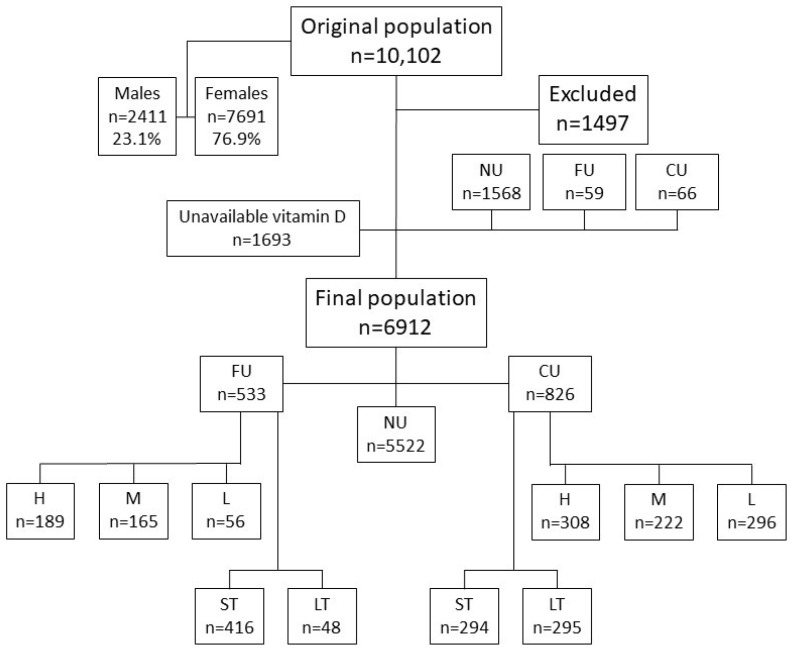
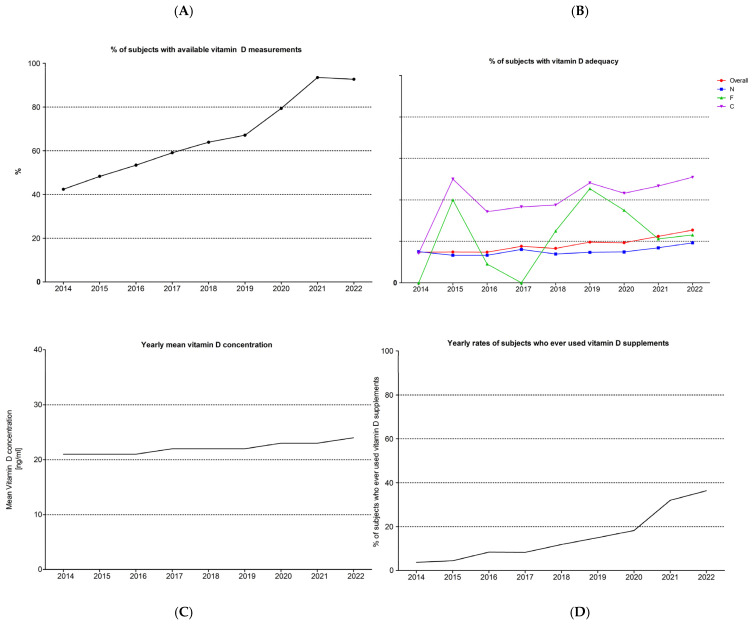
Results: We enrolled n = 6912 subjects with vitamin D measurements: n = 5195 females (75.2%), age 44.0 ± 16.8 years, BMI 27.9 ± 6.5 kg/m2; never users: n = 5553 (80.3%), former users: n = 533 (7.7%), current users: n = 826 (12.0%). Current use of VDS was higher in females. VDT rose from 42.1% in 2014 to 92.7% in 2022, and VDA rose from 14.8% to 25.5% for the same time. VDA was found overall in n = 1511 (21.9%); Never users: n = 864 (15.6%), Former users: n = 123 (23.2%); and Current users: n = 370 (44.8%). The maximal VDA (67.9%) was found in subjects using high-dose VDS in the long term.
Conclusions: Despite the significant rise in VDT and VDS use, VDA was found in a minority of patients. Prolonged use of high-dose supplements produces modest improvements in VDA.
Keywords: cholecalciferol; vitamin D adequacy; vitamin D deficiency; vitamin D insufficiency; vitamin D supplementation.
Conflict of interest statement
Paparodis has received speaker honoraria and has served as a consultant and/or advisor for the following pharmaceutical companies, which manufacture and/or distribute vitamin D supplements in Greece: ITF, Rafarm, Proton Pharma, Innovis, IBSA, Faran, Isoplus. All other authors have no relevant financial or non-financial interests to disclose.
Figures
References
-
- Giustina A., Adler R.A., Binkley N., Bollerslev J., Bouillon R., Dawson-Hughes B., Ebeling P.R., Feldman D., Formenti A.M., Lazaretti-Castro M., et al. Consensus statement from 2(nd) International Conference on Controversies in Vitamin D. Rev. Endocr. Metab. Disord. 2020;21:89–116. doi: 10.1007/s11154-019-09532-w. - DOI - PMC - PubMed
-
- Roth D.E., Abrams S.A., Aloia J., Bergeron G., Bourassa M.W., Brown K.H., Calvo M.S., Cashman K.D., Combs G., De-Regil L.M., et al. Global prevalence and disease burden of vitamin D deficiency: A roadmap for action in low- and middle-income countries. Ann. N. Y. Acad. Sci. 2018;1430:44–79. doi: 10.1111/nyas.13968. - DOI - PMC - PubMed
MeSH terms
Substances
LinkOut - more resources
Full Text Sources
Medical
