


Reproductive Safety Issues of Novel Small Molecules for the Treatment of Inflammatory Bowel Disease: A Systematic Review
- PMID: 38202041
- PMCID: PMC10780022
- DOI: 10.3390/jcm13010034
Reproductive Safety Issues of Novel Small Molecules for the Treatment of Inflammatory Bowel Disease: A Systematic Review
Abstract
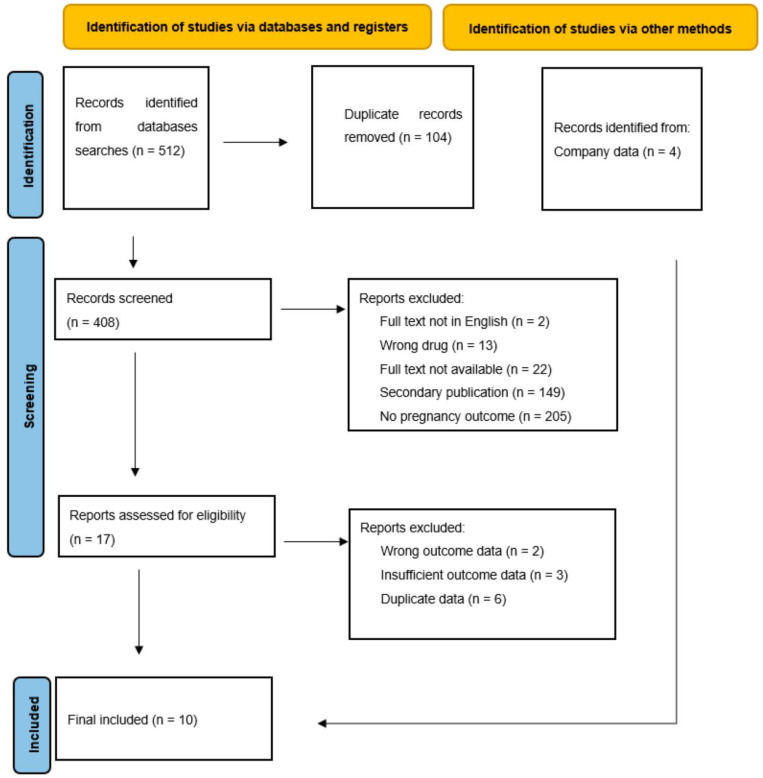
Maintenance of remission during pregnancy is vital for women with inflammatory bowel disease (IBD). The antenatal safety of novel small molecules for IBD is yet to be ascertained. We aimed to describe the current evidence on reproductive data regarding small-molecule drugs. We performed a systematic review searching Embase Classic + Embase and Ovid MEDLINE for reproductive outcomes for tofacitinib, filgotinib, upadacitininb, and ozanimod. Additionally, we asked the manufacturers for available data on file regarding reproduction. We analysed data from 10 sources; six studies and four manufacturer reports were identified from our search. Significant malformation risks were reported for tofacitinib, filgotinib, upadacitininb, and ozanimod in animal studies. In 126 tofacitinib-exposed pregnancies, there were 55 live births with 2 congenital malformations and 1 serious infant infection, 14 terminations, 15 miscarriages, and 42 outcomes unknown. In 50 filgotinib-exposed pregnancies, there were 20 healthy babies, 1 congenital malformation, 9 terminations, 10 miscarriages, and 10 outcomes unknown. In 78 upadacitinib-exposed pregnancies, there were 30 healthy babies, 15 terminations, 15 miscarriages, and 18 outcomes unknown. In 60 ozanimod-exposed pregnancies, there were 31 live births with 1 congenital malformation, 1 case of intra-uterine growth restriction, 1 case of neonatal icterus, 13 terminations, 9 miscarriages, and 8 unknown outcomes. Animal data suggest significant risks of malformations for tofacitinib, filgotinib, upadacitininb, and ozanimod. Human data from clinical trials and real-world observations do not show concerning data so far, but these are very limited. Currently, alternative treatments should be used for IBD during pregnancy.
Keywords: inflammatory bowel disease; novel small molecule; pregnancy.
Conflict of interest statement
I.C. received speaker honoraria from Celltrion, research grants from Celltrion, and a travel grant from Galapagos and Celltrion. C.P.S. received unrestricted research grants from Warner Chilcott, Janssen, and AbbVie, has provided consultancy to Warner Chilcott, Dr Falk, AbbVie, Takeda, Fresenius Kabi, Eli Lilly, Galapagos, Ferring, Arena, and Janssen, and had speaker arrangements with Warner Chilcott, Dr Falk, AbbVie, MSD, Pfizer, Eli Lilly, BMS, UCB, Fresenius Kabi, Celltrion, and Takeda.
Figures
References
-
- Alatab S., Sepanlou S.G., Ikuta K., Vahedi H., Bisignano C., Safiri S., Sadeghi A., Nixon M.R., Abdoli A., Abolhassani H., et al. The global, regional, and national burden of inflammatory bowel disease in 195 countries and territories, 1990–2017: A systematic analysis for the Global Burden of Disease Study 2017. Lancet Gastroenterol. Hepatol. 2020;5:17–30. doi: 10.1016/S2468-1253(19)30333-4. - DOI - PMC - PubMed
-
- Ng S.C., Shi H.Y., Hamidi N., Underwood F.E., Tang W., Benchimol E.I., Panaccione R., Ghosh S., Wu J.C.Y., Chan F.K.L., et al. Worldwide incidence and prevalence of inflammatory bowel disease in the 21st century: A systematic review of population-based studies. Lancet. 2017;390:2769–2778. doi: 10.1016/S0140-6736(17)32448-0. - DOI - PubMed
Publication types
LinkOut - more resources
Full Text Sources
