. 2024 Jan 2;29(1):244.
doi: 10.3390/molecules29010244.

The Effect of pH on the Viscoelastic Response of Alginate-Montmorillonite Nanocomposite Hydrogels

Affiliations

The Effect of pH on the Viscoelastic Response of Alginate-Montmorillonite Nanocomposite Hydrogels

Haniyeh Malektaj et al. Molecules. .

Abstract

Ionically cross-linked alginate hydrogels are used in a wide range of applications, such as drug delivery, tissue engineering, and food packaging. A shortcoming of these gels is that they lose their strength and degrade at low pH values. To develop gels able to preserve their integrity in a wide range of pH values, Ca-alginate-montmorillonite nanocomposite gels are prepared, and their chemical structure, morphology, and mechanical response are analyzed. As the uniformity of nanocomposite gels is strongly affected by concentrations of MMT and CaCl2, it is revealed that homogeneous gels can be prepared with 4 wt.% MMT and 0.5 M CaCl2 at the highest. The viscoelastic behavior of nanocomposite gels in aqueous solutions with pH = 7 and pH = 2 is investigated by means of small-amplitude compressive oscillatory tests. It is shown that Ca-alginate-MMT nanocomposite gels preserve their integrity while being swollen at pH = 2. The experimental data are fitted by a model with only two material parameters, which shows that the elastic moduli increase linearly with a concentration of MMT at all pH values under investigation due to formation of physical bonds between alginate chains and MMT platelets. The presence of these bonds is confirmed by ATR-FTIR spectroscopy. The morphology of nanocomposite gels is studied by means of wide-angle X-ray diffraction, which reveals that intercalation of polymer chains between clay platelets increases the interlayer gallery spacing.

Keywords: alginate; hydrogel; mechanical properties; montmorillonite; nanocomposite.


Conflict of interest statement

The authors declare no conflict of interest.

Figures
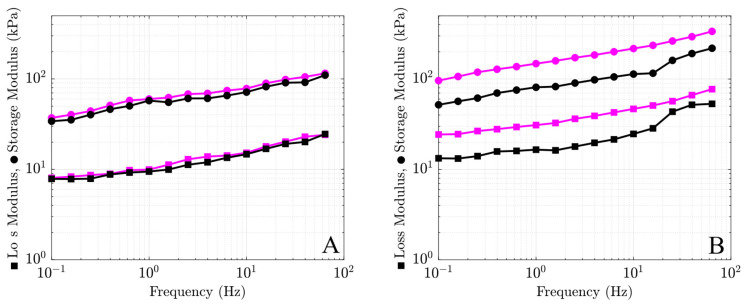
Figure 1
Figure 1
Storage modulus E′ (circles) and loss modulus E″ (squares) versus frequency f for alginate–MMT hydrogels cross-linked with (A) 4 wt.% of MMT and 0.5 M CaCl2 and (B) 4.5 wt.% of MMT and 1.5 M CaCl2 in aqueous solutions with pH = 7. Each figure shows observations on two samples (black and purple lines) with identical preparation conditions.
Figure 2
Figure 2
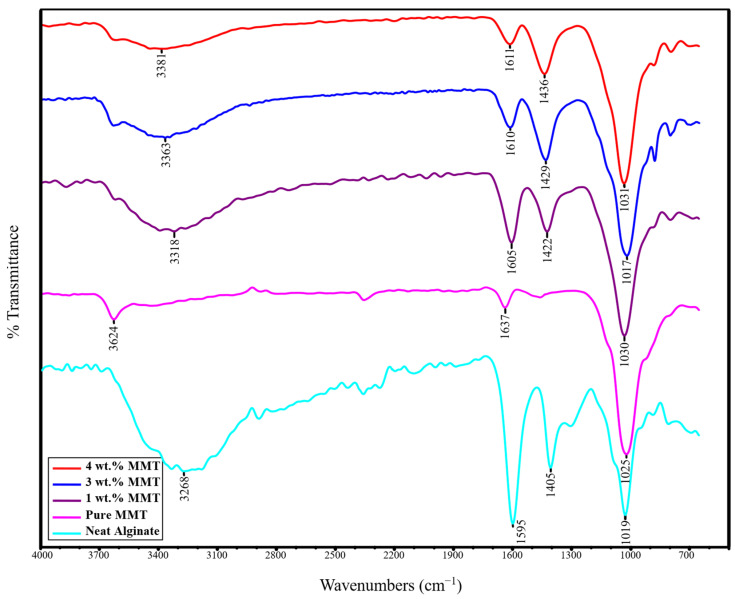
FTIR spectra of alginate, MMT, and Ca-alginate/MMT hydrogels with 1, 3, and 4 wt.% MMT.
Figure 3
Figure 3
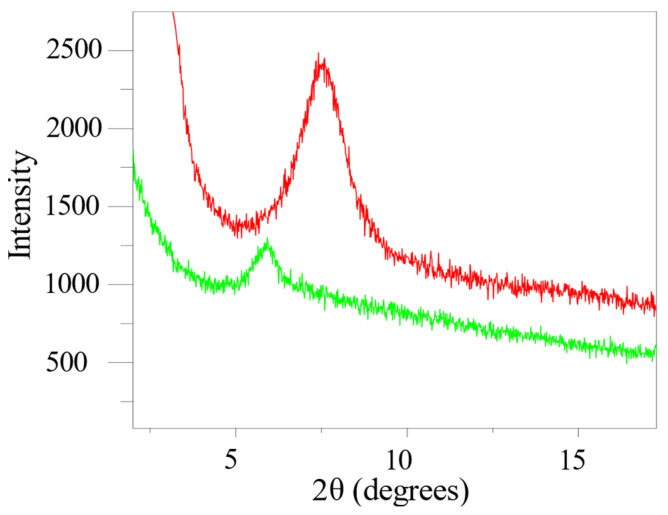
XRD patterns of pure MMT (red) and Ca-alginate/MMT nanocomposite hydrogel (green).
Figure 4
Figure 4
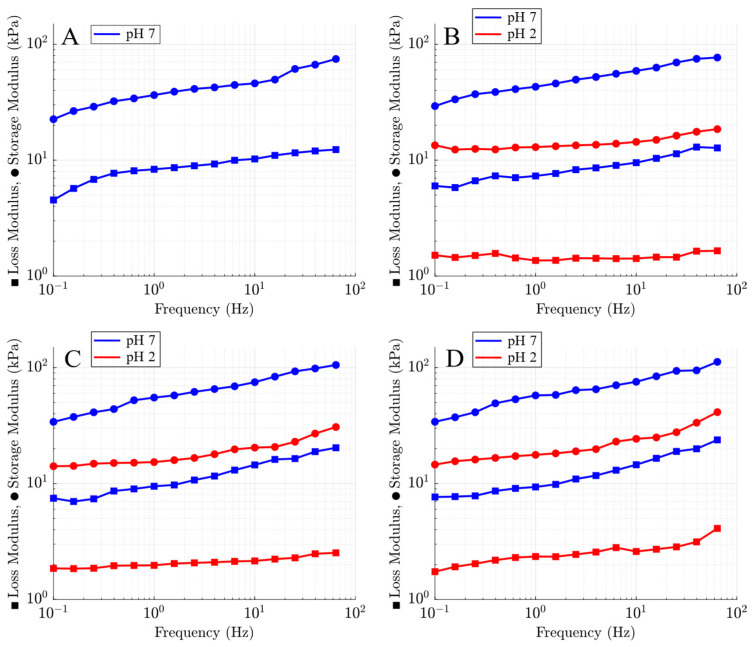
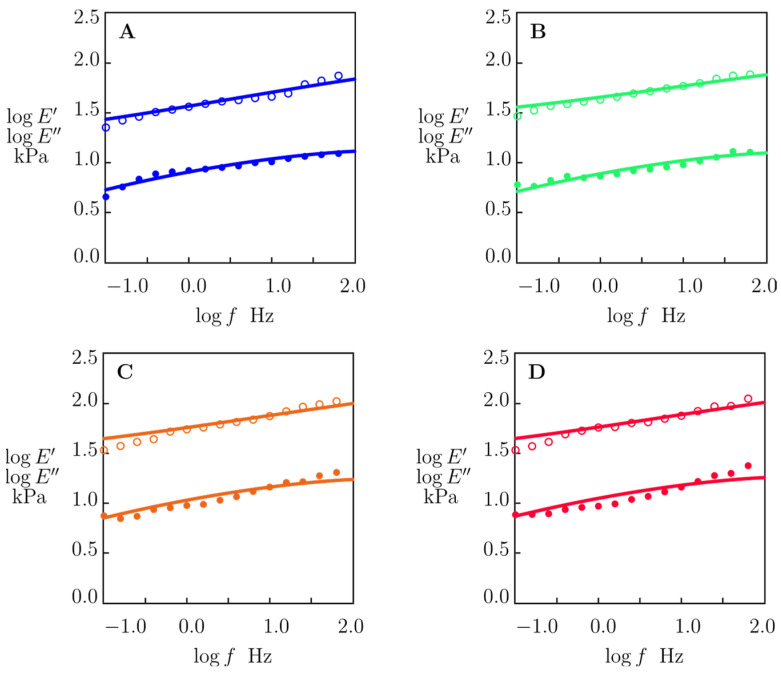
Storage modulus E′ (circles) and loss modulus E″ (squares) versus frequency f for alginate–MMT gels with (A) 0, (B) 1, (C) 3, and (D) 4 wt.% of MMT in aqueous solutions with pH = 7 and pH = 2.
Figure 5
Figure 5
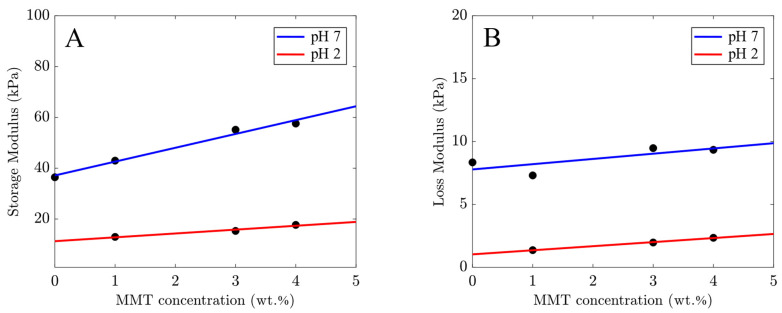
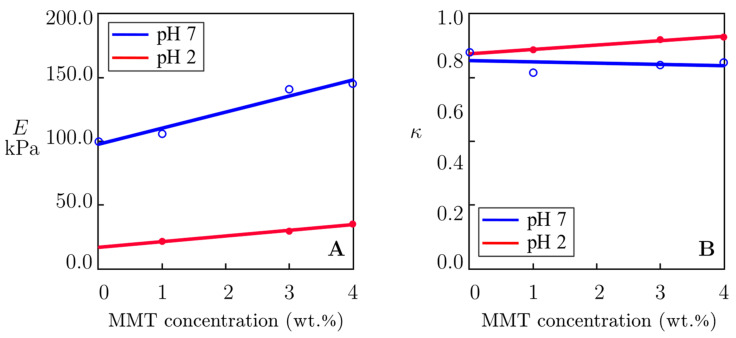
(A) Storage modulus E′ and (B) loss modulus E″ at frequency f = 1 Hz versus concentrations of MMT in aqueous solutions with pH = 7 and pH = 2. Circles: experimental data. Solid line: their approximation by a linear function.
Figure 6
Figure 6
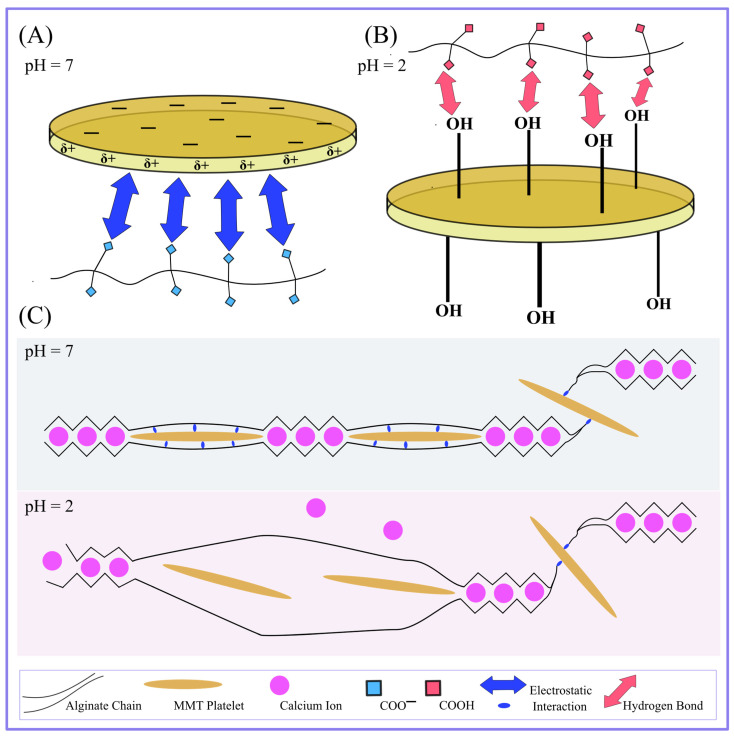
(A) Schematic presentation of the electrostatic links between the positively charged edge of MMT and the negatively charged alginate chains at pH = 7, and (B) hydrogen bonds between the OH groups of MMT and protonated COOH groups of alginate chains at pH = 2. (C) By lowering the pH from 7 to 2, the weak “egg-box” structure is broken; consequently, the electrostatic connection between MMT and alginate chains is broken.
Figure 7
Figure 7
Storage modulus E′ (◦) and loss modulus E″ (•) versus frequency f. Symbols: experimental data in small-amplitude oscillatory tests at room temperature on alginate–MMT nanocomposite gels with various concentrations of MMT swollen in water with pH = 7. (A) 0, (B) 1.0, (C) 3.0, (D) 4.0 wt.% MMT. Solid lines: results of numerical analysis.
Figure 8
Figure 8
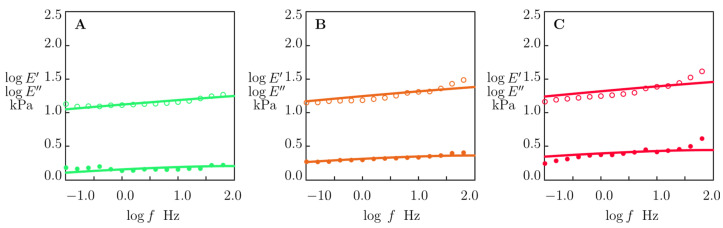
Storage modulus E′ (◦) and loss modulus E″ (•) versus frequency f. Symbols: experimental data in small-amplitude oscillatory tests at room temperature on alginate–MMT nanocomposite gels with various concentrations of MMT swollen in water with pH = 2. (A) 1.0, (B) 3.0, (C) 4.0 wt.% MMT. Solid lines: results of numerical analysis.
Figure 9
Figure 9
(A) Elastic modulus E and (B) coefficient κ versus MMT concentration. Symbols: treatment of experimental data at room temperature on alginate–MMT nanocomposite gels swollen in water with pH = 7 and pH = 2. Solid lines: results of numerical simulation.

References

    1. Singh A.V. Biopolymers in drug delivery: A review. Pharmacologyonline. 2011;1:666–674.
    1. Vashist A., Vashist A., Gupta Y., Ahmad S. Recent advances in hydrogel based drug delivery systems for the human body. J. Mater. Chem. B. 2014;2:147–166. doi: 10.1039/C3TB21016B. - DOI - PubMed
    1. Hama R., Ulziibayar A., Reinhardt J.W., Watanabe T., Kelly J., Shinoka T. Recent developments in biopolymer-based hydrogels for tissue engineering applications. Biomolecules. 2023;13:280. doi: 10.3390/biom13020280. - DOI - PMC - PubMed
    1. Pires P.C., Mascarenhas-Melo F., Pedrosa K., Lopes D., Lopes J., Macário-Soares A., Peixoto D., Giram P.S., Veiga F., Paiva-Santos A.C. Polymer-based biomaterials for pharmaceutical and biomedical applications: A focus on topical drug administration. Eur. Polym. J. 2023;187:111868. doi: 10.1016/j.eurpolymj.2023.111868. - DOI
    1. Liu J., Huang Y., Kumar A., Tan A., Jin S., Mozhi A., Liang X.-J. pH-sensitive nano-systems for drug delivery in cancer therapy. Biotechnol. Adv. 2014;32:693–710. doi: 10.1016/j.biotechadv.2013.11.009. - DOI - PubMed