


Integrated Bulk Segregant Analysis, Fine Mapping, and Transcriptome Revealed QTLs and Candidate Genes Associated with Drought Adaptation in Wild Watermelon
- PMID: 38203237
- PMCID: PMC10779233
- DOI: 10.3390/ijms25010065
Integrated Bulk Segregant Analysis, Fine Mapping, and Transcriptome Revealed QTLs and Candidate Genes Associated with Drought Adaptation in Wild Watermelon
Abstract
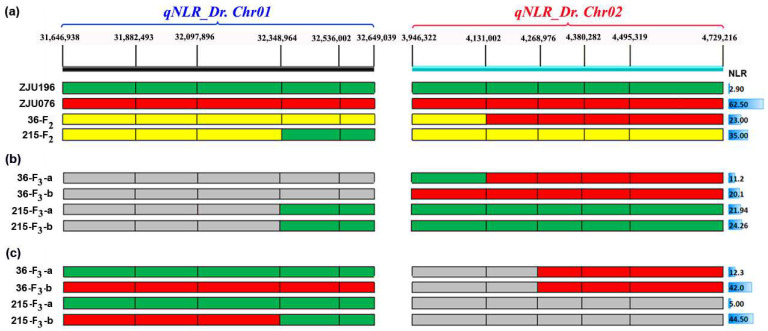
Drought stress has detrimental effects on crop productivity worldwide. A strong root system is crucial for maintaining water and nutrients uptake under drought stress. Wild watermelons possess resilient roots with excellent drought adaptability. However, the genetic factors controlling this trait remain uninvestigated. In this study, we conducted a bulk segregant analysis (BSA) on an F2 population consisting of two watermelon genotypes, wild and domesticated, which differ in their lateral root development under drought conditions. We identified two quantitative trait loci (qNLR_Dr. Chr01 and qNLR_Dr. Chr02) associated with the lateral root response to drought. Furthermore, we determined that a small region (0.93 Mb in qNLR_Dr. Chr01) is closely linked to drought adaptation through quantitative trait loci (QTL) validation and fine mapping. Transcriptome analysis of the parent roots under drought stress revealed unique effects on numerous genes in the sensitive genotype but not in the tolerant genotype. By integrating BSA, fine mapping, and the transcriptome, we identified six genes, namely L-Ascorbate Oxidase (AO), Cellulose Synthase-Interactive Protein 1 (CSI1), Late Embryogenesis Abundant Protein (LEA), Zinc-Finger Homeodomain Protein 2 (ZHD2), Pericycle Factor Type-A 5 (PFA5), and bZIP transcription factor 53-like (bZIP53-like), that might be involved in the drought adaptation. Our findings provide valuable QTLs and genes for marker-assisted selection in improving water-use efficiency and drought tolerance in watermelon. They also lay the groundwork for the genetic manipulation of drought-adapting genes in watermelon and other Cucurbitacea species.
Keywords: drought tolerance; genetic resources; genomics-assisted breeding; quantitative trait loci (QTL) mapping; transcriptome; wild watermelon.
Conflict of interest statement
The authors declare no conflict of interest.
Figures



References
-
- Regan P.M., Kim H., Maiden E. Climate change, adaptation, and agricultural output. Reg. Environ. Chang. 2018;19:113–123. doi: 10.1007/s10113-018-1364-0. - DOI
-
- FAOSTAT Food and Agriculture Organization of the United Nations. [(accessed on 16 August 2022)]. Available online: http://faostat.fao.org.
-
- Mall M., Kumar R., Akhtar M.Q. Chapter 1—Horticultural crops and abiotic stress challenges. In: Chandra Rai A., Rai A., Kumar Rai K., Rai V.P., Kumar A., editors. Stress Tolerance in Horticultural Crops. Woodhead Publishing; Sawston, UK: 2021. pp. 1–19.
MeSH terms
Substances
Grants and funding
- SCKJ-JYRC-2022-18/Project of Sanya Yazhou Bay Science and Technology City
- 321MS064/Natural Science Foundation of Hainan Province
- CARS25-17/Earmarked Fund for China Agriculture Research System
- 2017QNA6016, +226-2022-00100/the Fundamental Research Funds for the Central Universities
- LY21C150008/Zhejiang Provincial Natural Science Foundation
LinkOut - more resources
Full Text Sources
Research Materials
Miscellaneous
