


Fertility treatment outcomes in transgender men with a history of testosterone therapy
- PMID: 38204952
- PMCID: PMC10774903
- DOI: 10.1016/j.xfre.2023.10.006
Fertility treatment outcomes in transgender men with a history of testosterone therapy
Abstract
Objective: To evaluate fertility treatment outcomes among transgender (TG) men with a history of gender-affirming hormone therapy with exogenous testosterone.
Design: Descriptive, retrospective cohort study.
Patients: Transgender men with a history of gender-affirming hormone therapy with exogenous testosterone underwent fertility treatments, including embryo cryopreservation, in vitro fertilization (IVF), co-IVF, oocyte cryopreservation, and intrauterine insemination (IUI), between 2013 and 2021.
Intervention: Gender-affirming hormone therapy with testosterone.
Main outcome measures: Live births (LBs), number of frozen embryos, and number of frozen oocytes. Other outcome measures included total gonadotropin used, peak estradiol levels, oocytes retrieved, oocyte maturity rate, fertilization rate, and embryo grade.
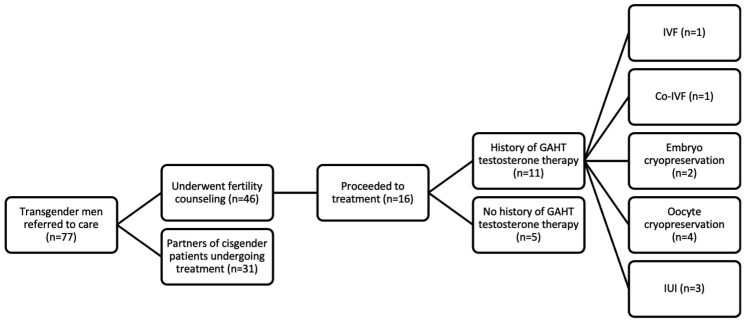
Results: A total of 77 TG men self-presented or were referred to care at a single academic fertility center, of which 46 (59.7%) TG men underwent fertility preservation and/or family-building counseling, with 16 (20.8%) patients proceeding to fertility treatment. Of those patients who underwent treatment, 11 (68.8%) had a history of gender-affirming hormone therapy with exogenous testosterone use. Cohort 1 included IVF (n = 1), co-IVF (n = 1), embryo cryopreservation (n = 2), cohort 2 included oocyte cryopreservation (n = 4), and cohort 3 included IUI (n = 3). In cohort 1, both the patients who underwent IVF and the patients who underwent co-IVF achieved LBs. All embryo cryopreservation cycles froze three or more embryos. In cohort 2, the average number of frozen mature oocytes was 19.3 ± 16.2 (range 6-43). All patients who underwent IUI cycles achieved LB.
Conclusion: In this study, no correlation existed between patient age, time on or off gender-affirming hormone therapy with exogenous testosterone, total gonadotropin used, and number of oocytes retrieved. All patients who completed IVF or embryo cryopreservation produced high-quality blastocytes, and this is the first study to show successful IUI cycles in patients with a history of gender-affirming hormone therapy with exogenous testosterone. This study demonstrates that TG men who have used gender-affirming hormone therapy previously can successfully undergo fertility treatments to attain oocyte and embryo cryopreservation, pregnancy, and LBs.
Keywords: assisted reproductive technology; exogenous testosterone; gender-affirming hormone therapy; transgender male.
© 2023 The Authors.
Conflict of interest statement
A.G. has nothing to disclose. S.L.E. has nothing to disclose. C.G. has nothing to disclose. D.G. has nothing to disclose. J.A.L. has nothing to disclose. K.T. has nothing to disclose. A.B.C. reports stock options and leadership roles for Progyny and Sema4 outside the submitted work.
Figures
References
-
- Herman J.L., Flores A.R., O’Neill K.K. How many adults and youth identify as transgender in the United States? https://williamsinstitute.law.ucla.edu/publications/trans-adults-united-... Available at:
-
- Pirtea P., Ayoubi J.M., Desmedt S., T’Sjoen G. Ovarian, breast, and metabolic changes induced by androgen treatment in transgender men. Fertil Steril. 2021;116:936–942. - PubMed
-
- Ikeda K., Baba T., Noguchi H., Nagasawa K., Endo T., Kiya T., et al. Excessive androgen exposure in female-to-male transsexual persons of reproductive age induces hyperplasia of the ovarian cortex and stroma but not polycystic ovary morphology. Hum Reprod. 2013;28:453–461. - PubMed
-
- De Roo C., Lierman S., Tilleman K., Peynshaert K., Braeckmans K., Caanen M., et al. Ovarian tissue cryopreservation in female-to-male transgender people: insights into ovarian histology and physiology after prolonged androgen treatment. Reprod Biomed Online. 2017;34:557–566. - PubMed
LinkOut - more resources
Full Text Sources
Miscellaneous
