


Gonadal Function in Boys with Bilateral Undescended Testes
- PMID: 38205164
- PMCID: PMC10777671
- DOI: 10.1210/jendso/bvad153
Gonadal Function in Boys with Bilateral Undescended Testes
Abstract
Background: Bilateral undescended testes (BUDT) may be a marker of an underlying condition that affects sex development or maturation.
Aims: To describe the extent of gonadal dysfunction in cases of BUDT who had systematic endocrine and genetic evaluation at a single tertiary pediatric center.
Methods: A retrospective review was conducted of all boys with BUDT who had endocrine evaluation between 2008 and 2021 at the Royal Hospital for Children, Glasgow (RHCG). Continuous variables were analyzed using Mann-Whitney U and non-continuous variables using Fisher's exact, via Graphpad Prism v 8.0. Multivariable logistic regression was used to identify any associations between groups. A P < .05 was considered statistically significant.
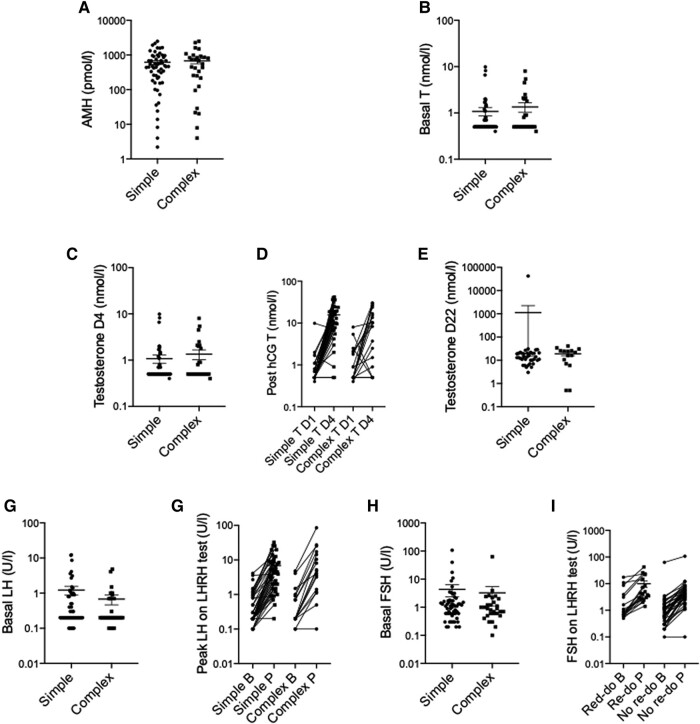
Results: A total of 243 bilateral orchidopexies were performed at RHCG between 2008 and 2021. Of these 130 (53%) boys were seen by the endocrine team. The median (range) age at first orchidopexy was 1 year (0.2, 18.0) with 16 (12%) requiring re-do orchidopexy. The median External Masculinization Score of the group was 10 (2, 11) with 33 (25%) having additional genital features. Of the 130 boys, 71 (55%) had extragenital anomalies. Of the 70 who were tested, a genetic abnormality was detected in 38 (54%), most commonly a chromosomal variant in 16 (40%). Of the 100 who were tested, endocrine dysfunction was identified in 38 (38%).
Conclusion: Genetic findings and evidence of gonadal dysfunction are common in boys who are investigated secondary to presentation with BUDT. Endocrine and genetic evaluation should be part of routine clinical management of all cases of BUDT.
Keywords: cryptorchidism; gonadal function; hCG; orchidopexy.
© The Author(s) 2023. Published by Oxford University Press on behalf of the Endocrine Society.
Figures




Comment in
-
Cryptorchidism Is Frequently Associated With Testicular Dysfunction.J Endocr Soc. 2024 Feb 12;8(4):bvae025. doi: 10.1210/jendso/bvae025. eCollection 2024 Feb 19. J Endocr Soc. 2024. PMID: 38390517 Free PMC article. No abstract available.
References
-
- Virtanen HE, Toppari J. Epidemiology and pathogenesis of cryptorchidism. Hum Reprod Update. 2008;14(1):49‐58. - PubMed
-
- Bergbrant S, Omling E, Björk J, Hagander L. Cryptorchidism in Sweden: a nationwide study of prevalence, operative management, and complications. J Pediatr. 2018;194:197‐203.e6. - PubMed
-
- Quinton R, Duke VM, Robertson A, et al. Idiopathic gonadotrophin deficiency: genetic questions addressed through phenotypic characterization. Clin Endocrinol (Oxf). 2001;55(2):163‐174. - PubMed
-
- Sadov S, Koskenniemi JJ, Virtanen HE, et al. Testicular growth during puberty in boys with and without a history of congenital cryptorchidism. J Clin Endocrinol Metab. 2016;101(6):2570‐2577. - PubMed
LinkOut - more resources
Full Text Sources