


The Cardiac Circadian Clock: Implications for Cardiovascular Disease and its Treatment
- PMID: 38205356
- PMCID: PMC10774593
- DOI: 10.1016/j.jacbts.2023.03.024
The Cardiac Circadian Clock: Implications for Cardiovascular Disease and its Treatment
Abstract
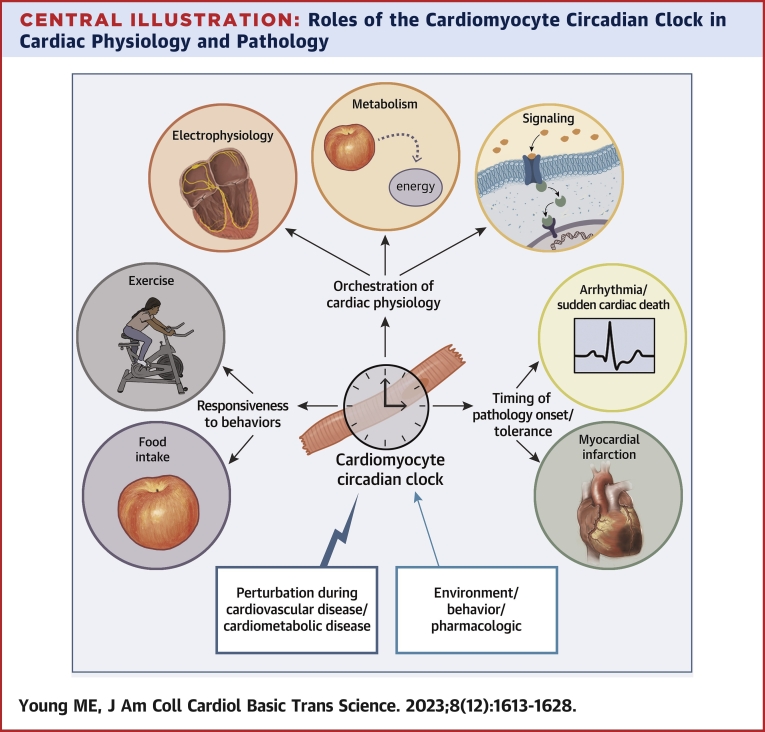
Virtually all aspects of physiology fluctuate with respect to the time of day. This is beautifully exemplified by cardiovascular physiology, for which blood pressure and electrophysiology exhibit robust diurnal oscillations. At molecular/biochemical levels (eg, transcription, translation, signaling, metabolism), cardiovascular-relevant tissues (such as the heart) are profoundly different during the day vs the night. Unfortunately, this in turn contributes toward 24-hour rhythms in both risk of adverse event onset (eg, arrhythmias, myocardial infarction) and pathogenesis severity (eg, extent of ischemic damage). Accumulating evidence indicates that cell-autonomous timekeeping mechanisms, termed circadian clocks, temporally govern biological processes known to play critical roles in cardiovascular function/dysfunction. In this paper, a comprehensive review of our current understanding of the cardiomyocyte circadian clock during both health and disease is detailed. Unprecedented basic, translational, and epidemiologic studies support a need to implement chronobiological considerations in strategies designed for both prevention and treatment of cardiovascular disease.
Keywords: chronobiology; electrophysiology; heart failure; ischemia; metabolism.
© 2023 The Author.
Conflict of interest statement
This work was supported by the National Heart, Lung, and Blood Institute (HL149159 and HL007081). Dr Young has reported that he has no relationships relevant to the contents of this paper to disclose.
Figures
References
-
- Degaute J.P., van de Borne P., Linkowski P., Van Cauter E. Quantitative analysis of the 24-hour blood pressure and heart rate patterns in young men. Hypertension. 1991;18(2):199–210. - PubMed
-
- Muller J., Tofler G., Stone P. Circadian variation and triggers of onset of acute cardiovascular disease. Circulation. 1989;79:733–743. - PubMed
-
- Prinz P.N., Halter J., Benedetti C., Raskind M. Circadian variation of plasma catecholamines in young and old men: relation to rapid eye movement and slow wave sleep. J Clin Endocrinol Metab. 1979;49(2):300–304. - PubMed
Publication types
Grants and funding
LinkOut - more resources
Full Text Sources
