


Body temperature in the acute phase and clinical outcomes after acute ischemic stroke
- PMID: 38206979
- PMCID: PMC10783745
- DOI: 10.1371/journal.pone.0296639
Body temperature in the acute phase and clinical outcomes after acute ischemic stroke
Abstract
Background: This study aimed to examine whether post-stroke early body temperature is associated with neurological damage in the acute phase and functional outcomes at three months.
Methods: We included 7,177 patients with acute ischemic stroke within 24 h of onset. Axillary temperature was measured daily in the morning for seven days. Mean body temperature was grouped into five quintiles (Q1: 35.1‒36.5°C, Q2: 36.5‒36.7°C, Q3: 36.7‒36.8°C, Q4: 36.8‒37.1°C, and Q5: 37.1‒39.1°C). Clinical outcomes included neurological improvement during hospitalization and poor functional outcome (modified Rankin scale score, 3-6) at three months. A logistic regression analysis was performed to evaluate the association between body temperature and clinical outcomes.
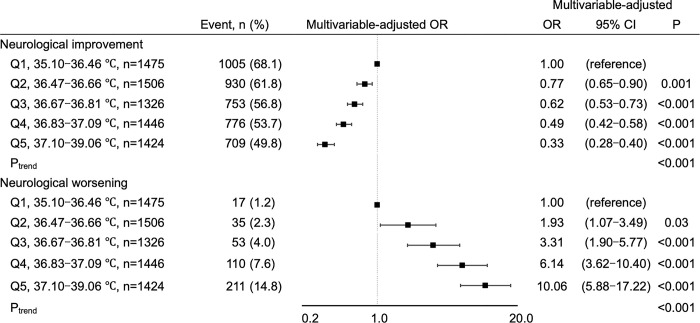
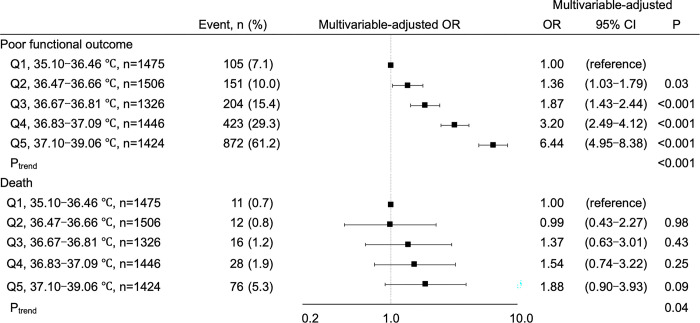
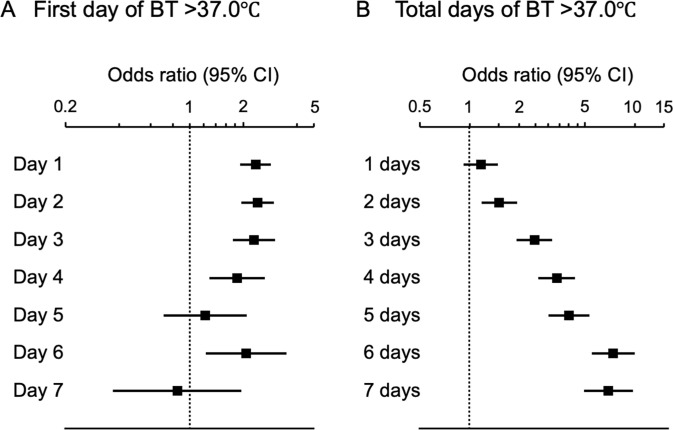
Results: The patient's mean (SD) age was 70.6 (12.3) years, and 35.7% of patients were women. Mean body temperature was significantly associated with less neurological improvement from Q2 (odds ratios [95% confidence interval], 0.77 [0.65-0.99] vs. Q1) to Q5 (0.33 [0.28-0.40], P for trend <0.001) even after adjusting for potential confounders, including baseline neurological severity, C-reactive protein levels, and post-stroke acute infections. The multivariable-adjusted risk of poor functional outcome linearly increased from Q2 (1.36 [1.03-1.79]) to Q5 (6.44 [5.19-8.96], P for trend <0.001). These associations were maintained even in the analyses excluding patients with acute infectious diseases. Multivariable-adjusted risk of poor functional outcome was higher in patients with early body temperature elevation on days 1-3 and with longer duration with body temperature >37.0°C.
Conclusions: Post-stroke early high body temperature is independently associated with unfavorable outcomes following acute ischemic stroke.
Copyright: © 2024 Mezuki et al. This is an open access article distributed under the terms of the Creative Commons Attribution License, which permits unrestricted use, distribution, and reproduction in any medium, provided the original author and source are credited.
Conflict of interest statement
The authors have declared that no competing interests exist.
Figures
References
-
- Chai Z, Gatti S, Toniatti C, Poli V, Bartfai T. Interleukin (IL)-6 gene expression in the central nervous system is necessary for fever response to lipopolysaccharide or IL-1 beta: a study on IL-6-deficient mice. J Exp Med. 1996;183: 311–316. doi: 10.1084/jem.183.1.311 PubMed Central: PMC2192408. - DOI - PMC - PubMed
-
- den Hertog HM, van der Worp HB, van Gemert HM, Algra A, Kappelle LJ, van Gijn J et al. An early rise in body temperature is related to unfavorable outcome after stroke: data from the Pais study. J Neurol. 2011;258: 302–307. doi: 10.1007/s00415-010-5756-4 . PubMed Central: PMC3036804. - DOI - PMC - PubMed
MeSH terms
LinkOut - more resources
Full Text Sources
Medical
Research Materials
