Review
. 2024 Mar 21;143(12):1101-1111.
doi: 10.1182/blood.2023021002.

Genetic mechanisms underlying tumor microenvironment composition and function in diffuse large B-cell lymphoma

Affiliations
Review

Genetic mechanisms underlying tumor microenvironment composition and function in diffuse large B-cell lymphoma

Leandro Cerchietti. Blood. .

Abstract

Cells in the tumor microenvironment (TME) of diffuse large B-cell lymphoma (DLBCL) show enormous diversity and plasticity, with functions that can range from tumor inhibitory to tumor supportive. The patient's age, immune status, and DLBCL treatments are factors that contribute to the shaping of this TME, but evidence suggests that genetic factors, arising principally in lymphoma cells themselves, are among the most important. Here, we review the current understanding of the role of these genetic drivers of DLBCL in establishing and modulating the lymphoma microenvironment. A better comprehension of the relationship between lymphoma genetic factors and TME biology should lead to better therapeutic interventions, especially immunotherapies.


Conflict of interest statement

Conflict-of-interest disclosure: The author declares no competing financial interests.

Figures
None
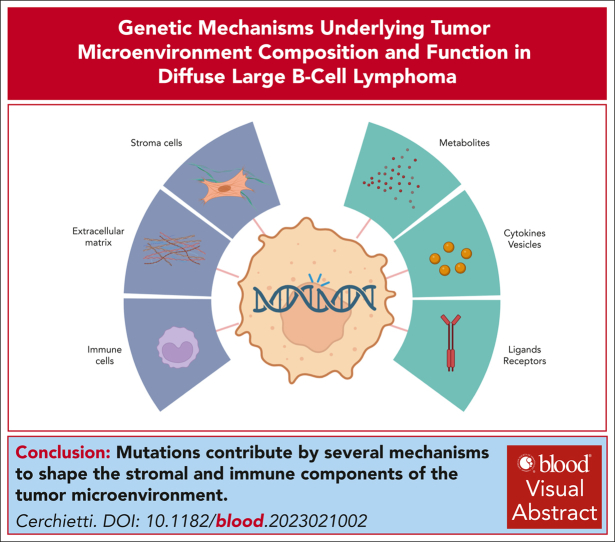
Graphical abstract
Figure 1.
Figure 1.
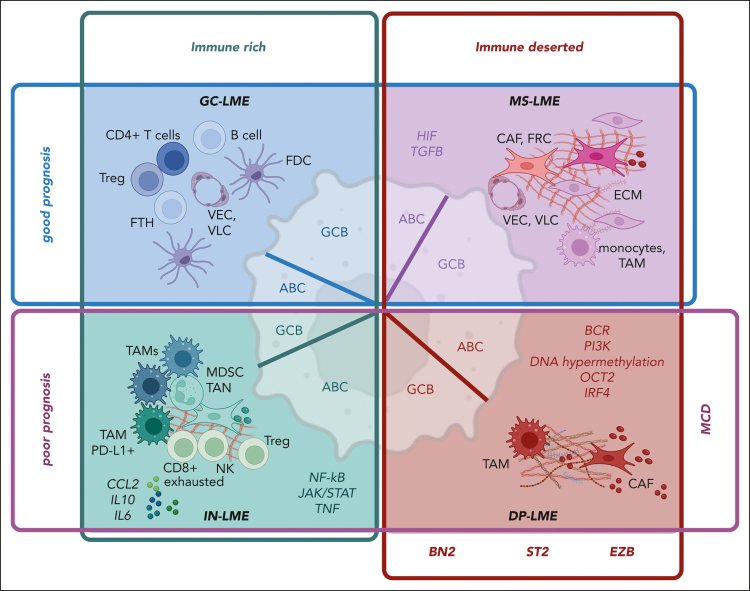
DLBCL LME categories. Gene expression classification of “immune rich” and “immune deserted” DLBCL TMEs into: (clockwise) GC-LME, MS-LME, DP-LME, and IN-LME. The proportion of GCB-like and ABC-like DLBCLs per LME category is indicated. GC- and MS-LMEs carry comparatively better prognosis than IN- and DP-LMEs. DLBCL genetic classes associated with LMEs are indicated: MCD with IN- and DP-LMEs and BN2, ST2, and EZB with “immune deserted” LME categories. Representative TME cell subtypes and functions as well as pathways activated in lymphoma cells are shown for each LME category. CAF, cancer-associated fibroblasts; FTH, follicular T helper cell; ECM, extracellular matrix; FDC, follicular dendritic cells; FRC, fibroblastic reticular cells; TAN, tumor-associated neutrophils; TAM, tumor-associated macrophages; Treg, regulatory T cell; VEC, vascular endothelial cells; VLC, vascular lymphatic cells; MDSC, myeloid-derived suppressor cells.
Figure 2.
Figure 2.
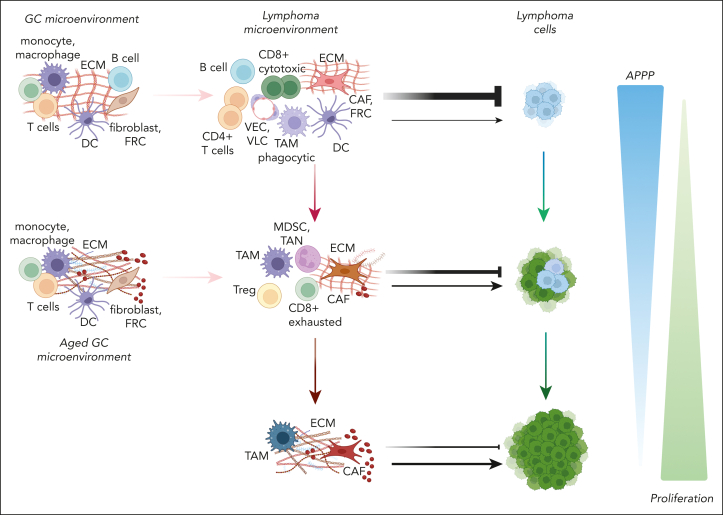
Coevolution of TME and cancer cells during lymphoma progression. Lymphoma cells induce a progressive reprogramming of the germinal center microenvironment that may imply initial expansion of cell subpopulations (eg, CD4+ T-follicular helper cells), recruitment and phenotypic reprogramming (eg, FRC and fibroblasts into CAFs) and wipe out of functions (eg, CD8+ cytotoxic T cells becoming exhausted). A common pattern of this coevolution for most DLBCL subtypes is the progressive loss of TME cellular diversity and components of the APPP, whereas lymphoma cells gain in proliferation capacity. In the initial stages, the TME provide several external checkpoints for lymphoma progression (represented by thicker inhibitory vs stimulatory arrows), whereas lymphoma cells developed evasion mechanisms (genetic, epigenetic, metabolic) that affect the cellular composition and/or functionality of TME cells. Later stages are accompanied by profound changes in the TME with little resemblance to the organ of origin. At this stage, the TME provides stronger support to lymphoma growth (represented by thicker stimulatory vs inhibitory arrows). Aging tissues are characterized by attenuation of checkpoints (eg, immunesenescence) and increased lymphoma supporting mechanisms (eg, cellular and ECM inflammatory changes) that may facilitate lymphoma development and progression. ECM, extracellular matrix; FDC, follicular dendritic cells; FRC, fibroblastic reticular cells; MDSC, myeloid-derived suppressor cells; TAM, tumor-associated macrophages; TAN, tumor-associated neutrophils; VEC, vascular endothelial cells; VLC, vascular lymphatic cells.
Figure 3.
Figure 3.
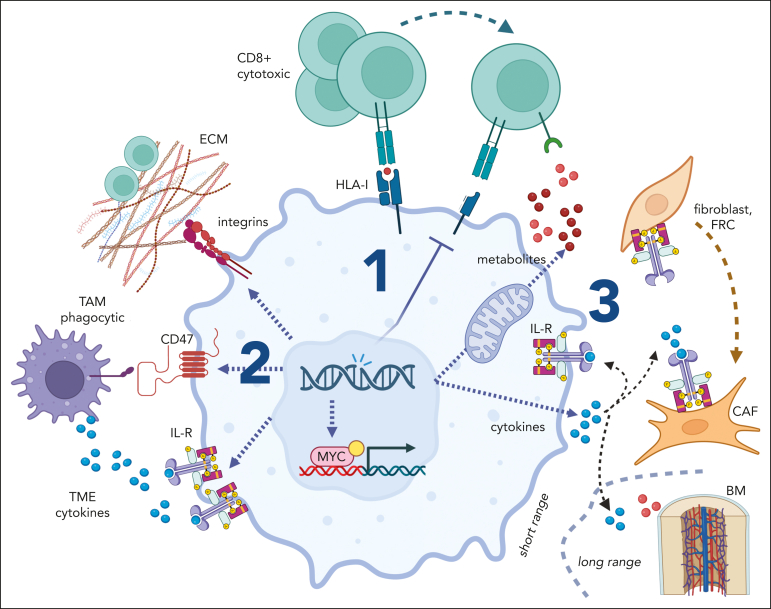
Genetic aberrations can shape the TME through several mechanisms. (1) Mutations that target molecules directly interacting with TME cells (eg, mutations in MHC-I components and NOTCH1); (2) Mutations that reprogram lymphoma cells (eg, MYC amplification) by changing the expression of membrane receptors for ECM and cells (eg, integrins), expression of suppressive molecules (eg, CD47), and pathway rewiring (eg, interleukin receptors) that makes lymphoma cells to thrive on certain TMEs; and (3) these mutations can also release into the extracellular space lymphoma products (eg, metabolites, cytokines) that induce short-range (ie, in an autocrine and/or paracrine manner) changes in cell subtypes and/or cell functionality favoring immunosuppression (eg, adenosine and inosine inhibiting CD8+ cytotoxic T cells) and TME polarization (eg, FGFR recruiting fibroblasts into CAFs) as well as long-range changes on distant organs that provide cells that infiltrate the TME (eg, inflammatory interleukins mobilizing monocytes from bone marrow).
Figure 4.
Figure 4.
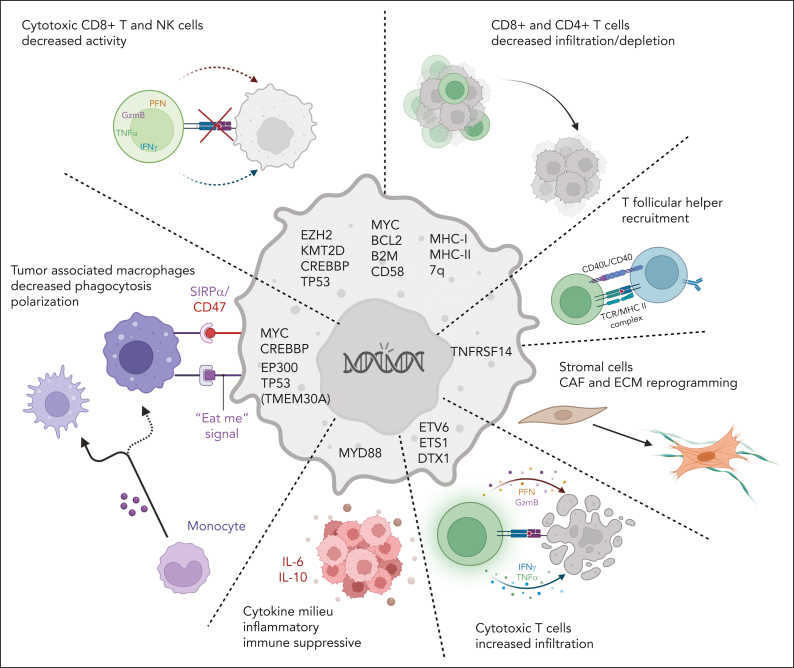
Effect of selected genetic aberrations on the TME composition and function. Specific mutations leading to gene LOF, GOF, and copy number alterations can contribute, by several mechanisms, to shape the stromal and immune components of the TME.

Comment in

References

    1. Frontzek F, Lenz G. Novel insights into the pathogenesis of molecular subtypes of diffuse large B-cell lymphoma and their clinical implications. Expert Rev Clin Pharmacol. 2019;12(11):1059–1067. - PubMed
    1. Chapuy B, Stewart C, Dunford AJ, et al. Molecular subtypes of diffuse large B cell lymphoma are associated with distinct pathogenic mechanisms and outcomes. Nat Med. 2018;24(5):679–690. - PMC - PubMed
    1. Schmitz R, Wright GW, Huang DW, et al. Genetics and pathogenesis of diffuse large B-cell lymphoma. N Engl J Med. 2018;378(15):1396–1407. - PMC - PubMed
    1. Steen CB, Luca BA, Esfahani MS, et al. The landscape of tumor cell states and ecosystems in diffuse large B cell lymphoma. Cancer Cell. 2021;39(10):1422–1437.e10. - PMC - PubMed
    1. Gerber-Ferder Y, Cosgrove J, Duperray-Susini A, et al. Breast cancer remotely imposes a myeloid bias on haematopoietic stem cells by reprogramming the bone marrow niche. Nat Cell Biol. 2023;25(12):1736–1745. - PubMed

Publication types