


Comparing efficacy and safety of upfront treatment strategies for anaplastic lymphoma kinase-positive non-small cell lung cancer: a network meta-analysis
- PMID: 38213541
- PMCID: PMC10784113
- DOI: 10.37349/etat.2023.00187
Comparing efficacy and safety of upfront treatment strategies for anaplastic lymphoma kinase-positive non-small cell lung cancer: a network meta-analysis
Abstract
Aim: This article is based on our previous research, which was presented as a post at the Congress Aiom 2022 Congress and published in Tumori Journal as Conference Abstract (Tumori J. 2022;108:1-194. doi: 10.1177/03008916221114500). In this paper, a comprehensive presentation of all the achieved results is provided. Several tyrosine kinase inhibitors (TKIs) have been investigated to treat patients with anaplastic lymphoma kinase (ALK)-positive non-small cell lung cancer (NSCLC). However, direct comparisons between these TKIs are lacking, with many only being compared to crizotinib. To address this gap, a network meta-analysis was conducted to compare the efficacy and safety of various first-line systemic therapies for ALK-positive NSCLC.
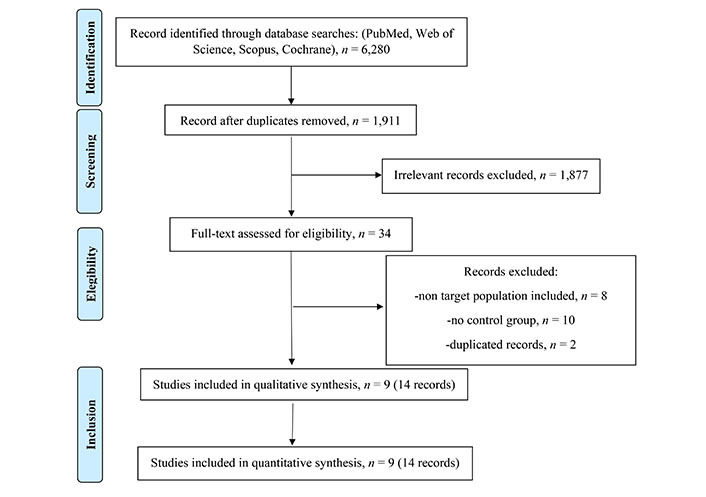
Methods: A thorough search of PubMed, Embase, and Cochrane Library was performed to identify randomized controlled trials (RCTs) published between January 01, 2000 and April 01, 2022, and included trials that investigated upfront treatments for this molecular subgroup and reported overall survival (OS), progression-free survival (PFS), objective response rate (ORR), and adverse events (AEs) of grade 3 or higher (grade ≥ 3 AEs).
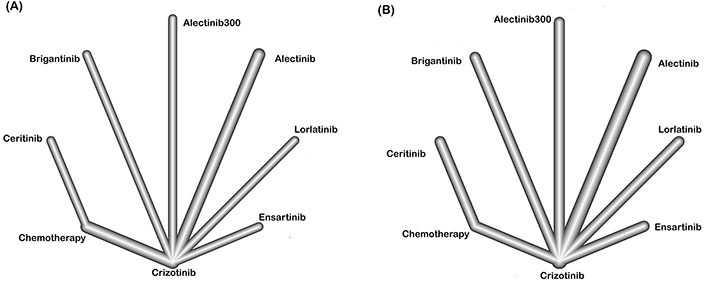
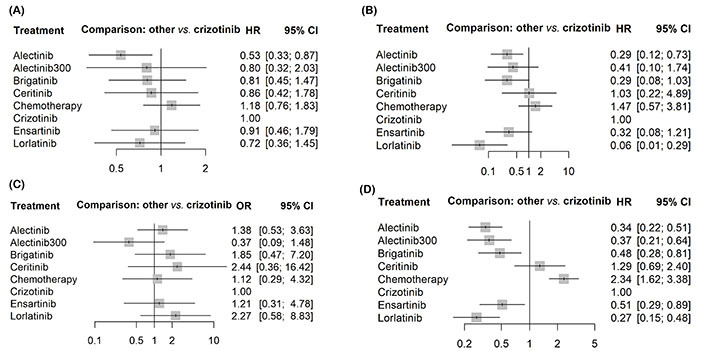
Results: The analysis included 9 RCTs with 2,443 patients receiving eight different treatments: alectinib (at two different dosages), brigatinib, ceritinib, crizotinib, ensartinib, lorlatinib, and chemotherapy. Second and third-generation TKIs significantly prolonged PFS compared to crizotinib, with lorlatinib having the highest probability of yielding the most favorable PFS, followed by alectinib (300 mg or 600 mg). However, only alectinib has been shown to significantly prolong OS compared to crizotinib to date. Lorlatinib appears superior in reducing the risk of central nervous system (CNS) progression, followed by alectinib 600 mg. Ceritinib had the highest rate of AEs, followed by lorlatinib and brigatinib.
Conclusions: Based on the network meta-analysis, alectinib and lorlatinib emerged as the most promising upfront treatment options. These treatments provide prolonged disease control while maintaining an acceptable safety profile.
Keywords: Non-small cell lung cancer; anaplastic lymphoma kinase translocations; targeted therapy.
© The Author(s) 2023.
Conflict of interest statement
Raffaele Giusti declared financial interests with Roche (expert testimony, personal, advisory board for clinician’s expertise on drug management); Molteni (writing engagement, personal, publication fee for open access manuscript); Novartis (advisory board, personal); Angelini Pharma (invited speaker, personal, invited speaker to national and international congress); Pfizer (advisory board, personal) and Takeda (expert testimony, personal, expert testimony on drug management). Giovanni Scambia has served as consultant for TESARO Bio Italy S.r.l and Johnson & Johnson. He received onoraria from Clovis Oncology Italy S.r.l, and institutional research funding from MSD Italy S.r.l. Gennaro Daniele has served on advisory board of Beigene and received support for travel and accomodation from Roche. The other authors declare that they have no conflict of interest.
Figures
References
-
- American Lung Association [internet] Washington: The Association; c2023 [cited 2022 Nov 16] Available from: https://www.lung.org/
-
- Malik SM, Maher VE, Bijwaard KE, Becker RL, Zhang L, Tang SW, et al. U.S. Food and Drug Administration approval: crizotinib for treatment of advanced or metastatic non-small cell lung cancer that is anaplastic lymphoma kinase positive. Clin Cancer Res. 2014;20:2029–34. doi: 10.1158/1078-0432.CCR-13-3077. - DOI - PubMed
Publication types
LinkOut - more resources
Full Text Sources
Miscellaneous