


Large area fractional laser treatment of mouse skin increases energy expenditure
- PMID: 38213618
- PMCID: PMC10783634
- DOI: 10.1016/j.isci.2023.108677
Large area fractional laser treatment of mouse skin increases energy expenditure
Abstract
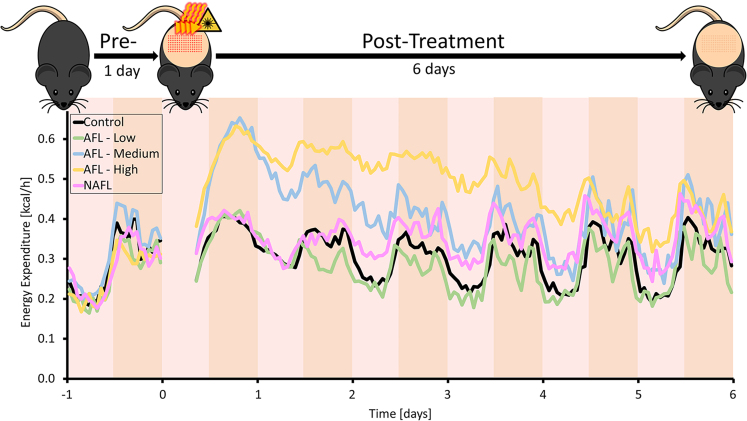
Fractional laser (FL) treatment is a common dermatologic procedure that generates arrays of microscopic treatment zones separated by intact tissue, promoting fast wound healing. Using a mouse model, we introduced a large area fractional laser treatment (LAFLT) method to study metabolic effects. Using two laser modalities, ablative FL (AFL) and non-ablative FL (NAFL), and exposing different percentages of mice's total body surface area (TBSA), we followed changes in metabolic parameters in real time using metabolic cages. Additionally, body composition, markers of inflammation, neurohormonal signaling, and browning of adipocytes were investigated. LAFLT, especially in high TBSA groups, had specific metabolic effects such as significantly increased average daily energy expenditure, increased fat mass loss, systemic browning of adipocytes, and inflammatory states, without compromising other organs. The ability of LAFLT to stimulate metabolism in a controlled way could develop into a promising therapeutic treatment to induce positive metabolic changes that replace or augment systemic drugs.
Keywords: Biological sciences; Dermatology; Immunology; Photomedicine.
© 2023 The Authors.
Conflict of interest statement
The authors N.S., M.W.-E., and D.M. disclose the patent application PCT/US2022/024315, the remaining authors declare no competing interests.
Figures



References
-
- Manstein D., Herron G.S., Sink R.K., Tanner H., Anderson R.R. Fractional Photothermolysis: A New Concept for Cutaneous Remodeling Using Microscopic Patterns of Thermal Injury. Lasers Surg. Med. 2004;34:426–438. - PubMed
Grants and funding
LinkOut - more resources
Full Text Sources
Medical
