


doi: 10.1038/s41598-023-50052-0.
Controlling the motion of gravitational spinners and waves in chiral waveguides
Affiliations
- PMID: 38216609
- PMCID: PMC10786887
- DOI: 10.1038/s41598-023-50052-0
Item in Clipboard
Controlling the motion of gravitational spinners and waves in chiral waveguides
Sci Rep.
.
Abstract
In this paper we present a mathematical modelling framework for chiral phenomena associated with rotational motions, highlighting the combination of gyroscopic action with gravity. We discuss new ideas of controlling gravity-induced waves by a cluster of gyroscopic spinners. For an elementary gravitational spinner, the transient oscillations are accompanied by a full classification and examples, linked to natural phenomena observed in planetary motion. Applications are presented in the theory of chiral metamaterials, and of the dynamic response of such materials to external loads.
© 2024. The Author(s).
Conflict of interest statement
The authors declare no competing interests.
Figures
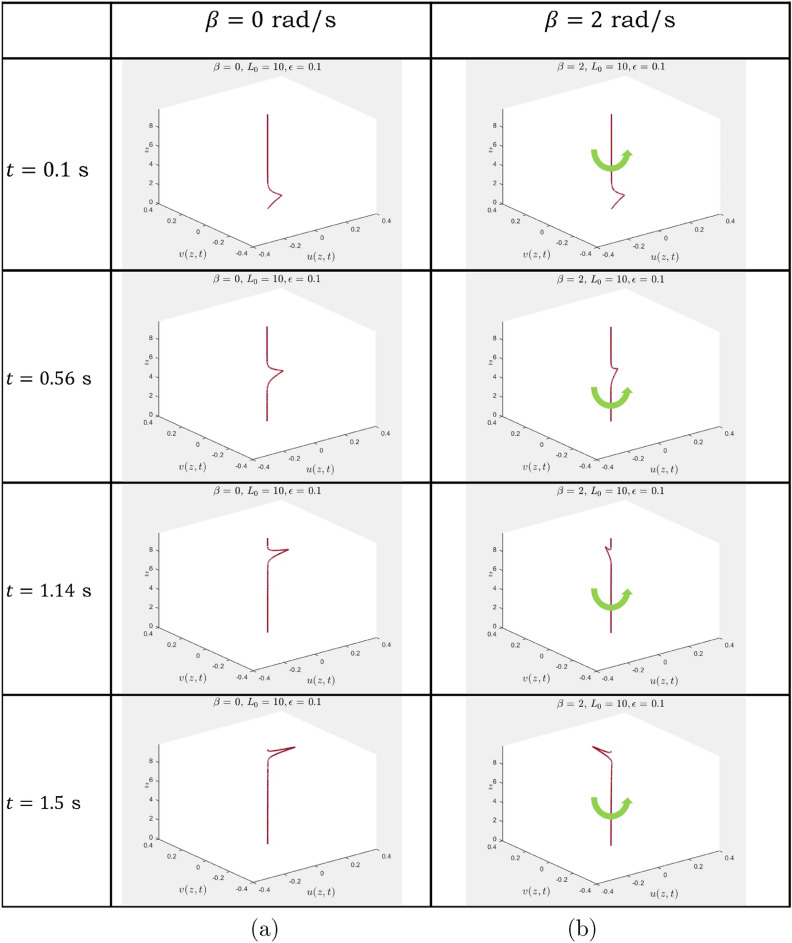
Gravity-induced waves in a gyroscopic waveguide: (a) , no chirality; (b) , rotational motion is observed along the waveguide—the arrow shows the orientation of the rope rotation.
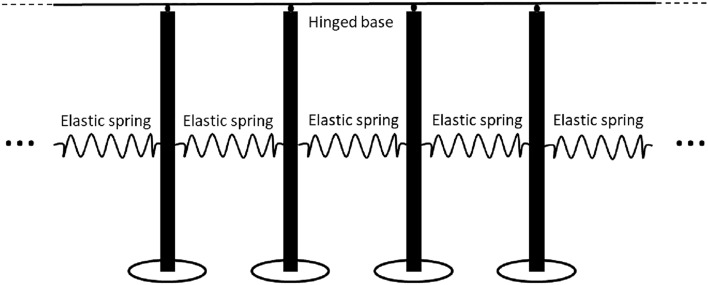
Gyroscopic structured chiral waveguide.
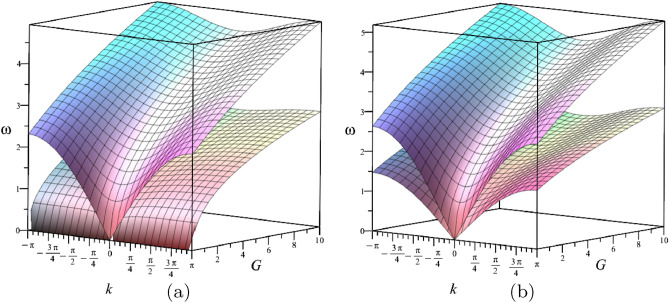
The graphs of as functions of k and G for ; (a) and (b) .
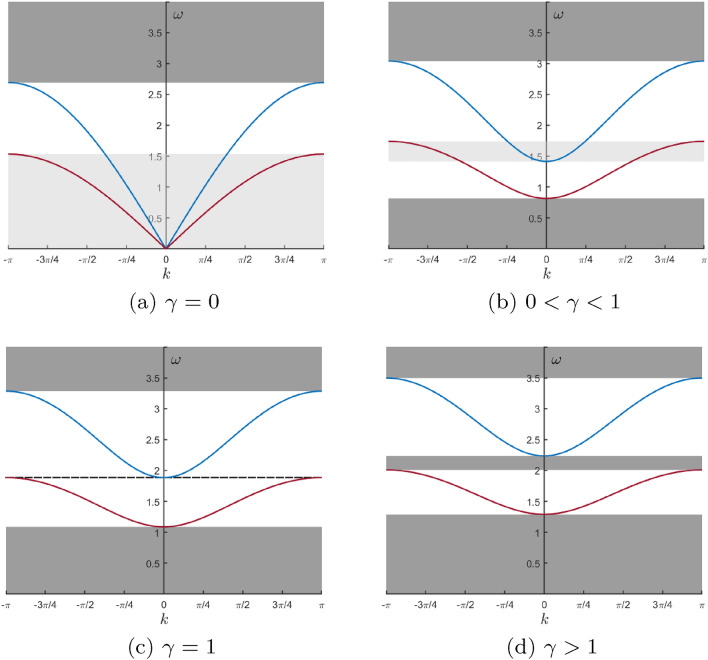
Dispersion diagrams for (a) , (b) , (c) and (d) . In the calculations the following parameters are chosen: , and and 2.5 [in parts (a–d), respectively]. Note that .
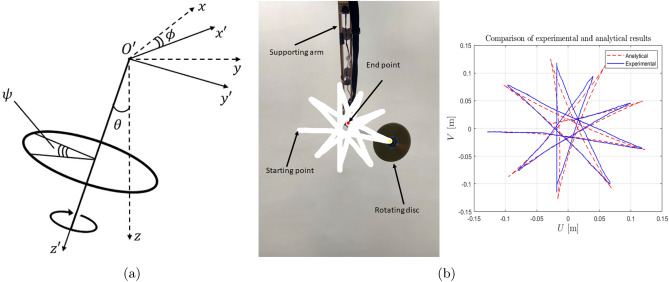
(a) A gyropendulum includes a gyroscopic spinner connected to the tip of a rod. The rod is hinged at its base which is located at the origin of the fixed coordinate system Oxyz. The gyroscopic spinner is shown in the local coordinate system , which moves with the spinner as it nutates through an angle , precesses through an angle and spins through an angle . The axes of the rod and the spinner are assumed to be aligned at any instant of time. (b) Experimental observation and analytical prediction for cusp-shaped trajectories; the video of the motion is provided in the electronic supplementary material.
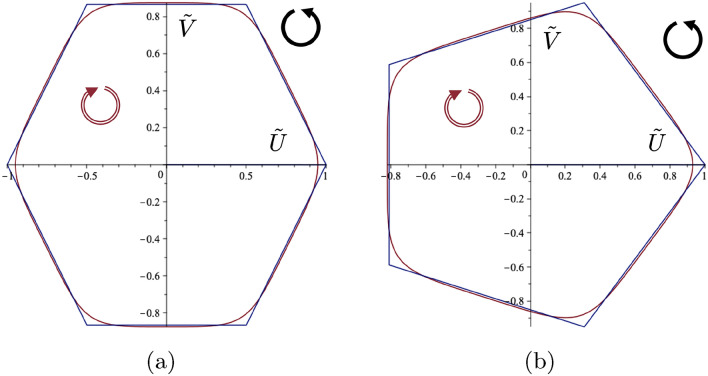
The approximations to the prescribed hexagonal and pentagonal orbits. The calculated values of and the initial conditions to generate these orbits are (a) , , and (b) , . The solid arrows show the direction of spin of the gyroscopic spinner, and the hollow arrows show the orientation of motion for each respective polygonal orbit of the gyropendulum.
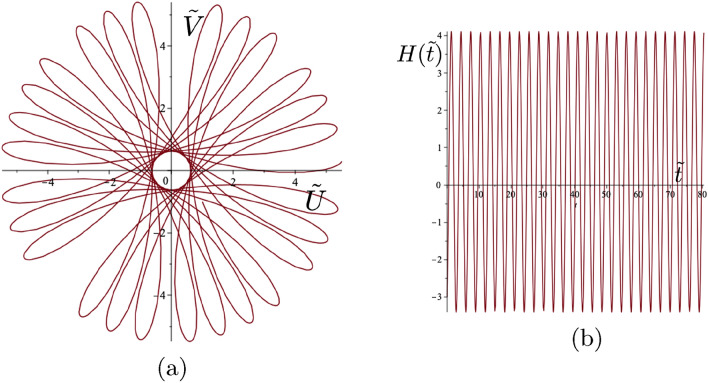
Class 1 example. Gyropendulum trajectory with and initial conditions , , , . (a) The self-intersecting trajectories around the origin of variable orientation. (b) The corresponding function . Here the calculated class values are , and in accordance with (36).
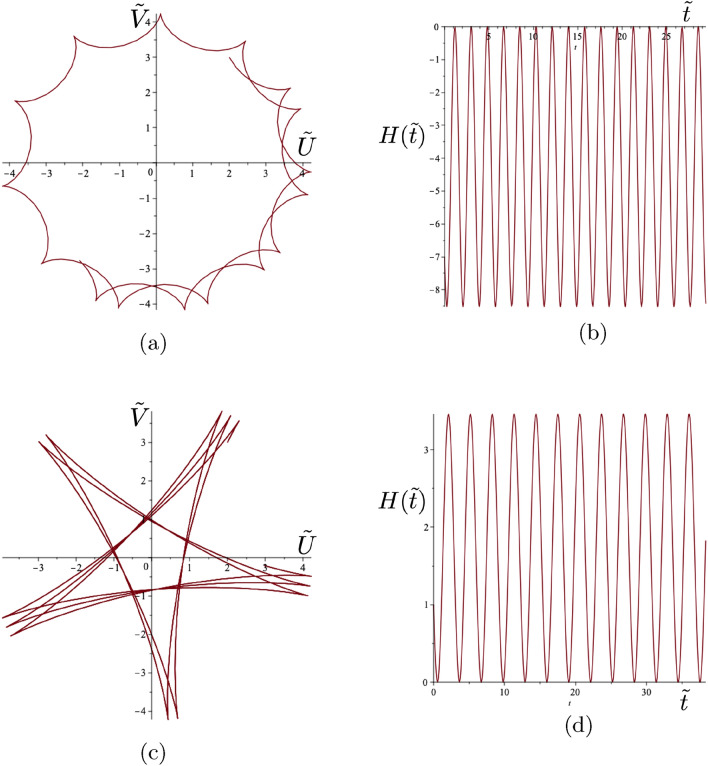
Class 2(a) examples. (a) Cusp trajectory of the gyropendulum and (b) the function with and initial conditions , , , . The condition for cusps is satisfied with . Here (c) Cusp trajectory of the gyropendulum and (d) the function with and initial conditions , , , . The condition for cusps is satisfied with . Here .
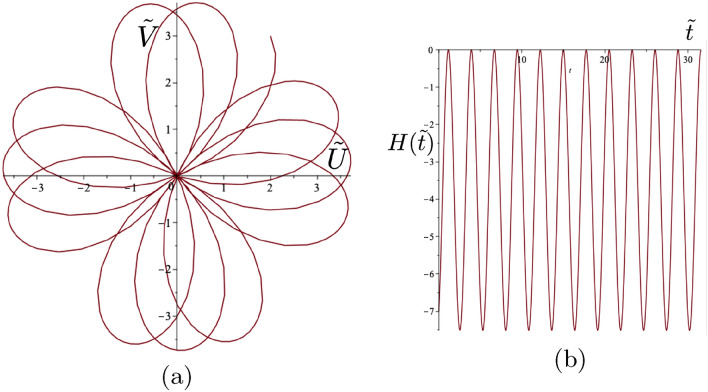
Class 2(b) example. (a) Trajectory of the gyropendulum with smooth loops passing through the origin and (b) the function with and initial conditions , , , . The condition for Class 2(b) is satisfied with . In addition .
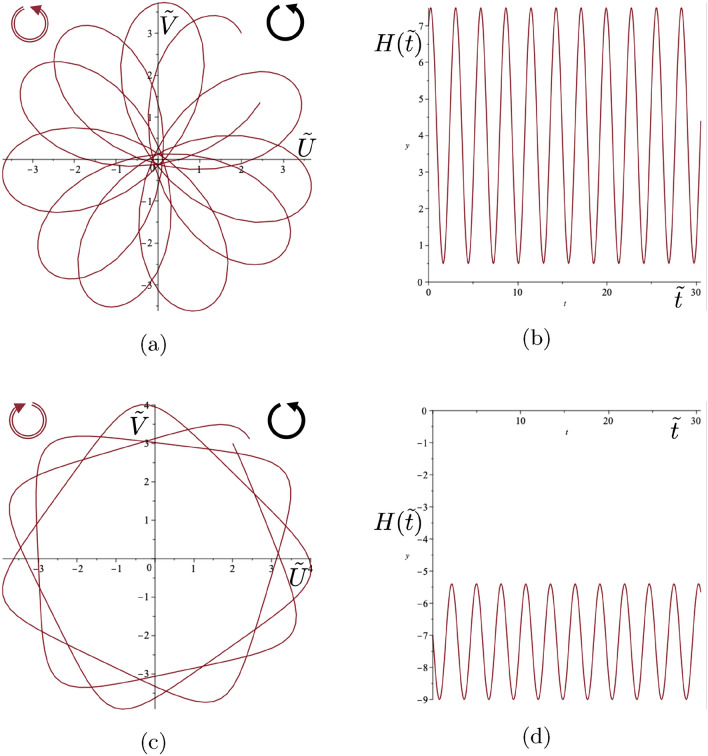
Class 3 examples. (a) Smooth trajectories of the gyropendulum not passing through the origin, and (b) the function with parameter values and initial conditions , , , . The Class 3 conditions are satisfied with , and (c) Smooth trajectories of the gyropendulum not passing through the origin, and (d) the function with parameter values and initial conditions , , , . The Class 3 conditions are satisfied with , and The solid arrows indicate the direction of spin of the gyroscopic spinner, and the hollow arrows show the orientation of motion for each respective trajectory of the gyropendulum.
References
-
- Capozziello S, Lattanzi A. Spiral galaxies as chiral objects? Astrophys. Space Sci. 2006;301:189–193. doi: 10.1007/s10509-006-1984-6. - DOI
-
- Lorentz HA. Versuch einer Theorie der Electrischen und Optischen Erscheinungen in Bewegten Körpern. BG Teubner; 1895.
-
- Foucault JBL. Démonstration physique du mouvement de rotation de la terre au moyen du pendule. C. R. Séances L’Acad. Sci. 1851;32:135–138.
-
- Shepherd TG. Rossby waves and two-dimensional turbulence in a large-scale zonal jet. J. Fluid Mech. 1987;183:467–509. doi: 10.1017/S0022112087002738. - DOI
Grants and funding
LinkOut - more resources
Full Text Sources
