. 2024 Jan 12;7(1):68.
doi: 10.1038/s42003-023-05587-3.

The origins of the Guinness stout yeast

Affiliations

The origins of the Guinness stout yeast

Daniel W M Kerruish et al. Commun Biol. .

Abstract

Beer is made via the fermentation of an aqueous extract predominantly composed of malted barley flavoured with hops. The transforming microorganism is typically a single strain of Saccharomyces cerevisiae, and for the majority of major beer brands the yeast strain is a unique component. The present yeast used to make Guinness stout brewed in Dublin, Ireland, can be traced back to 1903, but its origins are unknown. To that end, we used Illumina and Nanopore sequencing to generate whole-genome sequencing data for a total of 22 S. cerevisiae yeast strains: 16 from the Guinness collection and 6 other historical Irish brewing. The origins of the Guinness yeast were determined with a SNP-based analysis, demonstrating that the Guinness strains occupy a distinct group separate from other historical Irish brewing yeasts. Assessment of chromosome number, copy number variation and phenotypic evaluation of key brewing attributes established Guinness yeast-specific SNPs but no specific chromosomal amplifications. Our analysis also demonstrated the effects of yeast storage on phylogeny. Altogether, our results suggest that the Guinness yeast used today is related to the first deposited Guinness yeast; the 1903 Watling Laboratory Guinness yeast.


Conflict of interest statement

Daniel Kerrruish, Jessica Kearns, Eibhlin Colgan, and Sandra Stelma are employees of Diageo Ireland, the owners of Guinness. Chris Boulton is employed as a consultant by Diageo Ireland. All other authors declare no competing interests.

Figures
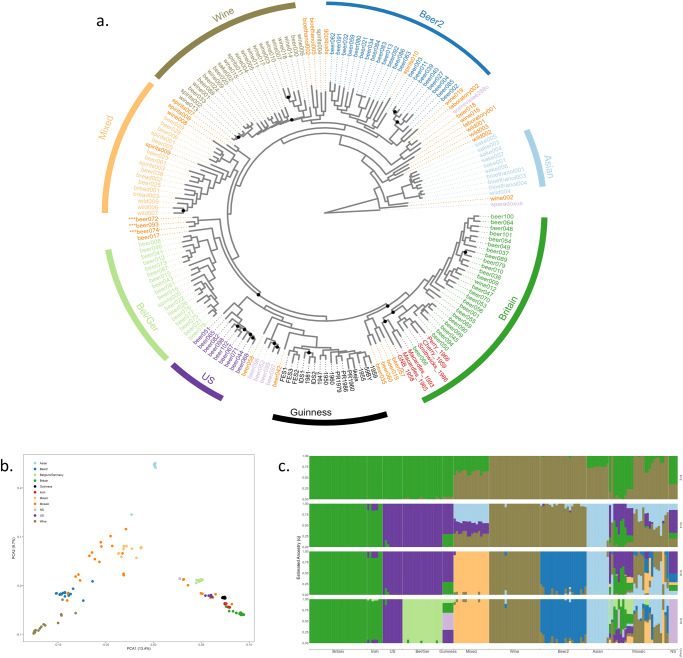
Fig. 1
Fig. 1. Phylogeny and population structure of the Guinness yeast and other industrial S. cerevisiae strains.
a Guinness and other Irish brewing yeast within the maximum-likelihood phylogenetic tree of S. cerevisiae. Guinness and other Irish brewing yeast were sequenced using an Illumina MiSeq platform and combined with 154 previously sequenced S. cerevisiae. Branch length reflects the number of substitutions per site, with colour denoting the yeast lineage. A maximum-likelihood (ML) phylogenetic tree was reconstructed in RAxML v8.2.4, performing 100 iterations to search for the best tree, using a discrete GTRGAMMA model of rate heterogeneity. Bootstrap branch support was assessed by performing 1000 pseudoreplicates. Trees were visualised using ggtree (v 3.6.2). Yeasts that are marked in highlighted orange are described as being Mosaic. Yeast marked with three asterisk are used to brew beers in the Hefeweizen style. b Principal component analysis of 434,890 SNPs sites from the assessed 176 S. cerevisiae strains. Population differences indicated by colour; NS not specified. c Population structure of the 434,890 SNPs sites of the S. cerevisiae strains used in this study. IDS1 was used as a representative Guinness yeast sample for all Guinness yeast due to the high degree of sequence similarity analysis consequently 161 genomes admixture were assessed. Resolved population fractions are represented by the vertical axis; colours denote estimated ancestral membership. Varying the number of ancestral populations (K) between 1 and 10 using the simple prior implemented in fastSTRUCTURE, K = 8 found to be optimal.
Fig. 2
Fig. 2
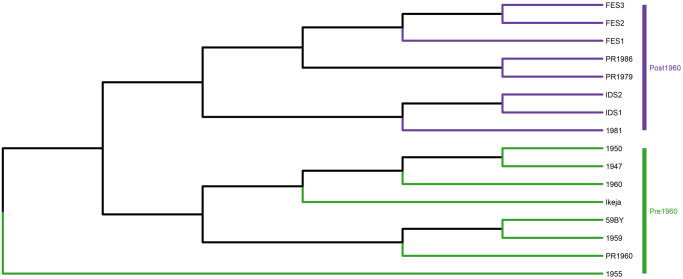
Hierarchical clustering of the 16 Guinness yeast using standard dissimilarity matrix of 20,000 protein coding biallelic SNPs as determined by de novo assembly of the Guinness yeast to the MinION sequenced reference genome IDS1.
Fig. 3
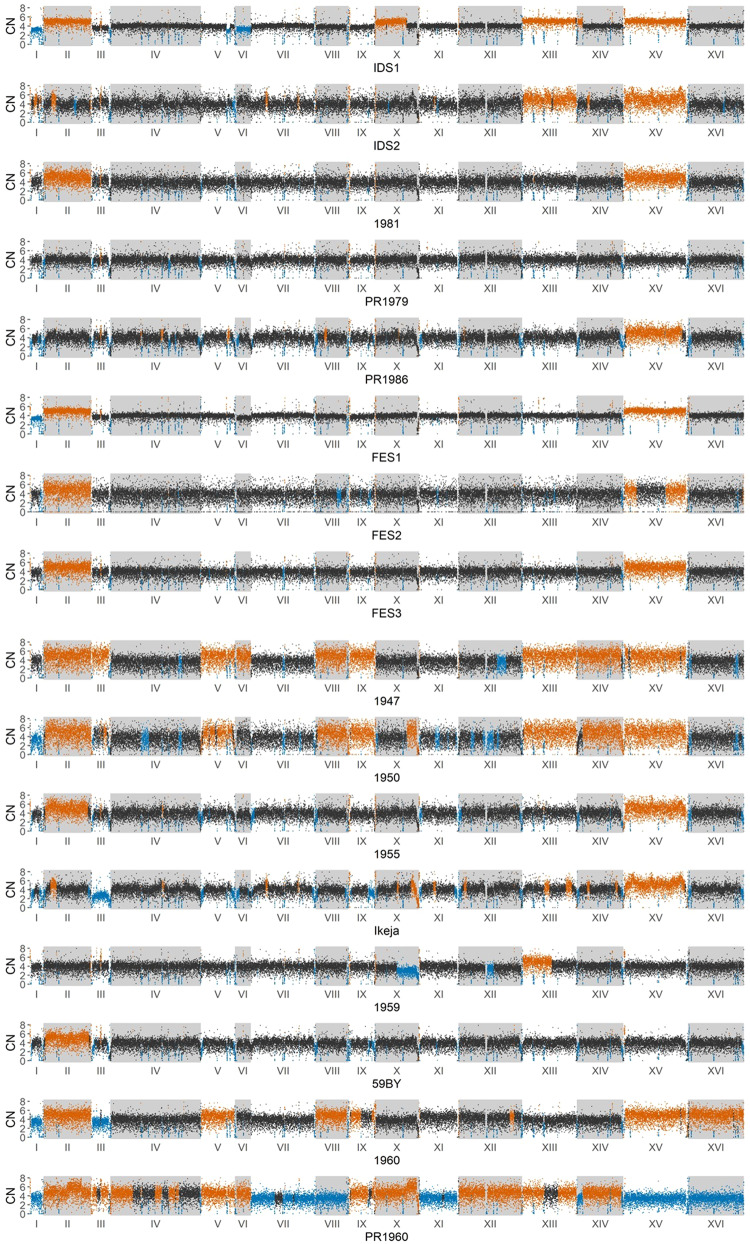
Fig. 3. Estimated CNV in 250 base pair non-overlapping windows across the entire genome of the 16 Guinness yeast.
A black dot on a plot represents a window where the estimate copy number is 4. A blue dot represents a region with an estimated loss of copy number (<4) and an orange dot represents a region of estimated increased copy number (>4).
Fig. 4
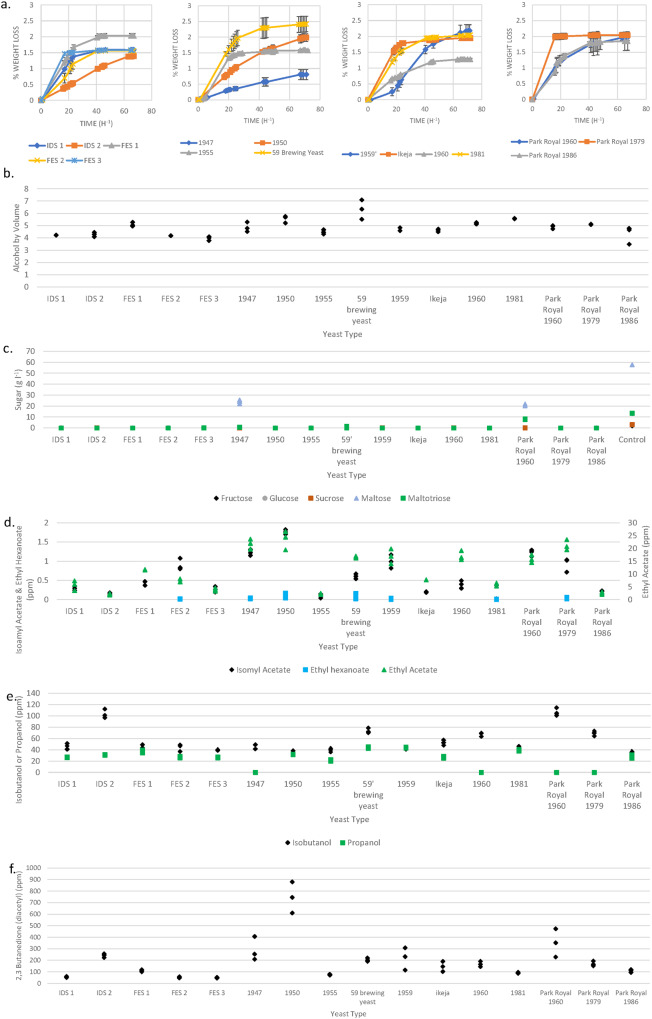
Fig. 4. Phenotypic assessment of the Guinness yeast.
a Percentage weight loss, b ethanol production, c sugar concentration d assessment of esters, e higher alcohols and f 2, 3 butanedione (diacetyl) production at the cessation of fermentation using the different Guinness yeast. Fermentations were performed using 100 ml of 12oP all-malt wort, with an inoculation rate of 1 × 107 ml−1 cells. Samples were incubated at 25 °C and stirred at 250 rpm. Observations presented are n = 3 biologically independent experiments. In a each time point represents the mean of 3 independent replicates and standard errors are shown as SD ± error bars.
Fig. 5
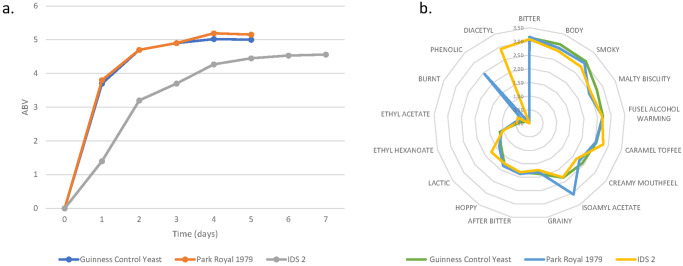
Fig. 5. 1HL fermentation and flavour assessment of the Guinness Park Royal 1979 and IDS2 yeast strains compared to present Guinness production yeast.
a Rate of fermentation and b flavour of Guinness Irish Draught Stout brewed using a control Guinness yeast from Dublin St James’s Gate and the Guinness yeasts: Park Royal 1979 and IDS2. All fermentations were conducted in 100 L fermentation vessels with Guinness wort collected from St James’s Gate Brewery. The tasting samples were assessed, in duplicate using the Guinness Draught attribute list by an expert panel using Quantitative Descriptive methodology. A minimum of n = 18 assessors were used to determine flavour attributes.
Fig. 6
Fig. 6. Phenolic off-flavour and flocculation phenotype of the Guinness yeast.
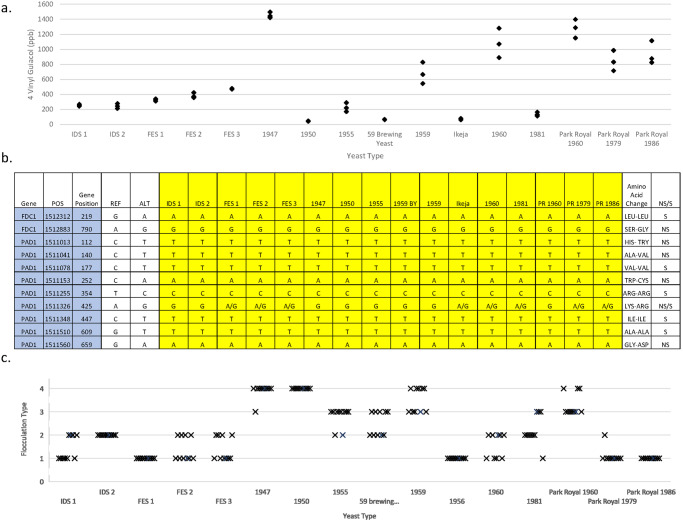
a Phenolic Off Flavours (POF) production as determined by the Analytica-EBC Method 2.3.9.5 and Gas chromatography mass spectrometry, and b Illumina sequencing data of the single nucleotide polymorphism mutations of the POF genes FDC1 and PAD1 of the different Guinness yeast. The effects of the SNP mutations result in amino acid substitutions that are non-synonymous (NS) or synonymous (S). Each POF observations presented are n = 3 biologically independent experiments. c Flocculence characteristics of the different Guinness yeast as determined by the Analytica-EBC Gilliland Method EBC 3.5.3.1. The method class yeast flocculence in terms of non-flocculant (Class 1), slightly flocculant (Class 2), moderately flocculant (Class 3) and highly flocculant (Class 4). Observations presented are n = 10 biologically independent experiments.

References

    1. Diamond J. Evolution, consequences and future of plant and animal domestication. Nature. 2002;418:700–707. doi: 10.1038/nature01019. - DOI - PubMed
    1. Steensels J, Gallone B, Voordeckers K, Verstrepen KJ. Domestication of industrial microbes. Curr. Biol. 2019;29:R381–R393. doi: 10.1016/j.cub.2019.04.025. - DOI - PubMed
    1. Peter J, et al. Genome evolution across 1011 Saccharomyces cerevisiae isolates. Nature. 2018;556:339–344. doi: 10.1038/s41586-018-0030-5. - DOI - PMC - PubMed
    1. Gallone B, et al. Domestication and divergence of Saccharomyces cerevisiae beer yeasts. Cell. 2016;166:1397–1410. doi: 10.1016/j.cell.2016.08.020. - DOI - PMC - PubMed
    1. Botstein D, Fink GR. Yeast: an experimental organism for 21st Century biology. Genetics. 2011;189:695–704. doi: 10.1534/genetics.111.130765. - DOI - PMC - PubMed

Publication types

MeSH terms

Substances