Randomized Controlled Trial
. 2024 Jun 17;109(7):1773-1780.
doi: 10.1210/clinem/dgae022.

Effects of Exogenous GIP and GLP-2 on Bone Turnover in Individuals With Type 2 Diabetes

Affiliations
Randomized Controlled Trial

Effects of Exogenous GIP and GLP-2 on Bone Turnover in Individuals With Type 2 Diabetes

Kirsa Skov-Jeppesen et al. J Clin Endocrinol Metab. .

Abstract

Context: Individuals with type 2 diabetes (T2D) have an increased risk of bone fractures despite normal or increased bone mineral density. The underlying causes are not well understood but may include disturbances in the gut-bone axis, in which both glucose-dependent insulinotropic polypeptide (GIP) and glucagon-like peptide-2 (GLP-2) are regulators of bone turnover. Thus, in healthy fasting participants, both exogenous GIP and GLP-2 acutely reduce bone resorption.

Objective: The objective of this study was to investigate the acute effects of subcutaneously administered GIP and GLP-2 on bone turnover in individuals with T2D.

Methods: We included 10 men with T2D. Participants met fasting in the morning on 3 separate test days and were injected subcutaneously with GIP, GLP-2, or placebo in a randomized crossover design. Blood samples were drawn at baseline and regularly after injections. Bone turnover was estimated by circulating levels of collagen type 1 C-terminal telopeptide (CTX), procollagen type 1 N-terminal propeptide (P1NP), sclerostin, and PTH.

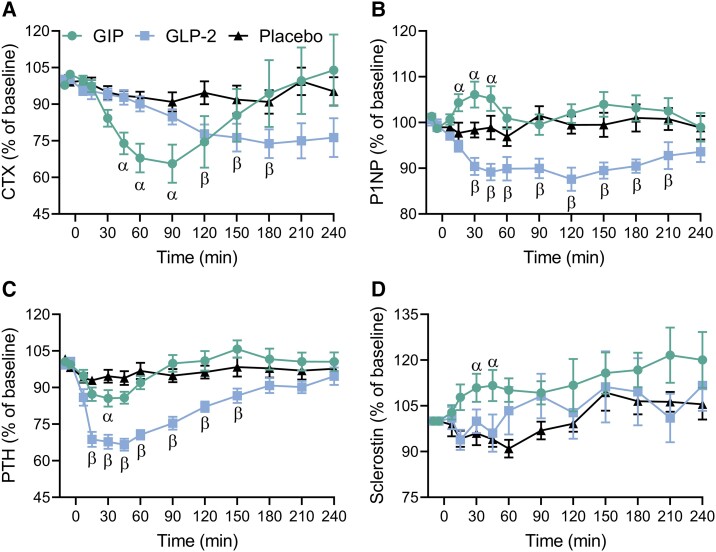
Results: GIP and GLP-2 significantly reduced CTX to (mean ± SEM) 66 ± 7.8% and 74 ± 5.9% of baseline, respectively, compared with after placebo (P = .001). In addition, P1NP and sclerostin increased acutely after GIP whereas a decrease in P1NP was seen after GLP-2. PTH levels decreased to 67 ± 2.5% of baseline after GLP-2 and to only 86 ± 3.4% after GIP.

Conclusion: Subcutaneous GIP and GLP-2 affect CTX and P1NP in individuals with T2D to the same extent as previously demonstrated in healthy individuals.

Keywords: CTX; P1NP; bone turnover; glucagon-like peptide-2 (GLP-2); glucose-dependent insulinotropic polypeptide (GIP); gut-bone axis.


Figures

Figure 1.
Figure 1.
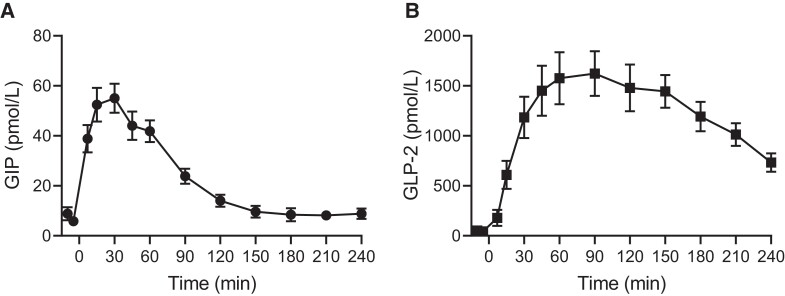
Plasma concentrations of GIP and GLP-2. Plasma concentrations of intact GIP (A) and intact GLP-2 (B) from t = −10 to t = 240 minutes during test days with subcutaneous injection of 200 µg GIP (A) and 800 µg GLP-2 (B), respectively. Data are shown as mean ± SEM. Abbreviations: GIP, glucose-dependent insulinotropic polypeptide; GLP-2, glucagon-like peptide-2.
Figure 2.
Figure 2.
Serum concentrations of CTX, P1NP, PTH, and sclerostin. CTX (A), P1NP (B), PTH (C), and sclerostin (D) presented as percentage of baseline (mean of t = −10 and t = −5 minutes) on test days with subcutaneous injection of GIP (circle), GLP-2 (square), or placebo (triangle). Data are shown as mean ± SEM. Data were analyzed by a mixed-effects model for the period from t = −10 to t = 240 minutes with Geisser–Greenhouse correction and Holm–Sidak multiple comparison tests with interventions compared to placebo. Symbols indicate a statistically significant difference (P < .05) between placebo and GIP (α) and between placebo and GLP-2 (β). Abbreviations: CTX, C-terminal telopeptide; GIP, glucose-dependent insulinotropic polypeptide; GLP-2, glucagon-like peptide-2; P1NP, procollagen type 1 N-terminal propeptide.
Figure 3.
Figure 3.
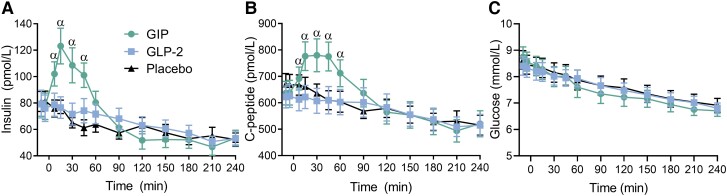
Serum concentrations of insulin, C-peptide, and glucose. Insulin (A), C-peptide (B), and glucose (C) presented as absolute values during test days with subcutaneous injection of GIP (circle), GLP-2 (square), or placebo (triangle). Data are shown as mean ± SEM. Data were analyzed using a mixed-effects model for the period t = −10 to t = 240 minutes with Geisser–Greenhouse correction and Holm–Sidak multiple comparison tests with interventions compared to placebo. Symbols indicate a significant difference (P < .05) between placebo and GIP (α). Abbreviations: GIP, glucose-dependent insulinotropic polypeptide; GLP-2, glucagon-like peptide-2.
Figure 4.
Figure 4.
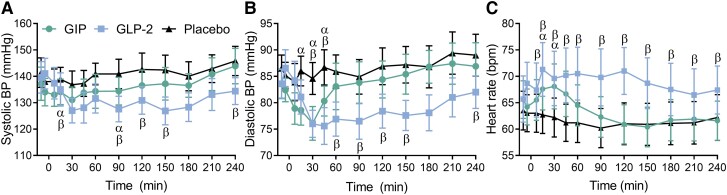
Blood pressure and heart rate. Systolic blood pressure (A), diastolic blood pressure (B), and heart rate (C) presented as absolute values during test days with subcutaneous injection of GIP (circle), GLP-2 (square), or placebo (triangle). Data are shown as mean ± SEM. Data were analyzed using a mixed-effects model for the period t = −10 to t = 240 minutes with Geisser–Greenhouse correction and Holm–Sidak multiple comparison tests with interventions compared to placebo. Symbols indicate significant differences (P < .05) between placebo and GIP (α), and between placebo and GLP-2 (β). Abbreviations: GIP, glucose-dependent insulinotropic polypeptide; GLP-2, glucagon-like peptide-2.

References

    1. Vestergaard P. Discrepancies in bone mineral density and fracture risk in patients with type 1 and type 2 diabetes-a meta-analysis. Osteoporos Int. 2007;18(4):427‐444. - PubMed
    1. Schwartz AV, Vittinghoff E, Bauer DC, et al. Association of BMD and FRAX score with risk of fracture in older adults with type 2 diabetes. JAMA. 2011;305(21):2184‐2192. - PMC - PubMed
    1. Schwartz AV, Sellmeyer DE, Ensrud KE, et al. Older women with diabetes have an increased risk of fracture: a prospective study. J Clin Endocrinol Metab. 2001;86(1):32‐38. - PubMed
    1. Janghorbani M, Van Dam RM, Willett WC, Hu FB. Systematic review of type 1 and type 2 diabetes mellitus and risk of fracture. Am J Epidemiol. 2007;166(5):495‐505. - PubMed
    1. Lopes LS, Schwartz RP, Ferraz-de-Souza B, da Silva MER, Corrêa PHS, Nery M. The role of enteric hormone GLP-2 in the response of bone markers to a mixed meal in postmenopausal women with type 2 diabetes mellitus. Diabetol Metab Syndr. 2015;7(1):13. - PMC - PubMed

Publication types

Substances