


Increase in invasive group A streptococcal disease among Australian children coinciding with northern hemisphere surges
- PMID: 38223399
- PMCID: PMC10786649
- DOI: 10.1016/j.lanwpc.2023.100873
Increase in invasive group A streptococcal disease among Australian children coinciding with northern hemisphere surges
Abstract
Background: Increases in invasive group A streptococcal disease (iGAS) have recently been reported in multiple countries in the northern hemisphere, occurring during, and outside of, typical spring peaks. We report the epidemiology of iGAS among children in Australia from 1 July 2018 to 31 December 2022.
Methods: The Paediatric Active Enhanced Disease Surveillance (PAEDS) Network prospectively collected iGAS patient notifications for children and young people aged less than 18 years admitted to five major Australian paediatric hospitals in Victoria, Queensland, Western Australia and the Northern Territory. Patients were eligible for inclusion if they had GAS isolated from a normally sterile body site, or met clinical criteria for streptococcal toxic shock syndrome or necrotising fasciitis with GAS isolated from a non-sterile site. We report patients' clinical and demographic characteristics, and estimate minimum incidence rates.
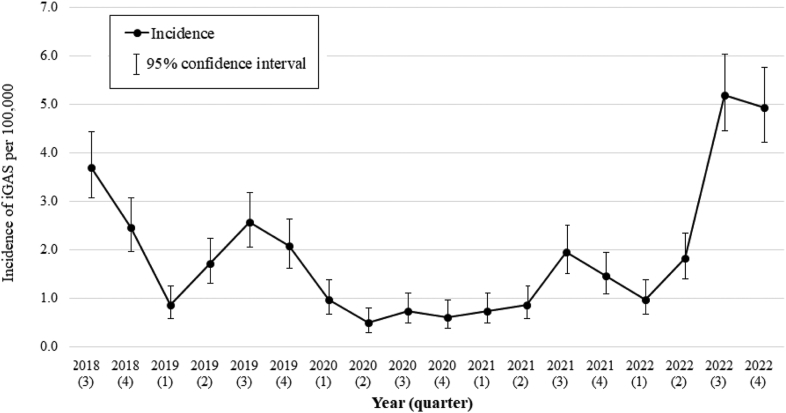
Findings: We identified 280 paediatric iGAS patients, median age 4.5 years (interquartile range 1.4-6.4). We observed a pre-pandemic peak annualised incidence of 3.7 per 100,000 (95% CI 3.1-4.4) in the 3rd quarter of 2018, followed by a decline to less than 1.0 per 100,000 per quarter from 2020 to mid-2021. The annualised incidence increased sharply from mid-2022, peaking at 5.2 per 100,000 (95% CI 4.4-6.0) in the 3rd quarter and persisting into the 4th quarter (4.9 per 100,000, 95% CI 4.2-5.7). There were 3 attributable deaths and 84 (32%) patients had severe disease (overall case fatality rate 1%, 95% CI 0.2-3.3). Respiratory virus co-infection, positive in 57 of 119 patients tested, was associated with severe disease (RR 1.9, 95% CI 1.2-3.0). The most common emm-type was emm-1 (60 of 163 isolates that underwent emm-typing, 37%), followed by emm-12 (18%).
Interpretation: Australia experienced an increase in the incidence of iGAS among children and young people in 2022 compared to pandemic years 2020-2021. This is similar to northern hemisphere observations, despite differences in seasons and circulating respiratory viruses. Outbreaks of iGAS continue to occur widely. This emphasises the unmet need for a vaccine to prevent significant morbidity associated with iGAS disease.
Funding: Murdoch Children's Research Institute funded open access publishing of this manuscript.
Keywords: Bacteraemia; Epidemiology; Invasive group A streptococcus; Sepsis; Streptococcus pyogenes; Viruses.
© 2023 The Author(s).
Conflict of interest statement
AC Steer acts as Co-Director of Australian Strep A Vaccine Initiative and Co-Chair of Strep A Vaccine Global Consortium. The rest of the authors declare no competing interest.
Figures

References
LinkOut - more resources
Full Text Sources
Miscellaneous
