. 2023 Dec 27;10(1):e23923.
doi: 10.1016/j.heliyon.2023.e23923. eCollection 2024 Jan 15.

CT radiomics for predicting the prognosis of patients with stage II rectal cancer during the three-year period after surgery, chemotherapy and radiotherapy

Affiliations

CT radiomics for predicting the prognosis of patients with stage II rectal cancer during the three-year period after surgery, chemotherapy and radiotherapy

Hanjing Zhang et al. Heliyon. .

Abstract

Objective: Pre-treatment enhanced CT image data were used to train and build models to predict the efficacy of non-small cell lung cancer after conventional radiotherapy and chemotherapy using two classification algorithms, Logistic Regression (LR) and Gaussian Naive Baye (GNB).

Methods: In this study, we used pre-treatment enhanced CT image data for region of interest (ROI) sketching and feature extraction. We utilized the least absolute shrinkage and selection operator (LASSO) mutual confidence method for feature screening. We pre-screened logistic regression (LR) and Gaussian naive Bayes (GNB) classification algorithms and trained and modeled the screened features. We plotted 5-fold and 10-fold cross-validated receiver operating characteristic (ROC) curves to calculate the area under the curve (AUC). We performed DeLong's test for validation and plotted calibration curves and decision curves to assess model performance.

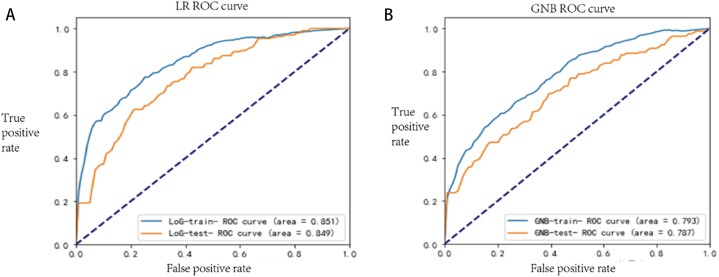
Results: A total of 102 patients were included in this study, and after a comparative analysis of the two models, LR had only slightly lower specificity than GNB, and higher sensitivity, accuracy, AUC value, precision, and F1 value than GNB (training set accuracy: 0.787, AUC value: 0.851; test set accuracy: 0.772, AUC value: 0.849), and the LR model has better performance in both the decision curve and the calibration curve.

Conclusion: CT can be used for efficacy prediction after radiotherapy and chemotherapy in NSCLC patients. LR is more suitable for predicting whether NSCLC prognosis is in remission without considering the computing speed.


Conflict of interest statement

The authors declare that they have no known competing financial interests or personal relationships that could have appeared to influence the work reported in this paper.

Figures
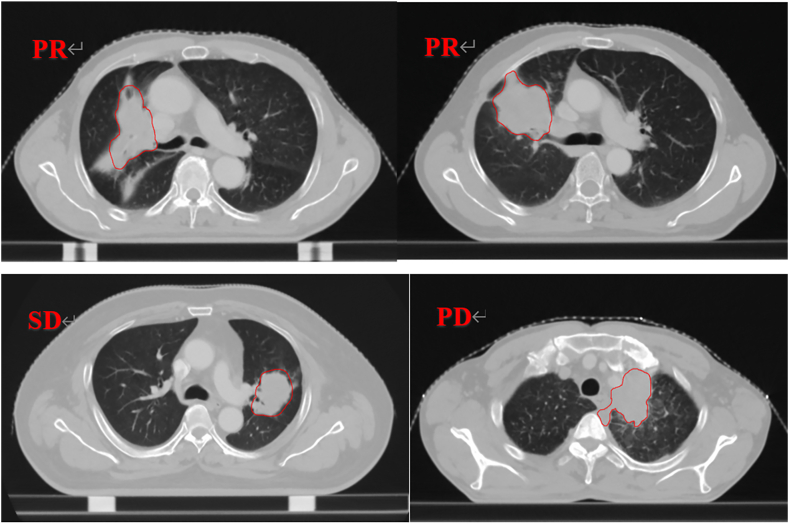
Fig. 1
Fig. 1
Illustration of ROI Contour PR, SD and PD respectively represent three types of therapeutic effects after evaluation based on RECIST 1.1 criteria; the contour in the figure represents GTV, where A corresponds to PR (Partial Response), B corresponds to SD (Stable Disease), and C corresponds to PD (Progressive Disease) in terms of total tumor volume. ROI refers to Region of Interest.
Fig. 2
Fig. 2
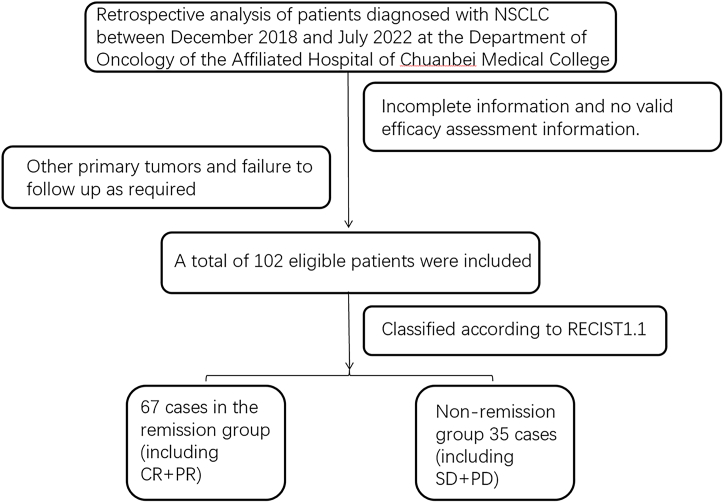
Inclusion of exclusion flow chart CR,complete response; PR,partial response; SD,stable disease; PD,progressive disease; NSCLC, non-small cell lung cancer.
Fig. 3
Fig. 3
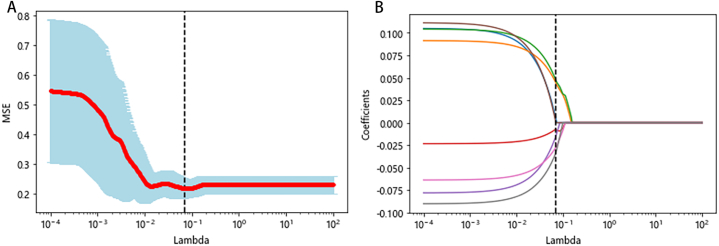
LASSO Feature Selection Results (λ = 0.0693) LASSO regression was employed for feature selection. The parameter (λ) was adjusted using ten rounds of five-fold cross-validation, and bias curves were plotted. The dashed lines indicate the minimum criterion (B) and the 1-SE of the minimum criterion (A). Applying the 1-SE criterion resulted in the selection of eight features, with the optimal value of λ being 0.0693.
Fig. 4
Fig. 4
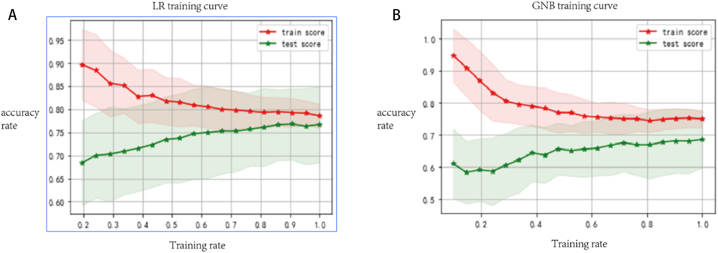
Training Curves of LR and GNB Algorithms for Mitigation and Non-Mitigation Groups (horizontal axis represents training rates, vertical axis represents the model's accuracy on the training and testing sets at that moment, solid line denotes the average accuracy, and shaded region indicates the standard deviation generated by validation). A corresponds to the training curve of the LR model, and B corresponds to the training curve of the GNB model.
Fig. 5
Fig. 5
AUC Values of ROC Curves for Two Algorithms in Mitigation and Non-Mitigation Groups, where Panel A represents the LR model and Panel B represents the GNB model.
Fig. 6
Fig. 6
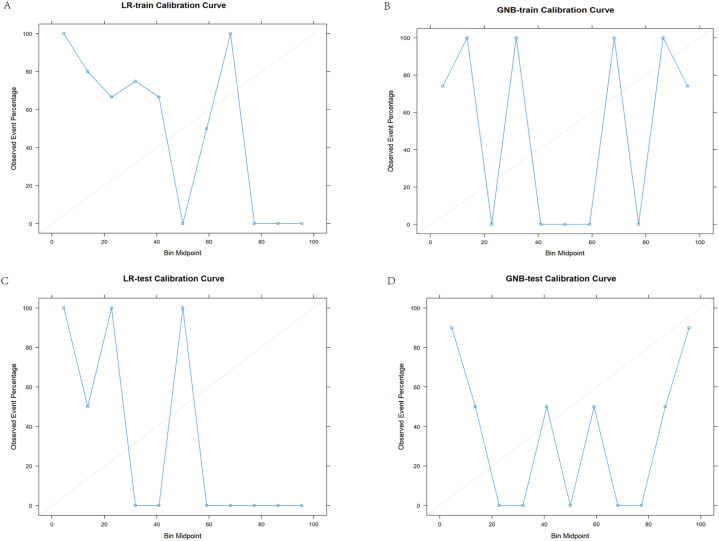
These are the calibration curves for the logistic regression (LR) and Gaussian naive Bayes (GNB) models, where the closer the curve is to the diagonal line, the more accurate the model is.A is the calibration curve for the training set of the LR model; B is the calibration curve for the test set of the LR model; C is the calibration curve for the training set of the GNB model; And D is the calibration curve for the test set of the GNB model.
Fig. 7
Fig. 7
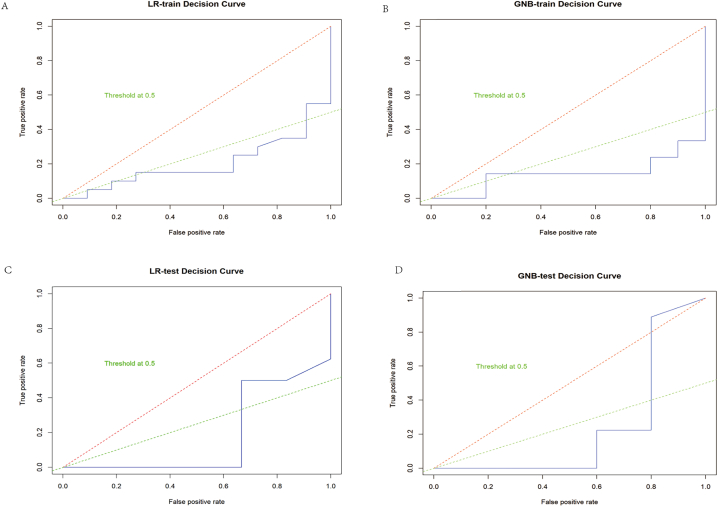
These are the decision curves for the logistic regression (LR) and Gaussian naive Bayes (GNB) models. The area below the decision curves represents all the net benefits brought by the model when combining different thresholds. The larger the area is, the stronger the model's ability to improve the overall decision-making effect. The green dashed line is the 0.5 threshold line.A is the decision curve for the training set of the LR model; B is the decision curve for the test set of the LR model; C is the decision curve for the training set of the GNB model; D is the decision curve for the test set of the GNB model.

References

    1. Sung H., Ferlay J., Siegel R.L., Laversanne M., Soerjomataram I., Jemal A., Bray F. Global cancer Statistics 2020: GLOBOCAN estimates of Incidence and mortality Worldwide for 36 cancers in 185 Countries. CA Cancer J Clin. 2021 May;71(3):209–249. - PubMed
    1. Fave X., Zhang L., Yang J., Mackin D., Balter P., Gomez D., Followill D., Jones A.K., Stingo F., Liao Z., Mohan R., Court L. Delta-radiomics features for the prediction of patient outcomes in non-small cell lung cancer. Sci. Rep. 2017 Apr 3;7(1):588. - PMC - PubMed
    1. Mithoowani H., Febbraro M. Non-small-cell lung cancer in 2022: a review for general Practitioners in oncology. Curr. Oncol. 2022 Mar 9;29(3):1828–1839. - PMC - PubMed
    1. Luo Hua-Chun, Zhi-Chao Fu, Cheng Hui-Hua, et al. Prostate cancer treated with reduced-volume intensity-modulated radiation therapy: report on the 5-year outcome of a prospective series. Medicine. 2017;96(52) - PMC - PubMed
    1. Wang L., Zhan C., Gu J., et al. Role of Skip Mediastinal lymph node metastasis for patients with Resectable non-small-cell lung cancer: a Propensity score matching analysis. Clin. Lung Cancer. 2019;20(3):346–355. - PubMed

LinkOut - more resources