


CKD-Associated Pruritus and Clinical Outcomes in Nondialysis CKD
- PMID: 38225976
- PMCID: PMC10788264
- DOI: 10.1016/j.xkme.2023.100754
CKD-Associated Pruritus and Clinical Outcomes in Nondialysis CKD
Abstract
Rationale & objective: Itching is a frequent symptom experienced by people with chronic kidney disease (CKD). We investigated the associations of CKD-associated pruritus (CKD-aP) with clinical outcomes.
Study design: This was a longitudinal cohort study.
Setting & participants: Patients from Brazil, France, and the United States enrolled in the Chronic Kidney Disease Outcomes and Practice Patterns Study (CKDopps) from 2013 to 2021, an international prospective cohort study of adults with nondialysis dependent CKD, and an estimated glomerular filtration rate (eGFR) of <60 mL/min/1.73 m2 were included.
Exposure: CKD-aP was self-reported by response to the question: "During the past 4 weeks, to what extent were you bothered by itchy skin?"
Outcomes: The outcomes were as follows: CKD progression, kidney replacement therapy (KRT) initiation, mortality, hospitalization, cardiovascular events, infection events.
Analytical approach: Associations with time-to-event outcomes were investigated using Cox proportional hazards models adjusted for potential confounders.
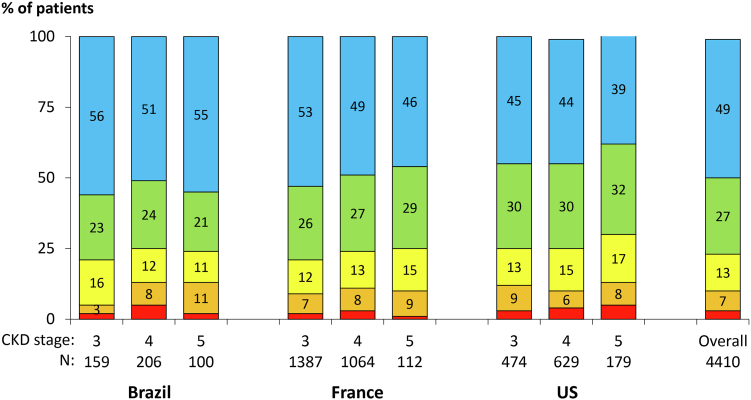
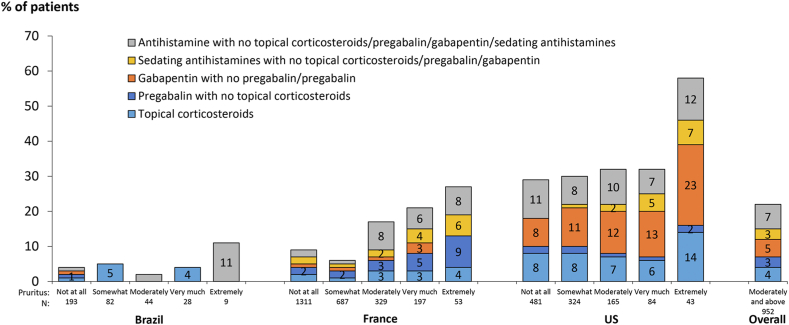
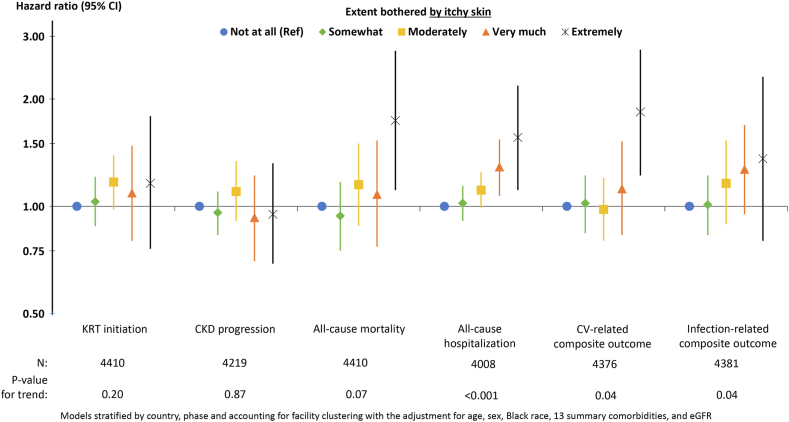
Results: There were 4,410 patients from 91 clinics with a median age of 69 years and a median eGFR at patient questionnaire completion of 29 (21-38) mL/min/1.73 m2. The proportion of patients not at all, somewhat, moderately, very much, and extremely bothered by itchy skin was 49%, 27%, 13%, 7%, and 3%, respectively. Patients with more advanced stages of CKD, older age, and greater comorbidities reported to be more likely bothered by itchy skin. Among patients at least moderately bothered, 23% were prescribed at least 1 pharmacotherapy (35% in the United States, 19% in France, 4% in Brazil), including antihistamine (10%), gabapentin (6%), topical corticosteroids (4%), pregabalin (3%), or sedating antihistamine (3%). The HR (95% CI) for patients extremely (vs not at all) bothered was 1.74 (1.11-2.73) for all-cause mortality, 1.56 (1.11-2.18) for all-cause hospitalization, and 1.84 (1.22-2.75) for cardiovascular events. As CKD-aP severity increased, patients also had higher rates of infection events (P = 0.04); CKD-aP severity was not associated with KRT initiation (P = 0.20) or CKD progression (P = 0.87).
Limitations: The limitations were 25% nonresponse rate, recall bias, and residual confounding factors.
Conclusions: These results demonstrate a strong association between severe itch and clinical outcomes, providing the nephrology community new insights into the possible adverse consequences of CKD-aP in individuals with nondialysis CKD, and warrant further exploration.
Plain-language summary: Chronic kidney disease-associated pruritus (CKD-aP) is a common disturbing symptom of chronic kidney disease (CKD). This article analyzes longitudinal data from the Chronic Kidney Disease Outcomes and Practice Patterns Study (CKDopps) to describe prevalence of CKD-aP in 4,410 individuals with nondialysis CKD, and its association with clinical outcomes. We found that 51% of the surveyed population were bothered by pruritus. CKD-aP was more prevalent in those with more advanced stages of CKD, older age, and with more comorbid conditions. Compared to those not at all bothered by pruritus, those who were extremely bothered had a higher risk of all-cause mortality, hospitalizations, and cardiovascular events. Severity of CKD-aP was not associated with CKD progression or initiation of kidney replacement therapy.
Keywords: Chronic kidney disease; hospitalization; mortality; pruritus.
© 2023 The Authors.
Figures
References
-
- Fishbane S., Jamal A., Munera C., et al. A Phase 3 trial of difelikefalin in hemodialysis patients with pruritus. N Engl J Med. 2020;382(3):222–232. - PubMed
-
- KORSUVATM (difelikefalin) injection, for intravenous use. United States Food and Drug Administration. https://www.accessdata.fda.gov/drugsatfda_docs/label/2021/214916s000lbl.pdf Accessed April 15, 2023.
Grants and funding
LinkOut - more resources
Full Text Sources
Research Materials
Miscellaneous
