


Health Literacy-Informed Communication to Reduce Discharge Medication Errors in Hospitalized Children: A Randomized Clinical Trial
- PMID: 38227315
- PMCID: PMC10792470
- DOI: 10.1001/jamanetworkopen.2023.50969
Health Literacy-Informed Communication to Reduce Discharge Medication Errors in Hospitalized Children: A Randomized Clinical Trial
Abstract
Importance: Inadequate communication between caregivers and clinicians at hospital discharge contributes to medication dosing errors in children. Health literacy-informed communication strategies during medication counseling can reduce dosing errors but have not been tested in the pediatric hospital setting.
Objective: To test a health literacy-informed communication intervention to decrease liquid medication dosing errors compared with standard counseling in hospitalized children.
Design, setting, and participants: This parallel, randomized clinical trial was performed from June 22, 2021, to August 20, 2022, at a tertiary care, US children's hospital. English- and Spanish-speaking caregivers of hospitalized children 6 years or younger prescribed a new, scheduled liquid medication at discharge were included in the analysis.
Interventions: Permuted block (n = 4) randomization (1:1) to a health literacy-informed discharge medication communication bundle (n = 99) compared with standard counseling (n = 99). A study team member delivered the intervention consisting of a written, pictogram-based medication instruction sheet, teach back (caregivers state information taught), and demonstration of dosing with show back (caregivers show how they would draw the liquid medication in the syringe).
Main outcome and measures: Observed dosing errors, assessed using a caregiver-submitted photograph of their child's medication-filled syringe and expressed as the percentage difference from the prescribed dose. Secondary outcomes included caregiver-reported medication knowledge. Outcome measurements were blinded to participant group assignment.
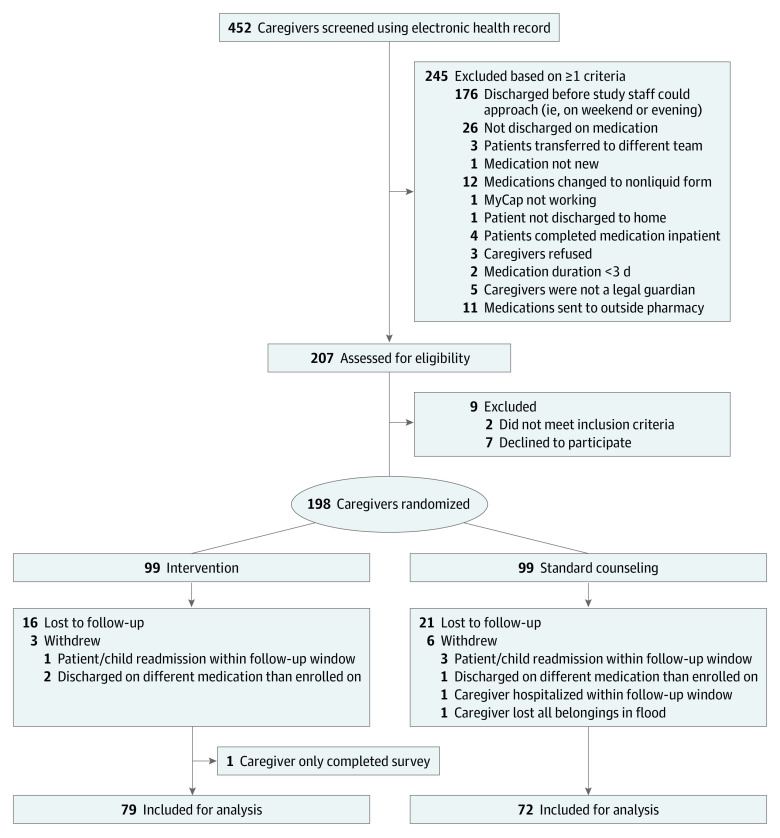
Results: Among 198 caregivers randomized (mean [SD] age, 31.4 [6.5] years; 186 women [93.9%]; 36 [18.2%] Hispanic or Latino and 158 [79.8%] White), the primary outcome was available for 151 (76.3%). The observed mean (SD) percentage dosing error was 1.0% (2.2 percentage points) among the intervention group and 3.3% (5.1 percentage points) among the standard counseling group (absolute difference, 2.3 [95% CI, 1.0-3.6] percentage points; P < .001). Twenty-four of 79 caregivers in the intervention group (30.4%) measured an incorrect dose compared with 39 of 72 (54.2%) in the standard counseling group (P = .003). The intervention enhanced caregiver-reported medication knowledge compared with the standard counseling group for medication dose (71 of 76 [93.4%] vs 55 of 69 [79.7%]; P = .03), duration of administration (65 of 76 [85.5%] vs 49 of 69 [71.0%]; P = .04), and correct reporting of 2 or more medication adverse effects (60 of 76 [78.9%] vs 13 of 69 [18.8%]; P < .001). There were no differences in knowledge of medication name, indication, frequency, or storage.
Conclusions and relevance: A health literacy-informed discharge medication communication bundle reduced home liquid medication administration errors and enhanced caregiver medication knowledge compared with standard counseling. Routine use of these standardized strategies can promote patient safety following hospital discharge.
Trial registration: ClinicalTrials.gov Identifier: NCT05143047.
Conflict of interest statement
Figures

References
-
- Smith MD, Spiller HA, Casavant MJ, Chounthirath T, Brophy TJ, Xiang H. Out-of-hospital medication errors among young children in the United States, 2002-2012. Pediatrics. 2014;134(5):867-876. - PubMed
-
- Rothman RL, Yin HS, Mulvaney S, Co JPT, Homer C, Lannon C. Health literacy and quality: focus on chronic illness care and patient safety. Pediatrics. 2009;124(suppl 3):S315-S326. - PubMed
-
- Yin HS, Dreyer BP, van Schaick L, Foltin GL, Dinglas C, Mendelsohn AL. Randomized controlled trial of a pictogram-based intervention to reduce liquid medication dosing errors and improve adherence among caregivers of young children. Arch Pediatr Adolesc Med. 2008;162(9):814-822. - PubMed
