Socioeconomic inequality in health-related quality of life among Korean adults with chronic disease: an analysis of the Korean Community Health Survey
- PMID: 38228085
- PMCID: PMC11099595
- DOI: 10.4178/epih.e2024018
Socioeconomic inequality in health-related quality of life among Korean adults with chronic disease: an analysis of the Korean Community Health Survey
Abstract
Objectives: Health-related quality of life is crucial for people dealing with chronic illness. This study investigated the quality of life in individuals with 5 common chronic conditions in Korea. We also analyzed socioeconomic factors such as education, income, occupation, and urbanization to identify determinants of inequality.
Methods: Using 2016 Korea Community Health Survey data, we examined individuals aged 30 or older with chronic diseases (diabetes, hypertension, cardiovascular disease, hyperlipidemia, arthritis) using the EuroQol 5-Dimension 3 Level tool. We analyzed the associations between socioeconomic factors (education, income, occupation, urbanization) and quality of life using descriptive statistics and regression analysis. Inequality indices (relative inequality index, absolute inequality index) were used to measure inequality in quality of life.
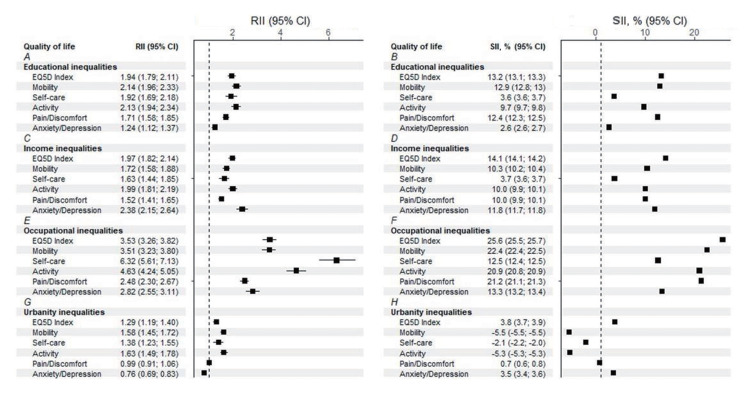
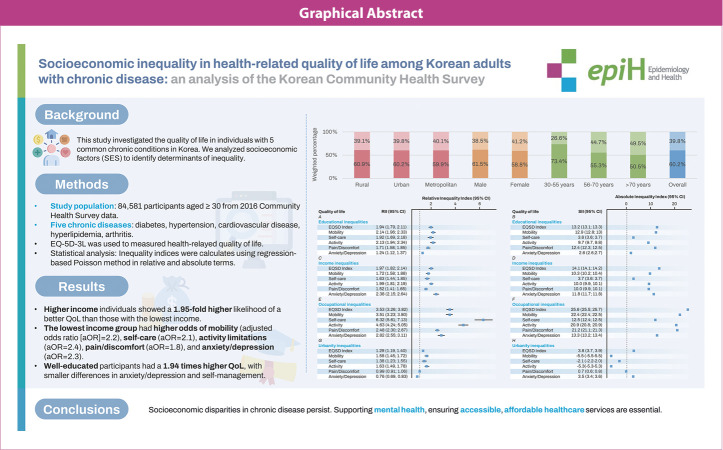
Results: Individuals with higher income levels showed a 1.95-fold higher likelihood of a better quality of life than those with the lowest income. The lowest income group had higher odds of mobility (adjusted odds ratio [aOR], 2.2), self-care (aOR, 2.1), activity limitations (aOR, 2.4), pain/discomfort (aOR, 1.8), and anxiety/depression (aOR, 2.3). Educational disparities included a 3-fold increase in mobility and daily activity problems for those with elementary or lower education. Well-educated participants had a 1.94 times higher quality of life, with smaller differences in anxiety/depression and self-management. The income gap accounted for 14.1% of variance in quality-of-life disparities.
Conclusions: Addressing socioeconomic disparities in the quality of life for individuals with chronic diseases necessitates tailored interventions and targeted health policies. This research informs policymakers in developing focused initiatives to alleviate health inequities. It emphasizes the importance of mental health support and ensuring affordable, accessible healthcare services.
Keywords: Chronic disease; Health inequalities; Inequality; Quality of life; Socioeconomic.
Conflict of interest statement
The authors have no conflicts of interest to declare for this study.
Figures
References
-
- Saeedi P, Petersohn I, Salpea P, Malanda B, Karuranga S, Unwin N, et al. Global and regional diabetes prevalence estimates for 2019 and projections for 2030 and 2045: results from the International Diabetes Federation Diabetes Atlas, 9th edition. Diabetes Res Clin Pract. 2019;157:107843. doi: 10.1016/j.diabres.2019.107843. - DOI - PubMed
-
- Kaplan RM, Spittel ML, David DH. Population health: behavioral and social science insights. 2015. [cited 2023 Jan 30]. Available from: https://www.ahrq.gov/sites/default/files/publications/files/population-h....
-
- Alonso J, Ferrer M, Gandek B, Ware JE, Jr, Aaronson NK, Mosconi P, et al. Health-related quality of life associated with chronic conditions in eight countries: results from the International Quality of Life Assessment (IQOLA) Project. Qual Life Res. 2004;13:283–298. doi: 10.1023/B:QURE.0000018472.46236.05. - DOI - PubMed
MeSH terms
LinkOut - more resources
Full Text Sources
Medical
Miscellaneous